

























































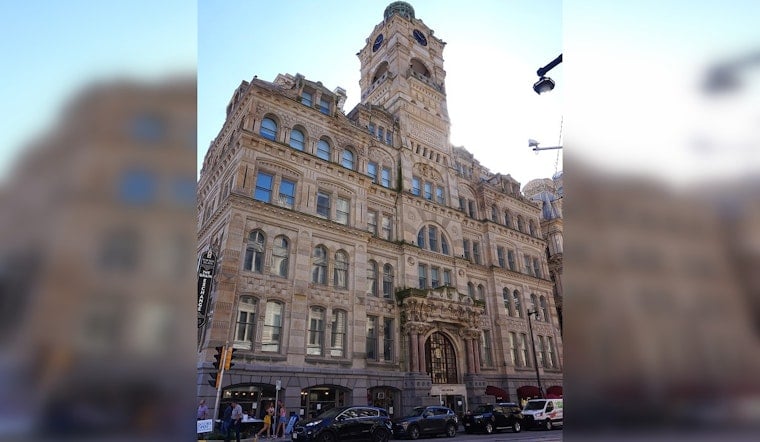
The 147-year-old Mackie Building in downtown Milwaukee, home to the historic Grain Exchange banquet hall, is facing a foreclosure lawsuit after its ownership entity defaulted on a $6.57 million loan. Waukesha State Bank filed the suit against 225 East Michigan Street LLC on August 3 in Milwaukee County Circuit Court, according to court filings.
The bank says the borrower owes $5.9 million in principal, with the total climbing to $6.2 million once interest and other fees are included, as reported by the Milwaukee Journal Sentinel. The loan, which is due in June 2027, is tied to the building at 225 E. Michigan St., which developer Joshua Jeffers' group purchased in 2014. Waukesha State Bank has also filed a separate suit in Waukesha County Circuit Court seeking a money judgment against Jeffers and affiliated development-firm entities.
The Grain Exchange's Revenue Problem
At the center of the financial strain is the building's anchor tenant, the Grain Exchange, a banquet and events venue operated by Bartolotta Restaurant Group since 2008. The venue pays rent based on a percentage of its revenue, and that revenue has struggled since the COVID-19 pandemic, according to Jeffers. He described the Grain Exchange's business as not even close to its pre-pandemic level, and said the venue has not returned to that level in the years since.
Jeffers said the Grain Exchange has served as the building's main financial driver, meaning its lower revenue has made it difficult for the ownership entity to keep up with mortgage payments. He noted that the building's smaller commercial tenants and its 25 apartments, added in a 2016 renovation of three underused office floors, are performing well by comparison. Bartolotta Restaurant Group, which also operates Lake Park Bistro, Joey Gerard's, Mr. B's, Bacchus, and Harbor House, said the lawsuit is not expected to affect the Grain Exchange's staffing, service, or events, though its lease renewal is winding down and not yet complete.
A Landmark Built on Milwaukee's Grain Trade
The Mackie Building was built in 1879 by businessman and U.S. Representative Alexander Mitchell and designed by Victorian architect Edward Townsend Mix, later earning a spot on the National Register of Historic Places in April 1973, according to Wikipedia. It originally housed the world's first grain trading pit, established within a 10,000-square-foot, three-story Grain Exchange room that became a national model for commodity trading floors, as detailed by Urban Milwaukee.
That grand hall spent more than 40 years hidden beneath a suspended office ceiling after being converted into low-ceiling workspace in the 1930s, before a three-year restoration in the late 1990s brought it back to life. Conrad Schmitt Studios led that effort, documenting and repainting more than 140 original ceiling fresco colors to restore the room's 40-foot ceilings. The Grain Exchange event space itself opened in 1982, decades before Bartolotta took over its operation.
Jeffers Says a Resolution Is Within Reach
Despite the foreclosure filing, Jeffers said he remains confident the financial issue can be resolved, telling the Journal Sentinel he has many resources at his disposal. His firm's 2016 renovation of the Mackie Building cost $14 million and was supported in part by $2 million in state historic rehabilitation tax credits tied to a $12.7 million adaptive reuse project that created the Mackie Flats apartments, according to the Wisconsin Legislative Fiscal Bureau.
The foreclosure suit lands as Jeffers' firm, J. Jeffers & Co., pushes forward on other major downtown projects. He is proceeding with plans to convert the neighboring Mitchell Building at 207 E. Michigan St., which he also bought in 2011, from offices into 60 apartments, with the development financing package about to be completed. That project includes $1.9 million from a new tax incremental financing district that will draw on property tax revenue generated by the improved building. J. Jeffers & Co. is also behind the 269-unit Fieldhouse Flats affordable housing development, which will include a new Milwaukee Area Technical College athletic facility on a block bordered by West Juneau, West McKinley and North Phillips avenues and North King Drive.
A Downtown Office Market Under Pressure
The Mackie Building's troubles reflect a broader squeeze on Milwaukee's commercial real estate sector. Data from JLL cited by The Daily Reporter showed the city's overall office market facing a 23.5% vacancy rate in mid-2024, a sign of how reduced in-person office work has curtailed downtown foot traffic and, by extension, demand for corporate event bookings.
J. Jeffers & Co.'s portfolio beyond the Mackie and Mitchell buildings includes the $59 million Huron Building office development and a $65 million historic rehabilitation of the 105-year-old Milwaukee Athletic Club, underscoring how deeply the firm's finances are woven into downtown's aging but architecturally significant building stock. Whether Waukesha State Bank and J. Jeffers & Co. can reach a restructuring agreement before any judicial sale remains to be seen, and how a change in ownership might affect Bartolotta's long-term operation of the Grain Exchange is likewise unresolved.





