

























































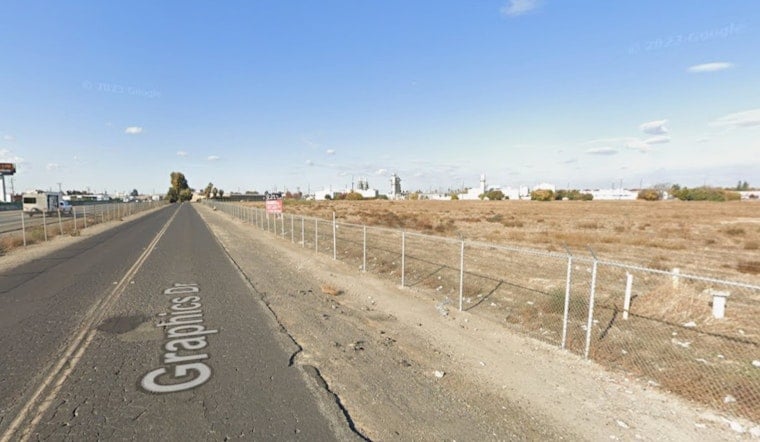
A wave of opposition is building in Modesto over the possibility that a Kansas City-based developer could bring a massive data center to a 45-acre stretch of land along Highway 99 that once housed an FMC chemical plant. Residents packed into public discourse this month, worried about electricity rates, water use, and environmental fallout from a project that has not even been formally proposed yet.
Elizabeth Miranda-Morales, a Modesto resident, said she does not want her children to grow up in an area affected by a data center, according to KCRA. Fellow resident Kayla Delgadillo told the station she does not want a data center in Modesto and believes many of her neighbors feel the same way, adding that the projects do not seem sustainable to her. The target of that anxiety is a 45-acre industrial property at 1200 Graphics Drive, a site formerly occupied by an FMC chemical plant until 1984 and located just south of the Modesto Irrigation District’s Woodland Power Station, according to the Central Valley Journalism Collaborative.
A Developer’s Quiet Paper Trail
NorthPoint Development has not filed a formal data center application with the city, but the station’s report notes the company has kept a foothold on the Graphics Drive parcel for more than a year. In May 2025, the Modesto Planning Commission unanimously approved Resolution No. 2025-20, granting NorthPoint a two-year extension, through June 7, 2027, to file a final parcel map merging properties at that address, per city records reviewed by the Central Valley Journalism Collaborative. That extension preserved tentative parcel-map rights but did not grant any land-use approval for a data center, the collaborative’s reporting notes.
District 3 Modesto City Council Member Chris Ricci said he was approached by NorthPoint about data centers, and he has gone public with concerns about the company’s electrical usage, its effects on residents’ rates, its environmental impacts, and its water use, per the same KCRA account. The City of Modesto has confirmed that no formal applications for data centers have been submitted, and the city said it has received inquiries from companies about building a data center within city limits.
Why City Hall Says the Odds Are Long
Data centers are not permitted under Modesto’s current municipal code, the city has confirmed. Ricci said that makes data centers coming to Modesto highly unlikely under existing rules, though he stopped short of calling it impossible, telling KCRA it is not 100% off the table. Changing the municipal code would require multiple steps, including approval from the City Council, and Ricci said he believes trying to rewrite the code for data centers would be a poor decision; he added he does not intend to meet about the issue.
An official city statement issued in August, after Ricci revealed the developer lobbying, laid out the same regulatory hurdles in more detail. Any future project would require a code amendment, full environmental review under the California Environmental Quality Act, and approvals from both the Planning Commission and City Council, according to The Modesto Bee. Public response to the prospect has been very negative, the station’s report notes, and residents and officials alike have raised concerns about the environmental and sustainability impacts of a project that does not yet formally exist.
Power, Water, and a Chemical Legacy Underfoot
Part of the anxiety traces to what a facility like this would actually draw from the grid. Modesto’s electricity comes from the Modesto Irrigation District, and industry experts note that a mid-sized data center pulling 30 to 50 megawatts consumes as much power as a major commercial airport or a large university campus, per the Central Valley Journalism Collaborative. MID serves roughly 131,000 retail customers across Stanislaus County, according to a Stanislaus LAFCO report, meaning a single large tenant could reshape the utility’s load in ways that ripple through everyone else’s bill.
State lawmakers have already moved to head off that scenario. California enacted Senate Bill 57, the Ratepayer and Technological Innovation Protection Act, in October 2025, authorizing state regulators to examine whether heavy AI data center energy demand shifts infrastructure costs onto residential ratepayers, according to the American Bar Association. The law requires the California Public Utilities Commission to deliver a formal report to the Legislature by January 1, 2027. In April 2026, the CPUC opened a statewide rulemaking to revise electric rate structures aimed specifically at large data center loads, implementing cost-allocation directives under SB 57 so that tech companies cover their own grid buildout rather than passing the bill to ordinary customers.
Water is the other flashpoint. A May 2026 study from Santa Clara University and the Next10 think tank found that California has no unified, mandatory water reporting system for data centers, even as AI facilities increasingly move into water-stressed Central Valley farm country, according to CalMatters. Governor Gavin Newsom vetoed a 2025 water disclosure bill, prompting renewed legislative efforts this year, the outlet reports. Layered on top of that is the Graphics Drive site’s own industrial past: environmental records document lingering soil and groundwater contamination from the former FMC plant, including arsenic, corrosive acids, and inorganic salts, according to the California Environmental Protection Agency.
A Regional Pattern Takes Shape
Modesto is not the only Stanislaus County community wrestling with tech-driven land conversion. Five miles north, in Riverbank, the city secured a 40-year lease with the U.S. Army in March 2026 to convert the 172-acre former Riverbank Army Ammunition Plant, inactive for ammunition manufacturing since 2010, into a commercial and light-industrial tech complex, according to the office of Rep. Tom McClintock. Riverbank resident Bonnie Arbuckle told KCRA that residents there cannot support data centers, and she has opposed one being built in her area.
Farther south, the pattern has already hardened into policy. Spurred by community resistance over energy, water, and noise, the Southern California city of Monterey Park enacted a citywide ban on data center developments through a municipal ordinance and a 2026 ballot measure after developers abandoned a 250,000-square-foot proposal there, according to CoStar News. Whether Modesto follows a similar path, or whether NorthPoint ultimately files a formal application despite the code barriers and Ricci’s public opposition, remains an open question.





