

























































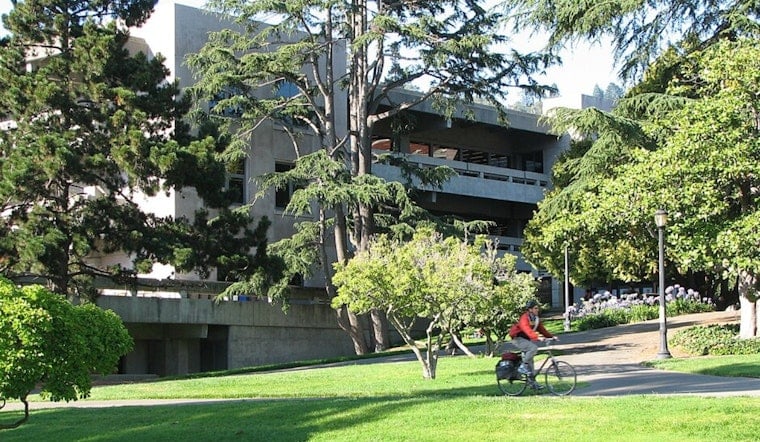
UC Berkeley's Moffitt Undergraduate Library reopened at 1 PM yesterday after most of two years closed, unveiling five newly themed floors, airport-lounge-style seating, sleeping cocoons and a building that no longer holds a single book. The five-story library, tucked along the Grand Promenade near Sather Gate, now has 1,594 seats spread across floors organized around aquatic, mineral, flower, birds and trees motifs.
The reopening caps a $58 million renovation of Moffitt's lower three floors, following the closure of the building after the fall 2024 semester, according to the San Francisco Chronicle. The project nearly doubled the building's amount of student-centered space, according to the UC Berkeley Library. Construction had originally been slated to start in summer 2024, but campus leadership pushed the timeline back until after fall 2024 finals so students would not lose study space mid-semester, officially closing the building on December 20, 2024.
Architecture firm BNIM designed the lower-three-floor renovation, adding more than 750 additional seats along with distinct functional personalities for each floor, according to BNIM. That work was meant to harmonize the lower levels with the building's upper floors, which had already been modernized in a $15 million renovation by Gensler completed in 2016, together forming a decade-long, roughly $73 million overhaul of the building, per American Libraries Magazine.
From Book Stacks to Digital Learning Hub
Moffitt opened in 1970 as a cast-in-place concrete Brutalist structure designed by prominent Bay Area architect John Carl Warnecke, who also designed President John F. Kennedy's gravesite at Arlington National Cemetery, according to the University of California Office of the President. All of Moffitt's physical books were relocated to the neighboring Main Gardner Stacks in 2016, freeing up the building's 125,000 square feet for high-density seating, 24-hour study zones, digital testing and collaborative research space. Doe Memorial Library and Main Gardner Stacks now house more than 2 million books, with Main Gardner Stacks closing nightly at 2 AM.
The building now has no books at all, and students can eat and drink coffee throughout the space. The Free Speech Movement Cafe on-site reopened with an expanded footprint and continues serving fair-trade organic espresso to the public. Historic images from the 1964 campus uprising, curated by Lynne Hollander Savio, are displayed nearby — a nod to Mario Savio's call for students to stop what he termed the operation of the machine.
Rest Pods, Reflection Room and a New Name
The renovated first floor includes a new 100-seat Computer-Based Testing Facility managed by Research, Teaching & Learning, letting students self-schedule proctored digital exams drawn from randomized test banks, according to the UC Berkeley Division of Undergraduate Education. It's designed to expand accommodations for disabled students. Whether the center can handle the crush of scheduling during high-volume midterm periods remains an open question for the university to work out as the semester ramps up.
The second floor now hosts a new Discovery Hub run by the campus-wide Berkeley Discovery initiative, connecting undergraduates with research opportunities, internships and experiential projects — a floor that had reportedly sat closed for 30 years or more before this renovation. It also includes four-person study nooks. The first floor's quiet zone includes a dedicated reflection room built specifically for student meditation and prayer, reflecting extensive student input campus planners gathered on furniture and room functions before construction began, per UC Berkeley Inspire. Elsewhere in the building, a wellness room includes rest pods alongside the airport-lounge seating and sleeping cocoons scattered throughout.
The building has also been renamed the Carol T. Christ Center for Connected Learning at Moffitt Library. UC Berkeley alumna and former faculty member Nadine Tang, who earned her M.S.W. in 1975, provided the capstone gift for the lower-floors renovation and requested the center be named for her friend, Chancellor Emerita Carol T. Christ, who stepped down from the chancellorship in mid-2024 after leading the university since 2017.
Students React to the New Space
Moffitt averages more than 1 million visits annually, making it one of the most heavily trafficked student facilities on a campus with roughly 20 libraries, and it remains the only campus library open 24 hours a day during the week, while other campus buildings don't reopen until 8 AM. It's also the largest of UC Berkeley's library system. Sophomore Zain Dahdul, 19, said he and his friends already loved the renovated library, while fellow sophomore Alexa Koniares, 19, said she had never seen Moffitt before its reopening. Sophomores Lorelei Everhart, 19, and Gianna Bordi, 19, senior Lorenzo Arevalo, 20, and students Allison Ng, 21, and Navika Singhal, 20, were among those checking out the new space.
The reopening coincided with the grand opening of UC Berkeley's new undergraduate academic building, an all-electric, LEED Gold-certified structure made of glass and exposed mass timber that can host 10 percent of the general assignment classroom capacity on campus. The timing also follows the university's opening of a $557 million computer and data science building. Kyle Gibson said UC Berkeley was having an incredible fall semester for incoming students.
The library's reopening comes to a campus still processing other recent news from the same stretch of ground: in January, Hoodline reported a fatal scooter crash on campus terrain directly adjacent to Moffitt. As students settle into the rebuilt library's quiet floors, noise floors, and its book-free stacks, the building's transformation marks the end of a project years in the making — one that turned a 1970s concrete study hall into what campus officials describe as a hub for digital learning, wellness and research.



