

























































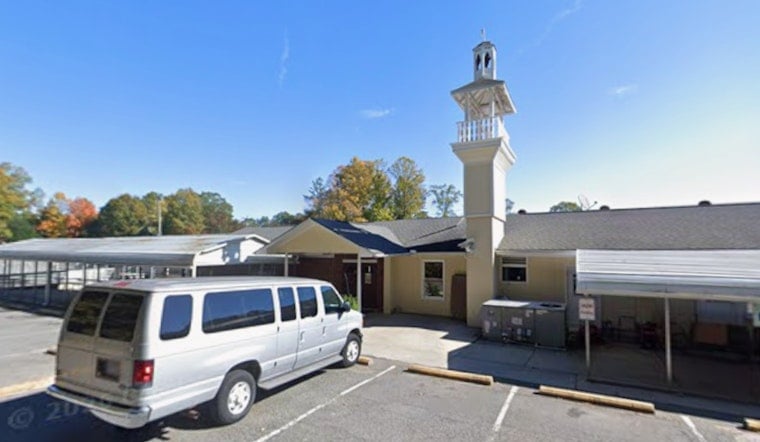
Charlotte Islamic community leaders gathered outside the Charlotte-Mecklenburg Government Center in Uptown Charlotte to stand behind the Muslim community in Mooresville, where a proposed mosque has drawn hateful, Islamophobic remarks at a recent town meeting. The show of solidarity followed comments at the Mooresville Town Board meeting on August 3, where speakers called Islam an evil ideology and labeled it a political regime seeking to take over regions and nations, according to a recording of the meeting cited by the Charlotte Observer.
The mosque at the center of the controversy, planned by the Islamic Center of Lake Norman, would rise on land off Brawley School Road that the Town of Mooresville has confirmed is zoned Community Commercial — a designation where religious assembly is a by-right permitted use requiring no public hearings or board votes, according to an official statement from the Town of Mooresville. The land was annexed in 1998 under zoning rules that already allowed places of worship by right, and the congregation has owned the site since 2019. Town commissioners, the statement makes clear, have no statutory authority to block the project based on public opposition.
Per the same statement, the development includes 4,926 total occupiable square feet across two structures: a 2,691-square-foot prayer hall and a 2,235-square-foot office and kitchen building, along with 52 parking spaces. Initial site work involving four retaining walls began this month. The Islamic Center of Lake Norman, founded in 2011, currently operates out of a rented office suite on South Park Drive and is the only Islamic center within a 30-mile radius offering daily prayers and Sunday school for local Muslim families, according to the Islamic Center of Lake Norman, which is organized as a 501(c)(3) nonprofit.
Speakers Question Safety and Cite Sharia Fears
At the town meeting, speakers also opposed sharia law and the Muslim center and questioned whether women and girls would be at risk, per the town recording described by the Observer. Ibn Tamir Abdul Mutakabbir, resident imam of Masjid Ash-Shaheed in Charlotte, responded by citing the constitutional protection of Americans’ rights to practice religion, assemble and worship, and argued that a mosque meeting building-code and traffic requirements should be allowed to be built. He noted that discrimination has existed since the founding of the United States and said his grandparents were World War II veterans.
Jibril Hough, spokesperson and trustee for the Islamic Center of Charlotte, said some Mooresville residents made an embarrassing scene for the growing Muslim community. Hough said Muslims were present in what is now the United States before Columbus and noted that mosques have existed in towns and cities across the Charlotte region for decades. He added that some of his own ancestry can be traced to people who fought in the American Revolution.
Death Threats and a Lingering 2015 Memory
Hadia Mubarak, a religious studies educator and resident scholar at Pillars Mosque in Charlotte, said she received death threats on social media this week after speaking about her right to wear hijab. Mubarak said she felt very unsafe as a Muslim in America but said Muslim Americans will stand up for the civil rights of people of any faith or no faith, according to WFAE. She said the Muslim faith teaches loving others and protecting people from harm.
The station reported that the 2015 fatal shooting of three Muslim college students in Chapel Hill remains a persistent safety reference point for local Muslim communities weighing public anti-Muslim rhetoric. Charlotte Islamic leaders said anti-Muslim sentiment is widespread across the region, not confined to Mooresville, and pointed to the philanthropic record of local congregations as a counterpoint to the hostility. Hough said Islamic centers and mosques have helped people with rent, electric bills and baby formula for nearly three decades, with some mosques donating between $50,000 and $100,000 to help people in need over the past year.
Part of a Broader Regional Pattern
The Mooresville dispute lands amid a string of anti-Muslim flashpoints across the region. In March, a Gaston County school board member sparked resignation calls after sharing a Facebook post calling Islam a satanic death cult, a post he later deleted while defending his right to political speech, as reported by WSOC-TV. That post led to community protests and calls for his resignation.
In May, the Lancaster County Council in nearby South Carolina voted unanimously to deny a conditional use permit for a proposed 3,000-square-foot mosque in Indian Land after public opposition centered on traffic concerns, according to WRHI. That same month, an anonymous 911 caller threatened to detonate four bombs at the Islamic Association of Raleigh campus while declaring, “I hate Muslims,” triggering an evacuation, a police sweep that found no explosive devices, and a federal hate crime investigation, as Hoodline reported in its piece on the Raleigh mosque bomb threat.
The Council on American-Islamic Relations recorded a record 8,683 anti-Muslim bias complaints nationwide during 2025, including 33 incidents specifically targeting Islamic institutions, a 0.3% rise over 2024, according to the organization's annual civil rights report. Under the federal Religious Land Use and Institutionalized Persons Act, enacted with unanimous bipartisan support in 2000, local governments are barred from enforcing zoning rules that impose a substantial burden on religious exercise or treat houses of worship on less-than-equal terms compared with secular assemblies, per the U.S. Department of Justice.
For now, Mooresville’s Islamic Center of Lake Norman project remains on track under its by-right zoning status, even as the town board meeting exposed the depth of local hostility some residents hold toward the proposal. Charlotte’s Muslim leaders say they intend to keep speaking out, framing the fight less as a zoning dispute and more as a test of whether constitutional protections hold up against organized public opposition.





