

























































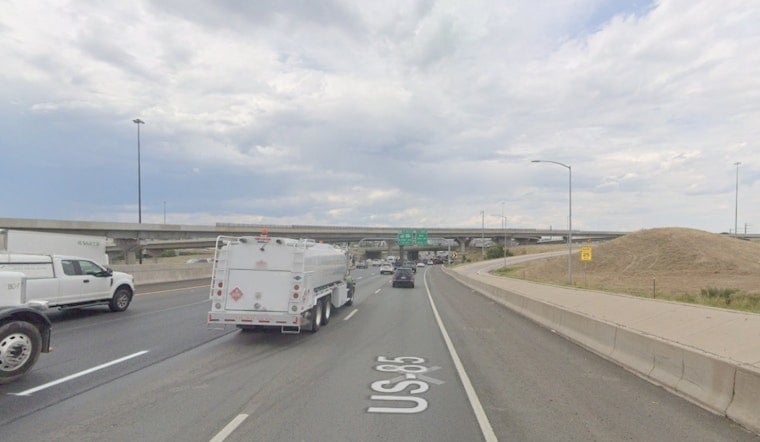
A moped rider suffered serious injuries Saturday morning after colliding with a motorist on southbound Interstate 25 near 6th Avenue in Denver, prompting a traffic alert and delays through the corridor. The crash, involving a motorist and a moped, was reported to have caused serious injuries, according to the responding agency.
The Denver Police Dept. posted a Crash Alert Saturday morning, saying it was investigating the collision at southbound I-25 and 6th Avenue and warning drivers to expect delays in the area. Denver Police only issue these public alerts when a crash results in serious injuries or forces a road closure, and the department has noted it is not monitored around the clock. Anyone with information can reach police at 720-913-2000, or call or text 911 in an emergency.
The presence of a moped on the interstate itself raises a legal question. Under Colorado Revised Statutes 42-4-109, low-power scooters and mopeds are prohibited from traveling on interstate highways, including I-25, unless a designated bicycle lane runs alongside the roadway, according to the Colorado General Assembly. State law defines these vehicles as having engine capacities of 50cc or smaller, or electric power under 4,476 watts. How the moped came to be on I-25, and whether speed or visibility played a role in the collision, remain open questions that have not been addressed in available reporting.
A Highway Interchange With a Troubled Recent History
This is not the first serious crash to strike this exact stretch of southbound I-25 in recent months. On June 5, a southbound motorist struck a stalled vehicle at the same interchange, resulting in a driver's death at a local hospital, as Hoodline reported in its story Deadly I-25 Crash Halts Denver Commute. Just weeks before Saturday's moped collision, another serious-injury crash occurred at the same interchange on August 1, again causing driver injuries and severe traffic delays.
The pattern extends beyond this single interchange. Two motorists were hospitalized after a crash snarled I-25 at West Colfax on August 13, and a single-vehicle crash on Denver's 6th Avenue corridor sent one person to the hospital with serious injuries on August 15. Taken together, the string of incidents points to a stretch of central Denver highway that has repeatedly produced serious and fatal outcomes over the past several months.
To legally operate a moped or low-power scooter on public roads in Colorado, riders must hold a valid driver's license and carry minimum bodily injury liability insurance of $25,000 per person and $50,000 per accident, along with $15,000 in property damage coverage, according to Zaner Harden Law. Scooters or mopeds that exceed 50cc or 4,476 watts are instead classified and regulated as motorcycles under state law.
Statewide Numbers Show a Worsening Toll for Two-Wheel Vehicles
The Denver crash lands amid a broader surge in two-wheel vehicle fatalities across Colorado. In 2024, the state recorded 165 motorcyclist deaths, a 57% increase over the preceding decade and the highest annual total in state history, per CGH Injury Lawyers. Two-wheel motor vehicles accounted for 24% of all state traffic deaths that year despite making up just 3% of registered vehicles, reflecting the elevated vulnerability riders face from reduced visibility and the lack of an enclosed vehicle structure.
Preliminary data from the Colorado Department of Transportation shows statewide traffic fatalities reached 701 in 2025, up 2% from the year before, with motorcycle and two-wheeler fatalities accounting for 147 of those deaths. CDOT coordinates safety initiatives with more than 130 law enforcement agencies and public health organizations across the state.
Denver's own numbers tell a similarly grim story. City traffic crash deaths reached 93 in 2025, the highest single-year total recorded on the Department of Transportation and Infrastructure's Vision Zero dashboard since records began in 2013, according to a report shared by Westword. The city adopted its Vision Zero policy in 2016, intending to eliminate traffic fatalities and serious injuries.
Regional Data Points to Careless Driving and Interchange Risk
Across the wider Denver metropolitan region, an estimated 9,608 fatal or severe-injury crashes occurred between 2020 and 2024, resulting in at least 1,564 deaths and more than 9,500 serious injuries, per the Denver Regional Council of Governments. The council has adopted a Regional Vision Zero plan aiming for zero traffic deaths by 2040 and zero serious injuries by 2045.
Careless driving is cited as the leading contributing factor in Denver crashes, accounting for roughly 16% of all reported collisions citywide, according to an analysis of Denver Open Data. That same analysis found crashes tend to cluster around highway interchanges and major arterials — a pattern consistent with the repeated incidents at I-25 and 6th Avenue.
The Colorado Department of Transportation and contractor Wilson & Company completed upgrades to this same stretch of southbound I-25 between 6th Avenue and Alameda Avenue in May 2025, replacing more than 2,500 linear feet of guardrail as part of the Central Denver Resurfacing Project. The project targeted the corridor after past incidents in which vehicles left the highway and entered the South Platte River, according to Wilson & Company. Despite that infrastructure work, the interchange has continued to see severe and fatal crashes in the months since.




