

























































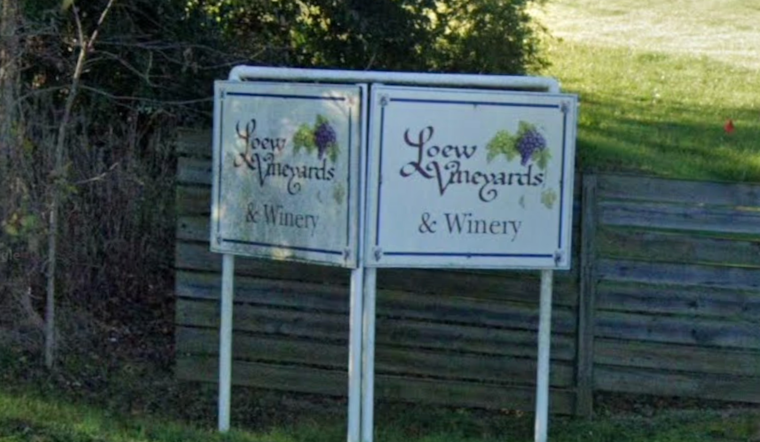
A Mount Airy winery has released Maryland's first Star-K certified honey wine, a cyser named Mechaya that traces its roots to a family label first used in 1870. Loew Vineyards marked the release on August 9 with a party at its property on Liberty Road, where guests sipped the new wine alongside kosher pizza and listened to music and a short dedication.
Mechaya, a mead fermented with local apple cider along with wildflower and clover honey, is fermented dry rather than as a sweet dessert wine, according to Baltimore Jewish Times. The outlet reports the wine carries bright, citrusy characteristics comparable to a sauvignon blanc, and that it pairs well with goat cheese, fruit-and-nut salad, roast chicken, or gefilte fish. It's now available for online sales and in the winery's tasting room.
The label itself is a tribute. Per the same account, the Mechaya label honors the original Löw label that dates to 1870, when the family produced and shipped honey wine across Europe from operations in Bursztyn and Lemberg, in what was then Galicia. That business ended when the war came.
A Family Rebuilt From Ashes
Winery co-founder William “Bill” Loew, born Wolfgang Löw in Lwów, was forced into a Jewish ghetto in 1942, according to The Washington Post. He escaped to Slovakia to join the Jewish underground, survived months in Auschwitz, and endured an April 1945 death march before U.S. troops liberated him at age 19. Loew eventually made his way to Maryland, where he spent four decades working to recreate the aroma and flavor of his family's ancestral honey wines, according to the Washington Jewish Week. He died on April 15, 2022, at age 96, having lived to see the vineyard re-established but not to witness the full kosher transition his granddaughter would later complete.
That destruction wasn't just personal. Members of the Jewish community produced an estimated 90 percent of all commercial mead in pre-World War II Poland, an industry gutted after Nazi persecution wiped out 90 percent of the local Jewish population, according to Homegrown Frederick. Bill and Lois Loew bought 37 acres on Liberty Road in Frederick County in 1982 and began planting the property that same year, founding what is now the fourth-oldest operating winery in Maryland.
Fifth-Generation Winemaker Leads the Revival
Rachel Loew Lipman, the fifth generation to make wine under the Loew family name, runs the winery with her partner Sam and has reconstructed her ancestors' winemaking history to bring Mechaya to life, per Baltimore Jewish Times. Lipman holds dual bachelor's degrees in horticulture and crop production and communications from the University of Maryland, College Park, earned in 2015, along with a winemaking certification from Washington State University, according to Anne's Place. Governor Wes Moore appointed her to the Maryland Agricultural Commission in October 2023 to represent the state's viticultural industry, per the Washington, DC Grandchildren of Holocaust Survivors organization.
Getting Mechaya to market required real technical work. Loew Vineyards received a Frederick County Agricultural Innovation Grant in 2025 to acquire specialized processing equipment, including a steam generator needed to kasher its stainless steel tanks and barrels, according to the Baltimore Jewish Times. Mechaya became the first Star-K-certified honey wine produced in Maryland, following the winery's earlier release of a 2025 Barbera Nouveau under Conservative kosher supervision from Rabbi Jordan Hersh of Beth Sholom Congregation — Maryland's first kosher-certified wine overall.
Honey Filled a Gap Left by a Brutal Freeze
The timing carried extra weight this year. An April 2025 freeze that dropped temperatures to 23.5 degrees Fahrenheit destroyed primary fruit across more than 600 of Maryland's roughly 1,000 grape-growing acres, preventing Loew Vineyards from making estate grape wine for that vintage, according to the show Industry Night with Nycci Nellis. Honey wine, unlike grape wine, doesn't depend on a vineyard's fruit set, and the winery harvested its own honey from the property this month, releasing this year's honey jars the same day as Mechaya.
Meadmaking is its own craft with its own demands, Baltimore Jewish Times reports. Honey must be diluted before fermentation, acidity has to be built into the process, and yeast nutrients require careful measurement throughout — unlike grape fermentation, which often finishes within two weeks, mead fermentation can take a month or more. Depending on what's blended with the honey, the results carry different names: honey with apple is a cyser, honey with grape juice is a pyment, and honey mixed with other fruit is a melomel.
A Personal Connection for Wine Club Members
The release resonated with longtime supporters of the winery. Heidi Wachs, a member of the Loew Vineyards wine club who receives a variety of wines four times a year, told Baltimore Jewish Times, “I love the history of the winery, and I'm personally connected to it as a grandchild of Holocaust survivors.” Jules Polonetsky, who wrote the piece for the outlet, is a Wine and Spirits Education Trust Level 3 certified wine expert who edits a wine education website at kosher-wine.org and previously served as a consumer affairs commissioner for New York City.
Maryland's wine industry has grown into a substantial agricultural presence, with more than 110 licensed wineries spanning over 1,000 acres of fruit and grape cultivation statewide, including 15 in Frederick County alone, according to data from the Maryland Wineries Association cited by Homegrown Frederick. Mount Airy sits slightly more than two hours from Philadelphia and roughly one hour from both Washington and Baltimore, putting Loew Vineyards within reach of much of the region ahead of Rosh Hashanah, which begins the evening of Friday, September 11. Mechaya can be ordered now.



