

























































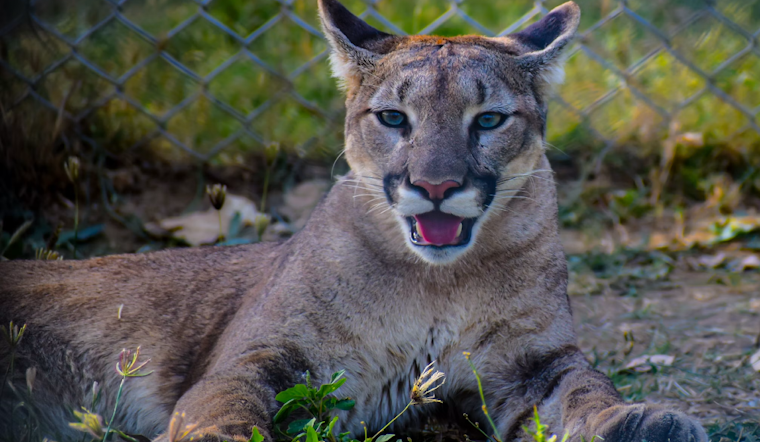
A mountain lion wandered into a Sherman Oaks backyard, drank from the swimming pool, and then sprawled out for a nap just outside a homeowner's sliding glass door — sticking around for a full hour before ambling back into the hills. Homeowner Andrea Bailey captured the whole scene on her security cameras in the Royal Woods neighborhood, a hillside subdivision pressed against the northern slopes of the Santa Monica Mountains.
Bailey said she was fascinated by the close-up view of the big cat, which the Los Angeles Fish and Wildlife regional office would classify as a puma, as reported by NBC Los Angeles. Video from her cameras showed the animal walking across the patio, lapping water from the pool, then curling up next to the window overlooking her back patio and yawning wide enough to show off its canine teeth before drifting off. Neighbor Farnaz Simantob told the outlet the cat came onto her property first and jumped the fence into her backyard, and separate footage from a neighbor's security cameras showed the lion walking along a sidewalk before slipping into that yard.
The encounter played out on a neighborhood WhatsApp group that Bailey used to alert residents in real time — the same chat neighbors were simultaneously using to track down a local mail thief, per the same report. Robert Kovacik covered the sighting for NBC4 News at 11 p.m. on Wednesday, alongside reporting from Jonathan Lloyd. The mountain lion was likely the same animal behind previous sightings reported in the neighborhood, according to the report, and it eventually returned to the wilderness on its own.
Heat Is Pushing Wildlife Into the Valley
The timing lines up with a broader pattern: extreme Southern California heat late this month has been driving foothill wildlife, including deer and the predators that follow them, down into suburban yards in search of shade and water, according to KNBC-TV. Mountain lions generally avoid humans and can be found wherever deer are present, and wildlife officials say sighting reports rarely turn up an animal that poses an imminent threat to public safety.
Royal Woods sits near Mulholland Drive and the Sepulveda Pass, a corridor that has long served as both a major vehicular route and a natural edge where mountain habitat meets dense Valley development, according to the Los Angeles Times. That geography is exactly why big cats descending from the ridgelines end up in backyards like Bailey's rather than staying confined to open space.
Legal Protections Now Shape What Happens Next
The California Fish and Game Commission voted unanimously in February to list six Southern California and Central Coast mountain lion populations, including the Santa Monica Mountains group, as threatened under the California Endangered Species Act, according to the Center for Biological Diversity. The designation legally requires state agencies to minimize habitat destruction and promote wildlife connectivity, adding weight to sightings like the one in Royal Woods. That same protection status factored into the City of Los Angeles's decision this week to block a proposed 301-unit housing development at the Woodland Hills Country Club site, just west of Sherman Oaks, citing wildfire risk and the land's role as critical mountain lion habitat, per Patch.
Mountain lions have been off-limits to sport and trophy hunters statewide since June 1990, when voters approved Proposition 117, the California Wildlife Protection Act, classifying pumas as specially protected mammals, according to the California Department of Fish and Wildlife. That same ballot measure created a dedicated $30 million annual fund for habitat acquisition. Wildlife officials describe the current statewide population estimate of roughly 4,000 to 6,000 mountain lions as a crude figure, since there is no ongoing statewide study tracking the numbers.
Freeways Still Split Up Local Cougar Populations
The National Park Service has run a continuous tracking study of Santa Monica Mountains mountain lions since 2002, monitoring more than 100 individual cats to study urban fragmentation, roadway deaths, and genetic isolation, as Hoodline has previously reported. Researchers have found that regional freeways effectively wall off cougar populations into ecological islands, severely limiting gene flow between them. Vehicle strikes on mountain roads like Kanan Road and Las Virgenes Canyon Road remain one of the leading causes of death for both collared and uncollared lions, disproportionately killing young cats that are dispersing to find new territory, per the Los Angeles Times.
To address that isolation, the $92 million Wallis Annenberg Wildlife Crossing over U.S. 101 at Liberty Canyon in Agoura Hills received its final $18 million in state funding this year and is scheduled to open to wildlife in December, according to Caltrans. Once complete, the 210-foot-wide vegetated bridge will be the largest wildlife overpass of its kind in North America, designed to reconnect isolated Santa Monica Mountains lions with adjacent ranges.
What Officials Recommend If You Encounter a Lion
Not every regional encounter has ended peacefully. In September 2024, state wildlife officers euthanized a mountain lion after it grabbed and mauled a 5-year-old boy during a daytime picnic at Tapia Park near Malibu Canyon; the child survived with non-life-threatening injuries after his father intervened, according to Valley News Group. Attacks on humans remain extremely rare, but wildlife officials urge caution regardless.
California Department of Fish and Wildlife guidance calls for hikers, joggers and bikers to avoid going out alone, particularly at dawn, dusk and at night, and to stay alert on trails. People should never approach a mountain lion, should give it an escape route, and should pick up and closely watch small children, since off-leash dogs and small kids can be mistaken for prey. If a lion is encountered, officials advise standing tall, facing the animal, speaking calmly without screaming, and never running, crouching, bending over or squatting, since those postures resemble four-legged prey and running can trigger a chase, catch and kill response. If attacked, people should fight back with whatever is available — rocks, sticks, garden tools, even an ink pen have worked in documented cases — try to stay on their feet, protect their head and neck if knocked down, and call 911 immediately. The Fish and Wildlife Department receives hundreds of mountain lion sighting reports each year and asks residents to report unusual behavior to their local regional office.
Sherman Oaks now joins a growing list of Southern California suburbs where cougars have turned up in surprisingly domestic settings this year, from a lion resting near a Pasadena apartment complex to another shutting down a street in San Dimas. For Bailey, the encounter ended without incident: the cat finished its nap, got up, and headed back into the wilderness on its own.





