

























































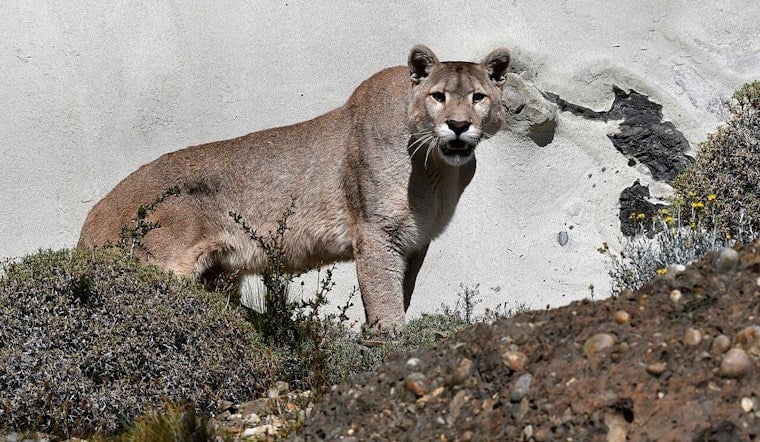
A mountain lion shut down a stretch of road in San Dimas on Friday after the big cat was found lounging on a sidewalk in the shade of a tree, prompting wildlife officials and sheriff's deputies to respond and urge nearby residents to stay indoors. The animal was located along Foothill Avenue between San Dimas Avenue and San Dimas Canyon Road, according to authorities.
The Los Angeles County Sheriff's San Dimas Station reported the sighting and posted updates on Instagram as the situation unfolded, according to the Los Angeles Times. Deputies urged residents to remain vigilant, stay away from the area, and secure both pets and any outdoor food that could draw the puma closer to homes. Runners and pedestrians in the area were also asked to keep their distance while the response continued.
The California Department of Fish and Wildlife received reports about the mountain lion and responded to its location, per the same account. Cort Klopping, a public information officer with the agency, is named in the reporting as officials worked to safely capture the animal, though it wasn't immediately clear from available reports how long the closure lasted or what condition the lion was in once officers arrived.
A Familiar Pattern Along the Foothills
San Dimas sits directly against the 6,785-acre San Dimas Canyon/San Antonio Wash Significant Ecological Area, a designated wildlife corridor that connects the Angeles National Forest to the foothill communities below, according to LA County Planning. Steep canyon drainages in that corridor act as natural pathways, guiding mountain lions from higher mountain habitat down toward residential streets, particularly during hot stretches when big cats seek shade or trail prey into neighborhoods.
This is not the first time a mountain lion has wandered into San Dimas. In November 2015, authorities captured an uninjured mountain lion roaming near commercial businesses and a bowling alley along Bonita Avenue closer to the 57 Freeway, using a net and without needing tranquilizers, the Los Angeles Times reported at the time. Friday's sighting occurred farther north, closer to the canyon corridor itself.
Part of a Broader Regional Trend
The San Dimas incident follows a string of similar urban mountain lion encounters across Southern California in recent months. On June 5, state wildlife officers tranquilized an 80-pound mountain lion that had spent hours near an apartment complex in Old Town Pasadena before safely relocating it to the Angeles National Forest, according to Pasadena Now — a case Hoodline also covered in its report on the Pasadena apartment complex lion. Weeks before that, on May 29, state biologists tranquilized a mountain lion lounging behind a bush in a Santa Monica yard, prompting local police shelter-in-place warnings before the animal was relocated, as reported by the Los Angeles Times.
Under California Department of Fish and Wildlife procedure, officers do not transport captured mountain lions to distant wilderness areas; instead, animals stranded in urban settings are tranquilized and relocated to the nearest suitable natural habitat, according to the Escalon Times. That protocol reflects the heightened legal status mountain lions now hold in the region.
New Protections Raise the Stakes
In February, the California Fish and Game Commission voted unanimously to list mountain lion populations in Southern California and the Central Coast, including the San Gabriel Mountains, as threatened under the California Endangered Species Act, according to CalMatters. The listing grants state-level protections against unauthorized take and mandates non-lethal management whenever feasible, a shift from earlier rules that allowed broader issuance of depredation permits.
That protected status stems partly from population data showing just how fragile these local cougar populations really are. A state-supported study released in January 2024 estimated California's total mountain lion population at between 3,200 and 4,500 animals, with roughly 1,400 in the Southern California and Central Coast regions, reversing a decades-old informal estimate of 6,000 statewide, per the Los Angeles Times. Research reviewed by state wildlife officials has also identified the San Gabriel and San Bernardino mountains population as one of six distinct Southern California subpopulations at risk of extinction due to genetic isolation and highway barriers, according to Allen Matkins.
Traffic remains one of the deadliest threats these animals face once they leave protected wildland. National Park Service tracking data for the Los Angeles region has documented at least 32 mountain lions killed by vehicle strikes between 2002 and 2026, per Pasadena Now's reporting.
What to Do if You Encounter a Mountain Lion
State wildlife guidance advises anyone who encounters a mountain lion to stand tall, maintain eye contact, raise their arms, speak firmly, and never run, since fleeing can trigger a predatory chase instinct, according to Framtida News. Wildlife officials note that mountain lions are naturally elusive and rarely initiate conflict with people unless cornered, which is part of why capture operations like Friday's focus on giving the animal a clear, calm path back to open space rather than provoking a confrontation.




