

























































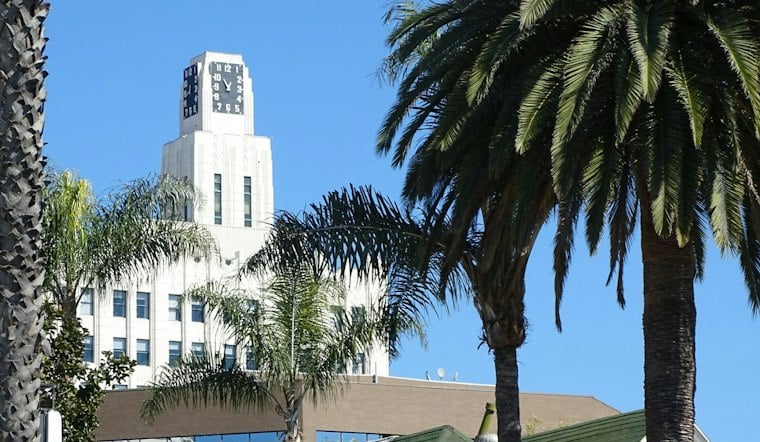
The Santa Monica Clock Tower, the century-old Art Deco landmark that once stood as the city's tallest building, has sold for $28.5 million — roughly half of what its previous owner paid for it in 2019. The sale closed in late September, capping a stretch that saw the 12-story office property at 225 Santa Monica Boulevard slide into a court-appointed receivership after its owner defaulted on its mortgage.
The buyer is connected to Simon, Daniel and Joseph Mani, who are behind Mani Brothers Real Estate Group in West Hollywood, according to The Real Deal, which first reported the sale. The buyer assumed the existing loan and extended its maturity date to May 2027, the outlet reported. Mani Brothers Real Estate Group did not immediately respond to a request for comment, per the same report.
Rockwood Capital, the prior owner, had purchased the tower from Sorgente Group of America for $58 million in 2019, according to the report — though a separate account from Santa Monica Mirror places that purchase in 2018. At the time, Rockwood assumed about $27 million in commercial mortgage-backed securities debt, per The Real Deal's reporting; a related account put that figure at $26.7 million. Rockwood is part of Harrison Street Asset Management, which declined to comment, the report notes.
A Loan Default and a Lawsuit
The tower's loan entered special servicing after missing its May 2025 maturity date, and the dispute has been in court since September 2025, the station's report states. Rialto Capital sued over Rockwood's alleged default, alleging Rockwood owed about $25 million, according to Rialto Capital's own account as relayed in the same reporting. The property was subsequently placed in receivership. Rialto Capital and the court-appointed receiver did not immediately respond to requests for comment, the article notes.
The financial unraveling had been building for more than a year. The property was recently appraised at $27.4 million, down from $49 million at loan issuance, according to an earlier therealdeal.com report — a 44 percent decline in roughly a decade. Separately, the Santa Monica Mirror cited Morningstar data placing the 2015 valuation at $49 million as well, with the estimate falling to $27.4 million by last summer.
Occupancy Collapse Behind the Discount
Occupancy at the Clock Tower fell to 43 percent, according to the latest Morningstar data cited in therealdeal.com's reporting, down from 100 percent at loan underwriting ten years earlier. Income dropped to about $144,000 from $2.2 million over that same stretch, and the property carried a debt service coverage ratio of 0.38 times — meaning it wasn't generating enough cash to cover its debts, per that reporting. A 2026 Newmark marketing brochure offered about 30,000 square feet of creative office space and 5,000 square feet of ground-floor restaurant or retail space at the building, underscoring how much of the tower sat empty heading into the sale.
Accounts of the building's exact footprint vary: therealdeal.com described it as 53,500 square feet, while the Santa Monica Mirror and other reporting put the figure at 50,000 square feet. Its construction date is similarly disputed — the Los Angeles Times reported the tower was completed in 1929, while a listing from westlaofficespaces.com describes it as built in 1931. What's not in dispute is its legacy: the Clock Tower was once Santa Monica's tallest building, a fixture near the Third Street Promenade for nearly a century.
A Struggling Office Market Citywide
The Clock Tower's troubles mirror a broader slump across Santa Monica's office market. Santa Monica had a 24 percent office vacancy rate as of last year, compared with 22 percent in West Los Angeles and 12.8 percent in Century City, according to therealdeal.com's earlier reporting — though the Santa Monica Mirror separately cited CBRE data putting local office vacancy as high as 25.8 percent. By the second quarter of 2026, Santa Monica had logged the largest occupancy loss in West Los Angeles amid pullbacks in the tech and media sectors, leaving roughly one-third of its office inventory available for lease, according to a Colliers report. Colliers also found West Los Angeles office vacancy held steady at 24.6 percent that quarter, even as midyear leasing activity across the broader submarket climbed 11.6 percent year over year to 2.5 million square feet.
Santa Monica's retail sector has shown similar strain. Vacancy rose sharply through 2025 with another jump in the first quarter of 2026, according to a market report from illicre.com, while rents have declined steadily from their 2023 highs and appear to be stabilizing in the mid-$4.00 range. Leasing volume remained limited and deal counts low in the most recent quarter, the report found, pointing to subdued tenant demand across the submarket.
Not every recent Santa Monica office sale has told the same story of decline. A 78,500-square-foot building at 501 Santa Monica Boulevard sold for $40 million in August 2025, according to the Los Angeles Times. Still, the Clock Tower's steep discount — a $58 million purchase in 2019 reduced to $28.5 million roughly seven years later — stands as one of the more striking markers of how far office values have fallen in the city's core.





