

























































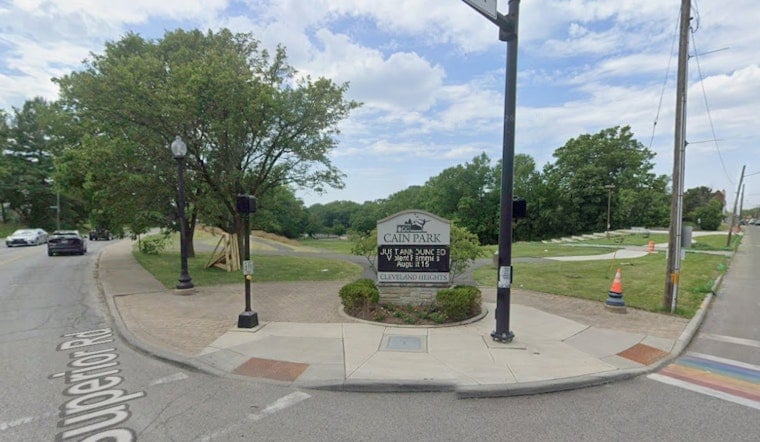
Cleveland Heights is rethinking the rules for a community expression wall at Cain Park after a dispute over an Israeli flag, a hamsa and pro-Palestinian markings turned a supervised arts activity into a local free-expression fight. The city says it is reviewing whether the wall’s open-ended policy needs to be clarified.
The controversy involves Alec Popivker, an Orthodox Jewish Cleveland Heights resident who painted an Israeli flag and hamsa before the Jewish Sabbath. City staff later painted over those images and the word “Shalom,” while an unknown person marked over the flag with black paint, wrote “Free Palestine” and added three downward-pointing arrows, according to a Cleveland.com report.
The dispute unfolded around two big Cain Park events: Pride in the Park on June 27 and the Cain Park Arts Festival from July 10 through July 12. Cleveland Heights’ official updates list both events, while Cain Park’s festival page says the three-day festival included an interactive mural-painting activity and took place in a municipally owned and operated park.
How Cain Park’s Wall Became A Flashpoint
Popivker had been told that painting was permitted on Saturdays from noon to 4 p.m., when staff could supervise the activity. Organizers say the walls are painted over each year before the arts festival and that political, controversial or provocative images and words are removed; they provide tempera paint and brushes for participants.
Popivker returned to the wall on July 12 after painting messages including “Am Israel Chai,” “Shalom,” “Biji Kurdistan” and “Save Nigeria,” as well as the Israeli flag and hamsa. He filed a police complaint after the flag was defaced and was warned he could be arrested if he continued painting.
That sequence is why the argument is no longer just about one painted symbol. Popivker questioned whether once-a-year Saturday access—and the threat of criminal enforcement—fits with the idea of free expression, particularly when the schedule conflicts with Shabbat.
City And Festival Organizers Face A Rulebook Problem
Cleveland Heights officials now plan to review the policy governing the community expression wall, with a city spokesperson saying some refinement may be needed. Council President Tony Cuda said City Council funds the arts festival but does not set its policy, leaving the city and festival organizers to sort out who makes the rules.
Festival director George Kozmon said organizers do not want to exclude anyone and acknowledged that concerns about the Saturday schedule and Shabbat were well-made. But he also described the wall as an art project—not a public comment wall—intended as a creative space for families and children, while police Lt. Michael Davis said being upset by a posting does not by itself make it vandalism or a crime, according to Cleveland.com coverage.
The Next Mural May Come With More Rules
For now, the city has not announced a final rewrite of the wall’s rules or said exactly how public participation will work next year. The likely outcome is a more specific policy spelling out when people may paint, what kinds of content can be removed, who has authority to make that call and how religious observances are handled.
That may not end the arguments—public art has a stubborn habit of attracting opinions—but it could at least make the boundaries visible before the next batch of paint hits the wall.



