

























































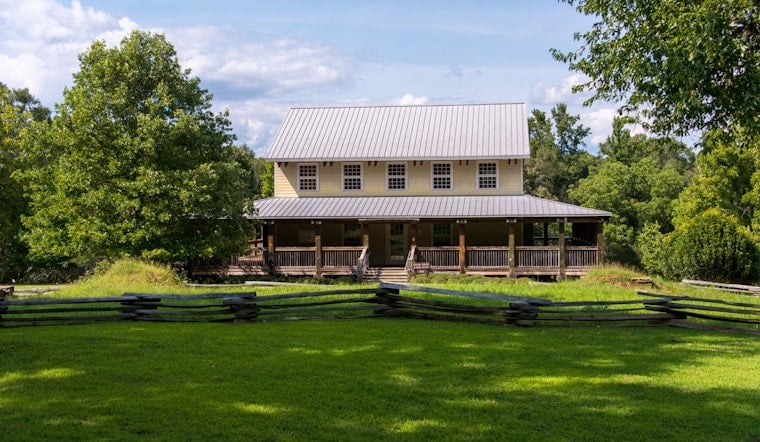
Visitors walking into the newly reopened visitor center at Musgrove Mill State Historic Site near Clinton can now ask questions of a Patriot militiaman, a Loyalist fighter, a civilian caught in the middle, and an enslaved African American seeking freedom — and get answers, in character, from digital displays built to recreate the tension of a backcountry war that often pitted neighbor against neighbor. The reopened exhibits debuted on August 19, with the 1780 fight as their historical focus.
The new digital characters are designed to respond to visitor questions, with their answers grounded in historical research and source materials curated by state park historians and Revolutionary War experts, according to the Greenville Journal. The South Carolina Department of Parks, Recreation and Tourism said the historical research and source materials behind the project ensure the exhibit's accuracy and authenticity. South Carolina State Parks, SCPRT and other partners gathered to celebrate the redesigned visitor center's reopening, which sits at 398 State Park Road just off S.C. Highway 56 north of Clinton.
The interpretive experience was designed by TimeLooper, a New York-based design firm that has also built interactive historical exhibits for the Pearl Harbor National Memorial in Honolulu and the Carolina Rising Museum in Gaffney, South Carolina, according to The Post and Courier. That production pedigree is on display in how the exhibit humanizes the battle: rather than reducing the fight to troop counts and battle lines, the characters share stories about the Battle of Musgrove Mill and the Revolutionary War era from four distinct vantage points.
A Trap Sprung on the Enoree River
The battle itself was a study in speed and deception. About 200 Patriot militiamen, commanded by Colonels Isaac Shelby, Elijah Clarke, and James Williams, rode 40 miles overnight before luring Loyalist forces across the Enoree River into a prepared ambush, according to American History Central. That smaller Patriot force went on to defeat a much larger contingent of South Carolina Loyalist militia and provincial troops who had come from South Carolina, New York and New Jersey.
The hour-long fight proved lopsided. Loyalist forces suffered more than 130 casualties — including 63 killed and 70 captured — compared to Patriot losses of four killed and 12 wounded, per the American Battlefield Trust. The lopsided numbers underscore just how completely the ambush caught Loyalist troops off guard.
Timing That Mattered for Patriot Morale
The victory landed at a critical moment. Patriot forces had suffered a crushing defeat at the Battle of Camden on August 16, 1780, and the Musgrove Mill fight came just one day after Colonel Thomas Sumter's militia was routed at the Battle of Fishing Creek on August 18, according to the Revolutionary War Journal. Coming on the heels of those back-to-back losses, the win at Musgrove Mill provided a crucial morale boost to Patriot forces during one of the darkest stretches of the Southern campaign.
South Carolina's 1780 backcountry conflict often played out as personal, neighbor-versus-neighbor partisan warfare rather than large regular-army engagements, the Post and Courier has reported. That framing helps explain why the new visitor center leans so heavily on personal perspective rather than pure military strategy: the war in the backcountry was fought between people who often knew each other.
A Site Shaped by a Neutral Millowner
The land itself has its own layered history. Property owner Edward Musgrove built his home and gristmill on the Enoree River in 1774 and tried to remain neutral during the war, even as a Loyalist camp stood at his mill, according to An Innovative Pursuit. Local legend tied to the park's Horseshoe Falls on Cedar Shoals Creek holds that Musgrove's daughter, Mary, hid a Patriot soldier known as “Horseshoe” in a cave to shelter him from Loyalist forces.
Today the historic site spans 397 acres along the Enoree River in Laurens County, with 2.5 miles of trails split between the British Camp Trail and the Battlefield Trail, according to the South Carolina Parks official site. Musgrove Mill is also on The Liberty Trail.
Federal, State and Local Dollars Behind the Redesign
Paying for the overhaul required a patchwork of public and private funding. The National Park Service supported the visitor center project. State appropriations and other donors provided additional support, while Laurens County and the City of Clinton each contributed accommodations tax grants toward the project.
The Duke Energy Foundation and the Bailey Foundation also supported the visitor center project, rounding out a funding mix that spans federal, state, local and corporate sources.
Musgrove Mill State Historic Site remains one of South Carolina's most historically significant Revolutionary War locations, and its new digital characters are meant to give that significance a human face — putting names and perspectives to a battle that, in its own hour of fighting along the Enoree River, helped keep the Patriot cause alive at one of its lowest points.



