

























































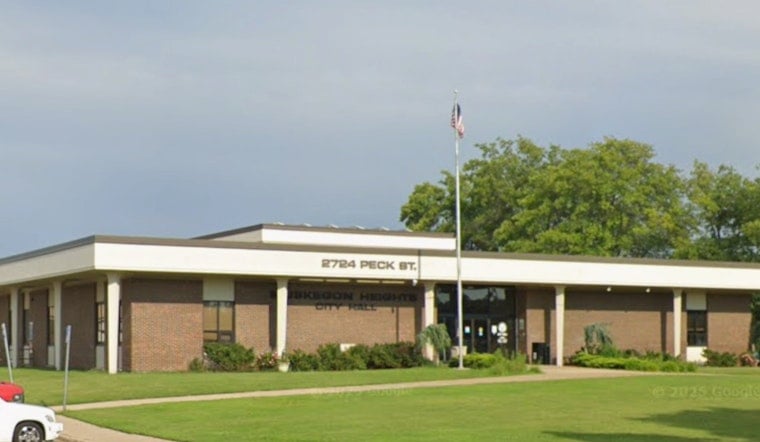
Former Muskegon Heights interim city manager and fire chief Shawnderick Roberson turned himself in Tuesday and was arraigned yesterday on three state felony charges in Muskegon County 60th District Court, including one count of possession with intent to deliver cocaine and two counts of state tax evasion. Newly filed court records now reveal exactly how investigators built the case: hidden spy cameras, phone taps, tracking devices, and repeated monitoring of a suspect's own video doorbell camera.
Court Records Detail Covert Surveillance Methods
Court records filed Wednesday and reported by The Detroit News show that federal agents and Michigan State Police investigators installed spy cameras, hid tracking devices, and built their case with the help of at least one phone tap during the long-running public corruption and drug investigation centered on Muskegon Heights. Investigators also repeatedly monitored an accused kingpin's video doorbell camera as part of the surveillance effort, according to the same court filings, detailed in reporting by Detroit News writer Robert Snell.
The disclosures follow Roberson's arraignment on the three state felony charges, which stem from a multi-agency investigation that included the FBI, DEA, IRS Criminal Investigation, and Michigan State Police. According to WZZM, Roberson turned himself in after local prosecutors authorized warrants stemming from the July 23 raid on Muskegon Heights City Hall.
City Hall Raid Turned Up Cash and Records, Not Drugs
The July 23 enforcement action involved simultaneous search warrants executed at City Hall and four residential locations across Muskegon County, per MIRS. City Hall was temporarily closed while agents carried out the search. Muskegon Heights City Attorney Te D. Smith later confirmed that an itemized search warrant return showed agents seized financial records, wage documents, and cash from the building, but that no illegal drugs were found inside City Hall itself, the station's report notes.
With the state charges now filed, the mayor of Muskegon Heights has terminated Roberson from his municipal roles, according to Michigan News Source. Police Chief Maurice Sain is now serving as acting city manager. Roberson had already been placed on administrative leave immediately after the July raid, before the mayor's decision to remove him entirely following the new charges.
Alleged Ties to a Houston-to-Michigan Drug Pipeline
Federal court records filed in late July identified 58-year-old Muskegon Heights resident Javon Brewer, a real estate business partner of Roberson, as matching the description of an alleged cocaine kingpin. That finding led federal prosecutors to place a forfeiture lien on Brewer's Muskegon Heights home on July 23, the same day as the City Hall raid, per the earlier Detroit News reporting. Public records show Brewer and Roberson jointly owned real estate in Muskegon County.
The investigation also swept up Lakento Smith, a convicted drug dealer whose 30-year federal prison sentence was commuted by President Joe Biden in January 2025. Smith was arrested in July on federal charges of laundering $130,000 in drug proceeds from Houston to Michigan as part of the broader Muskegon Heights probe, according to Law and Crime News. Hoodline previously reported on Smith's re-arrest following the multi-agency raids.
Land Bank Deals and a Years-Long Financial Trail
Public land records spanning 2016 through 2023 show Roberson purchased municipal properties from the Muskegon County Land Bank for as little as $200 to $500 before transferring or partnering on them with Brewer, who resold one of the homes for $86,000 in October 2023. State court dockets opened this week list January 1, 2021, as the alleged offense date for Roberson's cocaine charge, while his tax evasion charges cover tax years spanning 2020 through 2026, according to the Michigan News Source report.
Muskegon County Prosecutor D.J. Hilson said the state felony charges are being brought in conjunction with broader federal indictments from the U.S. Attorney's Office. State investigators are continuing to review hundreds of seized documents for potential additional charges, Hilson told WGVU, signaling that more counts or defendants could still emerge as the review progresses.
A Rare Federal Corruption Push in West Michigan
Federal judicial statistics reported in late July underscore how unusual this level of scrutiny is for the region: only seven individuals have been sentenced to federal prison for bribery or corruption in the Western District of Michigan since 2015, and four of those came from a single medical marijuana licensing board bribery case involving former House Speaker Rick Johnson. That rarity, detailed in the earlier Detroit News coverage, frames just how significant the Muskegon Heights case has become for federal and state investigators alike.
What remains unclear is whether federal grand jury indictments will formally name municipal officials beyond the narcotics figures already charged, how the land bank real estate transfers were authorized in the first place, and what additional evidence may surface from the wiretaps, hidden cameras, and tracking devices deployed during the operation. For now, Muskegon Heights is left without its interim city manager and fire chief, and with a city hall still under the shadow of a federal investigation reaching well beyond its walls.





