

























































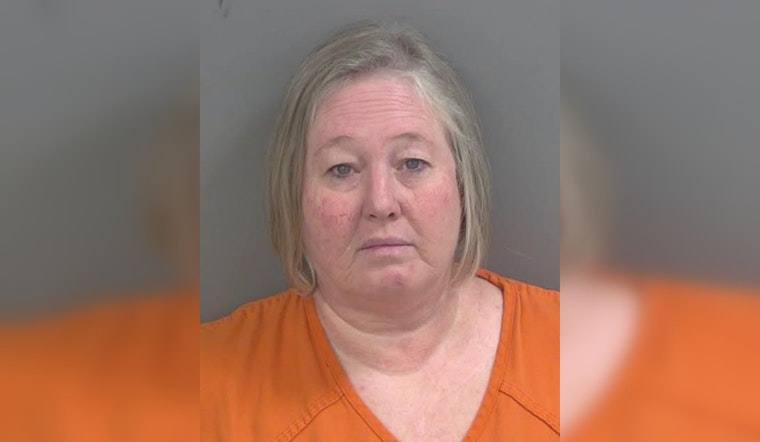
A 51-year-old woman who worked as an activities director for a Naples residential community is accused of faking cancer for years to con 238 of her neighbors out of more than $40,000 in cash, checks and online donations. Maribeth Ellen Jones turned herself in at the Naples Jail Center after detectives obtained a warrant for her arrest, and she now faces a second-degree felony grand theft charge.
According to the Collier County Sheriff's Office, Jones claimed in 2022 and again in 2024 that she had cancer and was undergoing treatment, and told community members her condition was worsening. Residents, believing she was fighting for her life, gave her cash and personal checks directly and also created GoFundMe pages on her behalf, according to the sheriff's office. The GoFundMe page was linked to Jones's own personal bank account, investigators found, and she had also been the beneficiary of two earlier GoFundMe campaigns in which she claimed to have cancer.
Investigators with the Collier County Sheriff's Office allege Jones used the donated money to pay off personal debts. In a detail that underscored how far the deception went, the sheriff's office says Jones had community members cut her hair under the guise of preparing for chemotherapy.
Sheriff Calls Out Breach of Community Trust
Sheriff Kevin Rambosk said the case exploited the kindness and generosity of people who believed Jones was fighting for her life. He said the scam hurts victims financially and undermines trust in legitimate fundraisers, adding that people who lie to steal from generosity in Collier County will be arrested and held accountable, according to the sheriff's office.
The Collier County Sheriff's Office Economic Crimes Bureau, a specialized division that investigates complex financial fraud, embezzlement and major theft cases across the county, led the investigation, per the Collier County Sheriff's Office. Jones lives in Bonita Springs, a Lee County municipality just across the county line from the Naples community where she allegedly ran the scheme for years.
What the Grand Theft Charge Could Mean
Jones is charged with grand theft between $20,000 and $100,000. Under Section 812.014(2)(c) of the Florida Statutes, theft in that dollar range is classified as a second-degree felony, according to Hussein & Webber, PL. A conviction on that charge carries potential penalties of up to 15 years in state prison, 15 years of probation and a fine of as much as $10,000, the firm notes.
Jones's case echoes other cancer-hoax prosecutions elsewhere in the country. In Iowa, 20-year-old Madison Russo pleaded guilty to first-degree theft and was sentenced to probation with $39,000 in restitution after faking pancreatic cancer and leukemia to solicit donations from more than 400 people on GoFundMe, as reported by Newsday. Florida has seen its own version of this scheme before: in Escambia County in 2011, deputies arrested a husband and wife who raised more than $19,000 over six years from church members and friends by falsely claiming the wife had terminal cancer, then spent the money to avert foreclosure and buy a motorcycle, according to NorthEscambia.com.
How Donors Can Try to Get Money Back
For the 238 people who gave to Jones, there may be a path to recovering some of what they lost. Under GoFundMe's Giving Guarantee policy, updated in September 2025, donors who contribute to fraudulent or misused campaigns are covered for full refunds up to one full year after making their donation, GoFundMe states. The platform maintains a zero-tolerance policy toward fraudulent campaigns and cooperates with law enforcement in criminal investigations involving misuse of the site.
The sheriff's office is also using the case to remind the public how to vet fundraisers before giving. Deputies recommend donating directly to the individual, hospital or a verified charity when possible, verifying a fundraiser's story through trusted family members or friends, and reviewing a campaign's comments and donation history. Donors should also watch for updates, documentation and transparency from organizers, and be wary when pressured to donate quickly or when a story cannot be independently confirmed, according to the sheriff's office.
In Florida, charitable solicitations are regulated by the Florida Department of Agriculture and Consumer Services, which requires non-exempt fundraising organizations to register annually and maintains a public Check-A-Charity database that residents can use to verify legitimacy, per Labyrinth, Inc. Florida residents who suspect a charity scam or imposter fraud can file a complaint with that agency or call the Florida Attorney General's Fraud Hotline at 1-866-NO-SCAM, according to My Florida Legal.





