

























































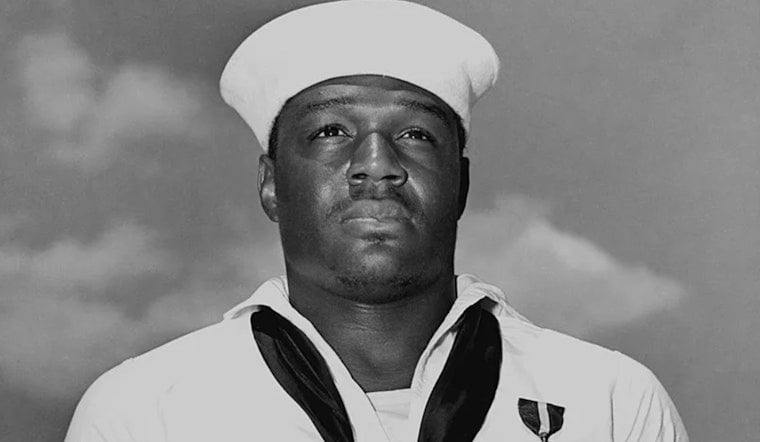
The U.S. Navy is reportedly weighing whether to strip the name of Pearl Harbor hero Doris Miller from an aircraft carrier still under construction and replace it with Donald Trump's, according to a CNN report. The ship, designated CVN-81, was announced in 2020 as the USS Doris Miller, marking the first time the Navy named a supercarrier after an enlisted sailor and the first named for an African American.
News of the potential change has drawn sharp condemnation, including from the Austin American-Statesman, which reported that Miller's family was not informed about the possible renaming, according to Thomas Bledsoe, Miller's great-nephew, who spoke to CNN. Roxanne Evans, quoted in the same report, called any attempt to diminish Miller's role in history “beyond a travesty” and said his place in history should be elevated, not eliminated.
NAACP President Derrick Johnson also condemned the potential change in an August 21 statement, calling the effort to replace Miller's name with Trump's a “slap in the face to every war hero and every service member who has worn the uniform,” according to The Guardian. Naming a carrier after a sitting, living president would be unprecedented in Navy history, as Forbes notes that supercarriers bearing presidential names — such as Gerald Ford, John F. Kennedy, Ronald Reagan and George H.W. Bush — have historically honored past presidents after their terms ended or after their deaths.
Who Was Doris Miller
Miller was born in Waco, Texas, and served as a U.S. Navy mess attendant and cook, one of the few positions open to Black sailors under the Navy's segregation policies of the era, per the Austin American-Statesman's reporting. During the December 7, 1941 attack on Pearl Harbor, Miller was aboard the battleship USS West Virginia when he carried wounded crewmates to safety and manned an unassigned .50-caliber anti-aircraft machine gun he had never been trained to operate, according to Newsweek.
Accounts of exactly how many Japanese planes Miller downed vary: some reporting credits him with shooting down as many as four planes, while other accounts describe at least one confirmed kill. On May 27, 1942, Admiral Chester Nimitz, then commander in chief of the Pacific Fleet, personally pinned the Navy Cross on Miller aboard the USS Enterprise at Pearl Harbor, making him the first African American recipient of the award, according to the Commemorative Air Force. Miller later took part in war bond tours before returning to sea duty aboard the escort carrier Liscombe Bay, which was torpedoed on November 24, 1943; Miller was initially listed as missing in action following the sinking.
A Legacy Carried By Schools, Roads and a Frigate
The Navy has honored Miller once before, naming a Knox-class frigate the USS Miller (FF-1091), which was built at Avondale Shipyards, commissioned in June 1973, and served until its decommissioning in October 1991, per the Naval History and Heritage Command. Schools, roads, military assets, veterans groups and community centers across the country have also been named after Miller, including an auditorium in Rosewood Park in Austin, where construction began in 1944 after Miller's death. The Austin American-Statesman reports that Tom Miller likely helped name the venue, changing it to Doris Miller Auditorium after Bertha Sadler Means requested it, with Lyndon Johnson also likely involved in the decision.
For years, Miller's family has pushed for him to receive the Medal of Honor, the nation's highest military award, upgrading his existing Navy Cross. Bledsoe called the Navy's recommendation of the Medal of Honor “very positive,” though the family was also not informed about the renewed push, he told CNN. Awarding the honor posthumously would require Congress to pass a statutory waiver bypassing the standard five-year time limit on military valor recommendations, with final authorization resting with the president, according to Forbes.
Legal Authority and a Ship Still Years From Completion
Under Title 10 of the U.S. Code and statutory traditions dating back to 1819, legal authority to name or rename Navy warships rests with the Secretary of the Navy, subject to direction from the president and secretary of defense, according to Task & Purpose. An August 13 White House presidential memorandum on naval shipbuilding referred to the carrier strictly by its hull designation, CVN-81, rather than USS Doris Miller, while also ordering technical redesigns — including reinstating steam catapults in place of electromagnetic launch systems and changing the position of the island control tower, changes Trump has suggested, per Forbes.
The carrier, built by Huntington Ingalls Industries' Newport News Shipbuilding in Virginia, is scheduled for its keel-laying later this year, with a commissioning target delayed to February 2034, according to 19FortyFive. That timeline leaves lawmakers and Navy leadership years to resolve the ship's official name before it enters service. It remains an open question whether Congress would pass a waiver to grant Miller the Medal of Honor as a form of compromise, and whether the Navy might reassign his name to another carrier or a smaller surface warship if CVN-81 is ultimately renamed.





