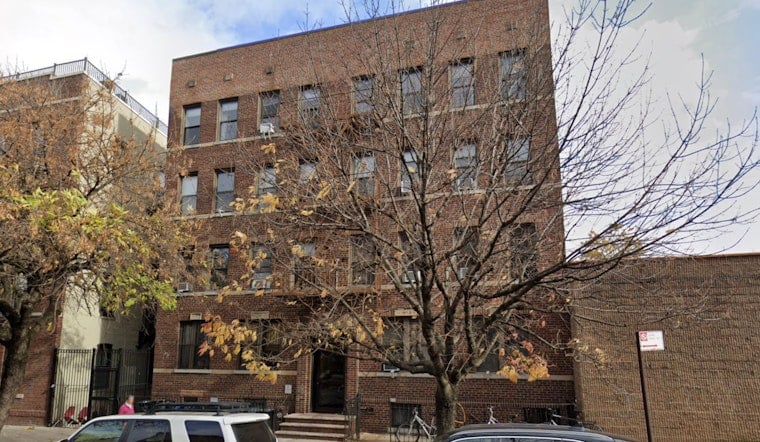
The developer behind Windsor Terrace's most contentious residential project has changed hands, and the new owner is restructuring the plan in a way that sidesteps a state wage law while expanding the site's housing count to more than 396 units. Goose Property Management has acquired the rezoned Arrow Linen site at 441 Prospect Avenue from Apex Development, which had spent years negotiating with the community before abandoning the project because, as Apex's Andrew Esposito put it, “the economics don’t work for us.”
Goose has filed plans for four ten-story residential buildings on the property rather than the single structure Apex had proposed, according to The Real Deal. Splitting the project into four 99-unit towers instead of one 396-unit building lets Goose avoid New York's 485-x wage floor, which requires developers of buildings with 100 or more units to pay construction wages of at least $40 per hour to qualify for a property tax abatement, as detailed by Nixon Peabody LLP. The result is a project that has nearly doubled in scale from what Windsor Terrace residents and Councilmember Shahana Hanif originally signed off on.
A Compromise Built on a Different Set of Numbers
The site's history explains why the shift matters so much locally. Apex won City Council approval in 2025 to rezone the property for a 250-unit residential building, a deal that came only after Hanif persuaded the company to cut the project from 13 floors down to 10. Apex also agreed to make 100 units affordable to households earning an average of 60 percent of area median income, part of a broader package detailed in coverage from City & State New York that also secured discounted space for local non-profits, including Sakhi for South Asian Women, and a community childcare center.
That compromise followed sustained pressure from the community. Brooklyn Community Board 7 voted overwhelmingly in September 2024 to recommend disapproval of Arrow Linen's initial rezoning application, demanding the property owner retract the filing and pursue more transparent engagement, according to a filing reviewed by the NYC Council. Local group Housing, Not Highrises had formed in 2023 specifically to fight the original high-density plans, pushing for a 7-to-9 story cap and demanding environmental remediation over potential asbestos and chemical contamination tied to the site's century of industrial laundry use near three neighborhood schools.
Now Goose Wants to Nearly Double the Deal
Under Goose's revised structure, the developer plans to keep about 100 units affordable and make roughly 25 percent of the total unit count affordable — a lower share than the 40 percent affordability level Apex had negotiated for a smaller building. Per The Real Deal, affordable-unit negotiations remain ongoing, according to Moshe Weisberg, director of construction at Developing NY State, the sister company handling construction on the project. Goose's units will include studios and two-bedroom apartments, and construction is expected to take about 18 months once underway.
The company behind the pivot has been expanding quickly across Brooklyn. Goose Property Management, led by Yitzchok Katz — son-in-law of Isaac Rabinowitz, who is associated with Rabsky Group — has become a major Brooklyn developer in recent years. It broke ground in April on a $166 million, 367-unit rental complex spread across connected 11-story buildings at 280 Bergen Street and 265 Wyckoff Street in Boerum Hill, as Hoodline previously reported. The firm also expanded its land holdings in August 2025 by purchasing an industrial lot at 264 Butler Street for $15.3 million, adjacent to a $22 million Gowanus assemblage it acquired in late 2024, according to PincusCo.
Arrow Linen's Century on the Block
The Arrow Linen Supply Company, founded in Brooklyn in 1947 by Sicilian immigrant Ambroglio Magliocco, has provided clean uniforms, linens, towels and aprons to restaurants and hotels across New York and New Jersey. Its warehouse has occupied the Prospect Avenue site for decades, with the broader industrial laundry use on the block dating back roughly a century. The company plans to move its laundry operations elsewhere, and its facility will be partially demolished, though architect Hamish Whitefield, who designed the project building, has incorporated parts of the original Arrow Linen warehouse into the new design.
Before the rezoning, the parcel was governed by low-density rules dating to the 1989 Windsor Terrace Rezoning and the 2005 South Park Slope Rezoning, both of which capped the surrounding blocks at R5B low-rise residential and industrial designations, according to filings reviewed by the NYC Council. Once the land was rezoned, New York City's Mandatory Inclusionary Housing rules — in place since 2016 — required that 25 to 30 percent of residential space on the upzoned site be designated permanently affordable, setting the statutory floor beneath which any developer's negotiations would have to land.
Community Task Force Watches the Handoff
As part of the original deal, Hanif secured an agreement to create a task force of residents and local stakeholders meant to ensure neighbors have a meaningful voice in delivering permanently affordable housing to Windsor Terrace. That task force has already met at Giovanni's restaurant to share concerns directly with the developer. Restaurant owner Giovanni Tafuri, who is involved with the group, said of new projects coming into the neighborhood, “Anything that comes in new, we want to be able to understand what it’s about and what it’s going to be bringing to us and what it’s going to add to the community and the neighborhood.”
Housing, Not Highrises had earlier vowed to support Hanif's 2025 reelection opponent, Maya Kornberg, if the buildings exceeded nine stories — a threat that did not stop Hanif from winning reelection that year. Whether the same coalition will mobilize again now that Goose has restructured the project into four towers, and whether the task force or Hanif's office will push back on the near-doubling of density or the lower affordability share, remains to be seen; the dossier does not indicate a response yet from either party. The broader pattern is not unique to Windsor Terrace: a July 2026 analysis from Vital City found that since 485-x took effect, nearly all private mixed-income residential filings in New York City have been capped below 100 units as developers reconfigure projects citywide to avoid the law's elevated wage mandates.