

























































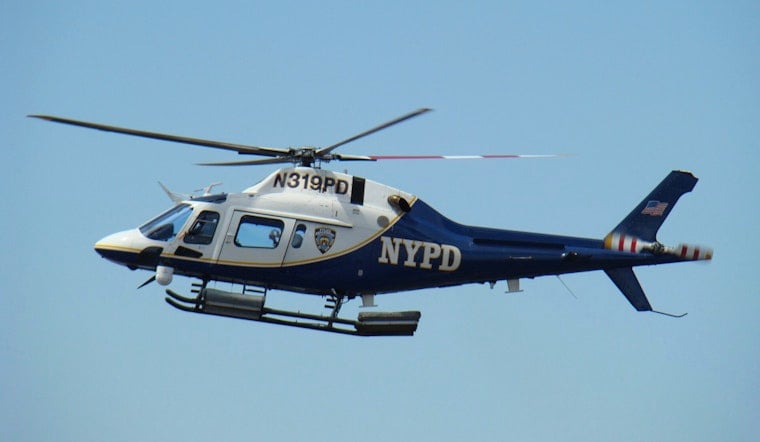
A 64-year-old woman got stuck in dense, impassable brush between Flatbush Avenue and Dead Horse Bay near the Marine Parkway Bridge on Sunday, and had to be pulled out by an NYPD helicopter crew that lowered an officer down to reach her. She was not injured, police said.
The woman called 911 at 2:25 p.m. after realizing she could not find her way back out of the overgrown parkland trails that lead toward Glass Bottle Beach, according to New York Daily News. A 911 dispatcher relayed that the area was impassable and that officers should drop a rescue basket, per the same account. The NYPD sent a police helicopter to search for her, and the crew soon spotted her from the air.
A Rapid Response From Across the Street
“We got good eyes on her right now,” an Aviation Unit officer said as the helicopter closed in, the outlet reported. An NYPD officer was lowered from the helicopter and was hoisted back up with the woman holding onto him, bringing the ordeal to a close. NYPD News posted video of the rescue on X on August 5, and photographer Theodore Parisienne captured images of the woman being airlifted to safety.
The quick turnaround owes something to geography. The NYPD Aviation Unit is based at Floyd Bennett Field, located directly across Flatbush Avenue from Dead Horse Bay, which allows the unit to reach emergencies across New York City within 8 to 10 minutes, according to Wikipedia. Formed in 1928 as the oldest municipal police air unit in the country, the unit took on expanded maritime search-and-rescue duties across New York Harbor after a 1998 agreement with the U.S. Coast Guard, per Vertical Magazine, which notes the unit flies twin-engine helicopters equipped with searchlights, infrared sensors and hoist rescue gear.
Why the Marshland Is Officially Off-Limits
Dead Horse Bay sits within the Jamaica Bay Unit of Gateway National Recreation Area, spanning 178 acres of federal land near the Marine Parkway Gil Hodges Memorial Bridge, which connects Brooklyn to the Rockaway Peninsula, according to the National Park Service. The bay got its name in the 1850s, when more than two dozen horse-rendering plants, fish-oil factories and garbage incinerators operated on nearby Barren Island, boiling down dead draft horses from city streets and dumping chopped bones straight into the water, per Smithsonian Magazine.
In the early 1950s, the city filled the bay's southern marshlands with compacted mounds of Queens and Brooklyn garbage capped with sand topsoil. That cap burst later in the decade, and the eroding landfill has been spilling vintage bottles and household debris onto the shore ever since, creating what beachcombers now call Glass Bottle Beach, Smithsonian Magazine reported. The site's mid-century junk still draws curious visitors despite the hazards buried beneath it.
Radiation Cleanup Has Kept the Area Closed Since 2020
Radiological waste was found at Glass Bottle Beach in 2020, and the National Park Service closed 84 acres of the southern portion of Dead Horse Bay that August after surveys detected leaking military deck markers containing radium-226 buried in the soil. As of 2025 and 2026, the agency continues to maintain that closure under a federal Comprehensive Environmental Response, Compensation, and Liability Act cleanup framework while it carries out multi-phase soil and groundwater sampling. Just weeks before the woman's rescue, the Park Service reissued a public safety alert in July warning that the southern area of Dead Horse Bay and Glass Bottle Beach remains closed to the public because of hazardous overgrown terrain and ongoing radiation cleanup activity.
The closure has not stopped people from wandering in. Despite the explicit federal restrictions and repeated safety alerts, visitors continue to push past overgrown trails into the impassable brush that trapped Sunday's stranded woman, putting themselves at risk in a zone still undergoing environmental investigation.
Not the First Air Rescue Near Floyd Bennett Field
This is not the only recent emergency requiring NYPD aerial extraction near Floyd Bennett Field. In February, the NYPD Aviation Unit and FDNY pulled three men from icy Jamaica Bay waters, deploying helicopters and scuba divers in a similar show of the unit's air-sea rescue capability. Jamaica Bay's wetlands and shifting tides have repeatedly forced specialized interventions in the waters surrounding the base.
Floyd Bennett Field itself has been at the center of other federal land disputes in recent years, including a 2,000-person migrant emergency shelter that closed in early 2025 and a 10-year Department of the Interior lease signed that March for energy infrastructure. Those episodes, paired with the ongoing radiation cleanup next door at Dead Horse Bay, leave park authorities with an unresolved challenge: how to keep people out of wide, dense federal marshland that keeps luring off-the-beaten-path explorers toward its hazardous shoreline.



