

























































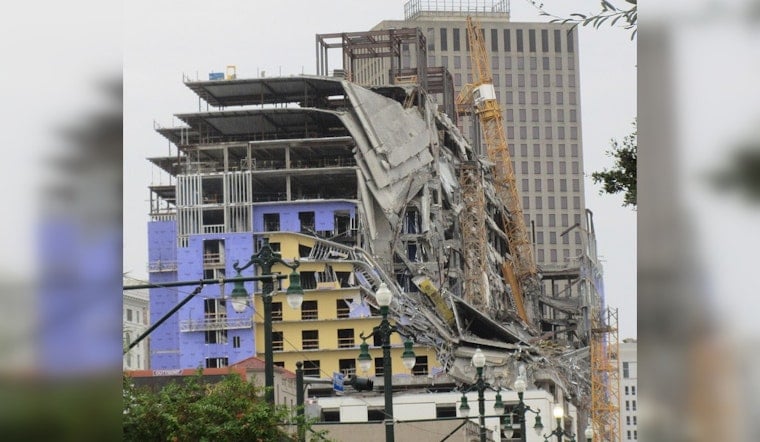
Nearly seven years after the Hard Rock Hotel construction site pancaked onto Canal Street, an Orleans Parish judge has signed off on a $106 million settlement covering nearly 500 people who say the disaster upended their lives. The deal, finalized Thursday, closes out more than a dozen lawsuits filed against the hotel's developer and 20 other defendants over the October 2019 collapse that killed three workers and injured hundreds more.
Orleans Parish Civil District Court Judge Kern Reese signed the settlement agreement, according to NOLA.com. The fund is designated for 490 victims, including injured construction workers, families of the deceased, and local business owners whose operations were shuttered when the collapse shut down commerce on surrounding streets for months. More than 130 lawsuits were originally filed against 1031 Canal Development, general contractor Citadel Builders, subcontractors and insurance companies in the wake of the disaster.
John Perry, based in Baton Rouge, will evaluate victims' claims and determine each eligible payment, per the same account. A distribution timeline for the settlement checks has not been determined. Attorney Mark Glago, who represented 200 victims and co-chaired the committee that negotiated the settlement alongside Walt Leger II, called it a significant sum that may bring some solace to victims' families.
A Deal Years in the Making
Settlement talks began in 2023, and plaintiffs reached a tentative agreement with 1031 Canal Development last fall, the report notes. Leger said every outstanding case tied to the collapse has now been resolved. The hotel developer, owned by Mohan Kailas and his family, will still receive financial compensation from the broader settlement, though its own share of the payout to victims will come from a separate fund contributed by the other defendants rather than the $106 million pool itself.
The building that collapsed was an $85 million project under construction at the intersection of Canal and Rampart streets. The structural failure caused the top three floors to pancake down onto the floors below, killing Jose Ponce Arreola, Anthony Magrette and Quinnyon Wimberly. Families of the deceased workers settled their own wrongful-death lawsuits in 2024, with payouts going to the workers' children; the amount of those settlements was not disclosed publicly.
Angela Magrette, whose husband Anthony was among the three killed, told NOLA.com she is glad other victims will finally receive money, but said her family still carries an open wound. She said the settlement does not serve justice.
Federal Investigators Pinpointed Design Flaws
An engineering investigation by the U.S. Occupational Safety and Health Administration determined that 81 structural steel beams on the 16th floor failed to meet basic design codes, leaving the upper three floors susceptible to collapse, according to WWL-TV. In April 2020, OSHA cited Heaslip Engineering, Suncoast Projects and Citadel for their roles in the disaster, fining the three companies a collective $220,000, part of a broader $306,000 in penalties levied against 11 companies involved in construction, as reported by ENR. Heaslip alone accounted for roughly $154,214 of that total for willful and serious violations in designing load-bearing steel connections.
Separately, lawsuits filed by victims in early 2020 alleged that contractors submitted pile load test results to the city that had been fraudulently taken from an entirely different construction project altogether, according to Construction Dive. Investigations by local journalists and the New Orleans Office of Inspector General further found that three city building inspectors had filed reports approving work at the site without ever physically visiting the property, WWL-TV has reported.
No Criminal Charges Were Ever Filed
Despite the scale of the failures uncovered, no criminal charges were filed in connection with the disaster. In October 2023, an Orleans Parish grand jury and the district attorney declined to indict any individuals or companies involved in the project, ending a four-year criminal review, per Construction Dive. That left civil litigation as the only avenue of accountability for the developers and contractors, and the $106 million settlement now represents the conclusion of that process.
The collapse also triggered a chaotic emergency response. In October 2019, crews used controlled explosive detonations to bring down two damaged tower cranes, more than 270 feet tall, that dangled precariously over the ruined building; one of the cranes crashed onto Rampart Street and severed a municipal sewer line, according to Fox Business. Due to the extreme structural instability of the wreckage, the bodies of Wimberly and Ponce Arreola remained trapped inside for 10 months before recovery teams were able to secure them in August 2020.
The disaster also had a human cost beyond the building itself. Honduran worker Delmer Joel Ramirez Palma, who was injured in the collapse after repeatedly warning supervisors about sagging floors and structural movement, was arrested by ICE two days later and deported in November 2019, despite public pleas from local officials and workplace safety advocates, The Guardian reported at the time.
What Happened to the Site
The former construction site was cleared after the collapse but has not been redeveloped, NOLA.com notes. To reach the main collapse zone and retrieve victims' remains, New Orleans fire officials issued emergency orders in May 2020 to demolish three adjacent historic buildings along Canal and Iberville streets, according to ENR. Nearby businesses that had been shuttered for months eventually reopened once the site was stabilized.
In July 2025, the city's Central Business District Historic District Landmarks Commission unanimously designated 1031 Canal Street a historic landmark, commemorating both its 1960 Woolworth lunch counter Civil Rights sit-in history and the collapse victims, as Hoodline previously reported. That designation gives the city long-term oversight of the site's redevelopment and lays groundwork for a permanent worker memorial, even as this week's settlement closes the book on the legal fight that followed one of New Orleans' deadliest construction disasters.





.jpg)