

























































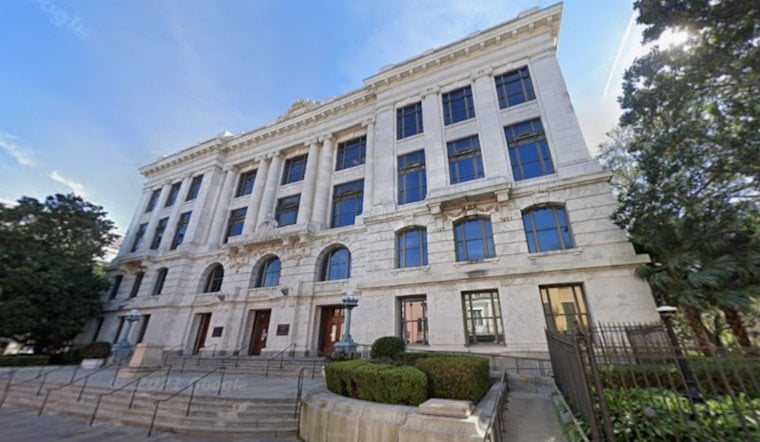
A Louisiana appeals court has thrown out two 30-year-old murder convictions against a New Orleans man, ruling that authorities failed to turn over key evidence tied to one of the city's most notorious corrupt police officers before his 1995 trial. Manuel Nelson, now 56, had been serving two life sentences for the July 1994 killings of Edward Elbert “Little” Wynn and William Henry “Peewee” Jones, both shot inside the Florida housing development within six days of each other.
The Louisiana Fourth Circuit Court of Appeal issued its ruling on Wednesday, granting Nelson's writ application and reversing a February denial from the Orleans Parish Criminal District Court, according to NOLA.com. Orleans Parish Criminal District Court Judge Robin Pittman had previously ruled that Nelson failed to show the undisclosed evidence would probably have produced a different verdict, but the three-judge appellate panel of Paula Brown, Dale Atkins and Rachael Johnson disagreed, finding that authorities withheld contemporaneous police notes, supplemental reports, a previously undisclosed ballistics report, post-conviction witness statements and FBI wiretap transcripts. Per court filings reviewed by NOLA.com, the court found that the involvement of former NOPD officers Len Davis and Sammie Williams in the original investigation raised, in the panel's words, the specter of corruption.
Nelson was tried and convicted of both murders at once in 1995, but wiretap recordings captured Davis and Williams discussing the killing of Peewee Jones and a shooting two days later in which Nelson himself was the victim. Per one wiretap cited by the appeals court, Davis and Williams agreed that Nelson's co-defendant, Lawrence Peters, had committed one of the killings alone — with Davis confirming that Peters killed the man by himself, and Williams, when asked, simply replying “yeah.” Peters is currently serving a life sentence. The appeals court also found that Williams tried to blame the killing on Nelson, and that per a Sammie Williams wiretap, it was Peters who killed Jones.
A Star Witness With Ties to the Lead Detective
The case against Nelson leaned heavily on testimony from a state star witness who, according to the appeals court findings, was dating the lead New Orleans police detective at the time of the trial. That same witness had initially told police she was asleep during one of the murders before later identifying Nelson. A different witness said the lead detective pressured her to identify Nelson as well. The appeals court also noted that Williams was at the scene of one of the killings before emergency responders arrived, in the days after the shootings in July 1994.
Wynn was shot 18 times; Jones was shot 15 times, per the NOLA.com report. An Orleans Parish District Attorney's Office spokesperson said in a statement that the wiretap recordings raised serious concerns, though the spokesperson also noted that the wiretap evidence relates to only one of Nelson's two charges. The DA's office had opposed Nelson's petition for post-conviction relief but now says it will decide whether to appeal the ruling, and plans to consult with the victims' next of kin and defense counsel in the coming week. Nelson's attorneys, William Quigley and Blythe Taplin of the Center for Social Justice at Loyola University New Orleans College of Law, declined to comment.
The Shadow of Len Davis and Operation Shattered Shield
Davis and other officers were suspected of running a protection racket for drug dealers at the time, an allegation that surfaced through the FBI's Operation Shattered Shield, an undercover probe into NOPD corruption. Davis is infamous in New Orleans as the officer convicted of ordering the October 13, 1994 execution of Kim Groves, a 32-year-old Ninth Ward woman who had reported Davis and Williams for police brutality. Groves was killed the same day Richard Pennington was sworn in as NOPD superintendent. President Joe Biden commuted Davis' federal death sentence to life in prison in 2024, one of 36 other federal death row prisoners whose sentences Biden commuted that year, as Hoodline previously reported. Williams, who agreed to cooperate with the government, ultimately received a five-year sentence.
Nelson's case is not the first to unravel because of Davis and Williams' fingerprints on a 1990s homicide investigation. In October 2022, a different Orleans Parish judge vacated the murder convictions of three other men, Kunta Gable, Leroy Nelson and Bernell Juluke, after prosecutors revealed Davis and Williams had suppressed evidence and framed suspects in a separate case tied to the Desire housing project; those three men had served 28 years before their release. The Orleans Parish DA's office created a dedicated Civil Rights Division in January 2021, led by former Innocence Project New Orleans director Emily Maw, specifically to re-examine convictions tainted by corrupt officers like Davis.
A City Reeling From Violence and a Broken System
The murders of Wynn and Jones occurred during New Orleans' deadliest year in modern history, when the city recorded 424 killings and the NOPD faced national scrutiny over brutality complaints. Nelson's convictions also came during former District Attorney Harry Connick Sr.'s decades-long tenure, an era marked by multiple murder convictions overturned for prosecutors withholding evidence from the defense. It remains an open question whether the Orleans Parish DA's office, now led by Jason Williams, will seek to retry Nelson decades later, appeal the ruling to the Louisiana Supreme Court, or dig into other 1990s cases connected to Davis and Williams. For now, the office says it intends to talk with victims' families and defense attorneys before deciding its next move.





