

























































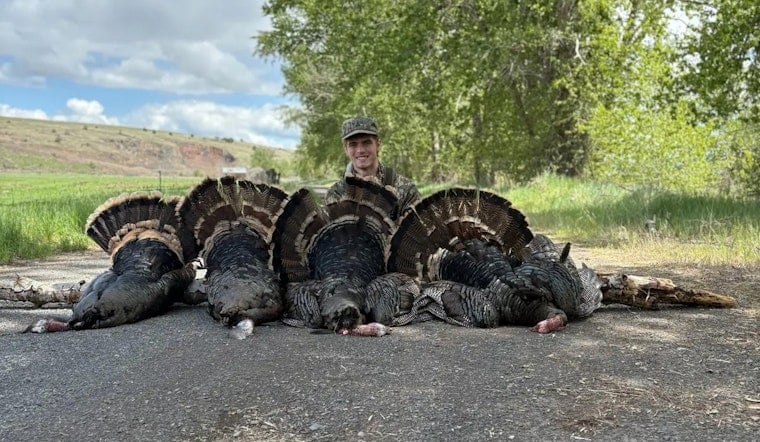
A 21-year-old New Philadelphia man has been ordered to post a public apology on his own TikTok account after pleading guilty to 17 wildlife charges tied to a poaching operation that stretched across 17 states. Carter J. Hickey was sentenced in New Philadelphia Municipal Court to 15 days in jail, two years of probation, an 80-hour community service requirement, and a five-year ban from hunting and trapping.
The sentence, first detailed by The Columbus Dispatch, also requires Hickey to pay a combined $28,500 in court-ordered restitution, fines and extra penalties. That total includes more than $12,000 in restitution, $11,000 in extra penalties, $5,500 in fines, and a separate $5,000 contribution to Ohio's Turn In a Poacher program. According to the U.S. Fish & Wildlife Service, which announced the case on August 4, wildlife officers seized 115 pounds of wild turkey meat and 47 whole or partial turkey fans from Hickey during the investigation, along with three forfeited firearms, a bow, hunting blinds, decoys and other gear.
Investigators say the case began in May 2025 after both the U.S. Fish & Wildlife Service Office of Law Enforcement and the Ohio Department of Natural Resources Division of Wildlife fielded a surge of complaints about Hickey's activity. Officers determined he had taken wildlife during closed seasons, spotlighted and killed animals with help from a motor vehicle, hunted without permission, allowed over-the-limit turkey takes, and helped others poach turkeys without licenses. He also unlawfully took a 10-point buck in a public park and trespassed in the city of Dover, for which he must write a letter of apology to the city, in addition to failing to follow game-check rules and illegally possessing animals.
Social Media Bragging Drew Scrutiny
Per the Fish & Wildlife Service, Hickey posted false information about his hunting activities on TikTok and bragged about his skills despite the illegal methods behind them. As part of his sentence, he must now post an apology to that same TikTok account — a penalty that mirrors a growing pattern of courts using offenders' own social platforms against them.
Wildlife wardens investigating similar cases have pointed to social media as a key driver of modern poaching. Investigators cited by Outdoor Life identified view counts and potential corporate sponsorships as the primary commercial motivation behind recent online poaching cases, noting that high-scoring buck videos generate engagement that creators can leverage into sponsor payouts.
Statewide Hunting Ban Follows Him Everywhere
Hickey's five-year hunting and trapping ban will not be limited to Ohio. Under the Interstate Wildlife Violator Compact, hunting license revocations issued in one member state are recognized and enforced by nearly all 50 states, according to the Oklahoma Department of Wildlife Conservation, since member agencies share conviction databases to keep suspended hunters from buying licenses elsewhere. That means Hickey is effectively barred from legal hunting nationwide until the ban lifts.
Ohio law also allows steep civil restitution for illegally taken trophy deer. Under a formula from the Ohio Legislative Service Commission, deer scoring over 125 gross antler inches trigger restitution calculated as the gross score minus 100, squared, then multiplied by $1.65 — on top of base fees. The Ohio Supreme Court has upheld the formula as a way to reflect the economic and biological value of trophy wildlife to the state.
Part of a Wider Ohio Crackdown
Hickey's case is the latest in a string of Ohio poaching prosecutions tied to online content. Two other central Ohio men, 28-year-old William Bethel of Columbus and 23-year-old Justin Booth, also 23 and from Columbus, pleaded guilty to 20 misdemeanors each in Franklin County Municipal Court after running the Creek Kings Outdoors YouTube channel, a case Hoodline previously reported. A joint ODNR and Metro Parks probe found the pair poached deer in Three Creeks Metro Park and other properties without permission between 2019 and 2024, at times posting videos of the poached deer and claiming the animals had actually been harvested in Kentucky. An investigation determined the deer were in fact unlawfully harvested in Ohio.
Bethel and Booth were sentenced to five years of probation, a five-year ban from hunting, fishing and trapping, and a five-year ban from Columbus and Franklin County Metro Parks properties. They were ordered to pay nearly $30,000 combined in restitution and more than $37,000 combined when court costs, fines and fees are included, with 531 additional jail days suspended. As reported by 10TV WBNS, the pair will serve nine days in jail specifically during the 2026–2027 hunting season, timed to keep them out of the field during peak months. Three additional defendants connected to that case lost their firearms and a combined two years of hunting privileges, and were fined $5,000 combined.
Ohio's Turn In a Poacher program, which received Hickey's $5,000 court-ordered contribution, has operated a 24/7 anonymous tip hotline since 1982, funded by public donations and court-mandated violator penalties, according to the Buckeye Firearms Association. The program works alongside the Ohio Division of Wildlife to reward citizens whose tips lead to convictions — the same kind of public reporting that first exposed Hickey's activity.
Fits a Broader Pattern of Multi-State Busts
The Hickey and Creek Kings cases follow other recent Ohio poaching prosecutions. In April, a separate two-year Ohio Division of Wildlife investigation led to convictions for 11 individuals, including five Michigan residents, in an undercover deer-poaching sting that Hoodline covered in a story headlined 5 Michigan Hunters Nailed. And in early 2025, a South Carolina man pleaded guilty in Knox County to 12 wildlife counts tied to spotlighting and vehicle-assisted hunting, forfeiting gear and paying over $4,000 in restitution.
Taken together, the cases point to a pattern wildlife officers are increasingly leaning on: using poachers' own uploaded video content as courtroom evidence while coordinating investigations across state lines. Enforcement challenges remain, though, particularly in monitoring sprawling public parks, managing urban wildlife borders, and tracking multi-state hunting networks that operate largely out of sight until a tip or a careless upload gives them away.



