

























































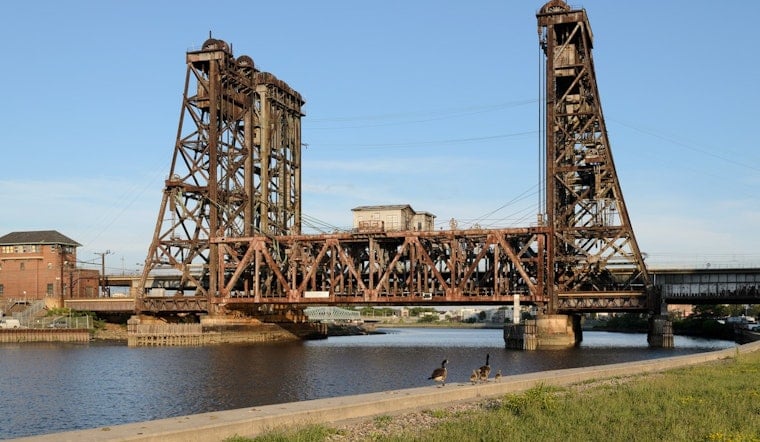
Amtrak has kicked off a $93 million rehabilitation of Newark's Dock Bridge, the 91-year-old triple-span structure over the Passaic River that carries an average of 720 train crossings a day for Amtrak, NJ Transit, and PATH. The work, awarded to contractor Skanska and already underway earlier in 2026, will permanently lock the bridge's three vertical-lift spans in place, ending their era as moveable structures.
The rehabilitation is part of the broader Gateway Program, the roughly $16 billion package of Northeast Corridor infrastructure initiatives aimed at boosting capacity, resiliency, and efficiency between New Jersey and New York City, as reported by Jersey Digs. Skanska's $93 million contract with Amtrak covers a long list of physical upgrades: jacking the bridge's existing counterweights and installing permanent counterweight supports, rehabilitating concrete piers, replacing catwalk railings, removing the current fender system, and modifying traction power systems and miter rails. The company will also support Amtrak's own force account work on the span, according to the same report.
Locking the Lift Spans for Good
Central to the project is the decommissioning of Dock Bridge's movable spans, which will be secured in a fixed position rather than continuing to operate as vertical lifts. That shift would convert the three moveable lift spans into a permanently fixed bridge. When closed, the bridge maintains a 24-foot vertical clearance over the river, rising to 135 feet when lifted — but marine lift requests grew so rare that the bridge went a full decade before 2014 without a single lift, the outlet notes. Converting the movable spans into fixed structures eliminates a major mechanical vulnerability while capitalizing on that steep decline in river navigation to cut ongoing maintenance costs.
Dock Bridge itself is a six-track, triple-span movable lift bridge, with three parallel vertical-lift spans carrying six passenger rail tracks along Amtrak's Northeast Corridor between Newark and Harrison. The structure opened in March 1935 with a 230-foot lift span on its initial west side that was, at the time, the longest three-track lift span in the world, according to HistoricBridges.org. Designed by consulting engineering firm Waddell & Hardesty based on patents by Dr. J.A.L. Waddell, the bridge earned a spot on the National Register of Historic Places in October 1980. A second pair of spans followed in 1937 to carry Hudson & Manhattan Railroad — now PATH — and Pennsylvania Railroad joint passenger service, a shift that let the Pennsylvania Railroad shut down its Manhattan Transfer station in the Kearny meadows, per Bridges and Tunnels. According to the National Park Service, Dock Bridge over the Passaic River in Newark was constructed in 1935 by Waddell & Hardesty, Consulting Engineers.
Skanska's Expanding Footprint on the Corridor
Skanska is no stranger to this stretch of the Northeast Corridor. The firm is also partnering with Amtrak on the Portal North Bridge replacement and demolition project in Secaucus, and on the Sawtooth Bridges replacement project in Kearny, per the Jersey Digs report. Skanska previously won a $1.56 billion contract from NJ Transit in October 2021, in joint venture with Traylor Bros., to build the new fixed-span Portal North Bridge over the Hackensack River — a project replacing a failure-prone, 111-year-old swing span, according to FOX 5 NY. In December 2024, Amtrak selected a joint venture of Skanska, Walsh Construction, and Herzog to handle pre-construction work on the $1.35 billion Sawtooth Bridges Replacement Project, a 1.9-mile segment in Kearny that will replace bridges built in 1907 and expand track capacity to four tracks.
Michael Donohue said the Dock Bridge rehabilitation will deliver safer and more efficient operations on a busy rail corridor, according to Jersey Digs. Gateway tunnel work has also begun in Hudson County as part of the same program, which is set to create two new tunnels under the Hudson River leading to Penn Station in New York City. The Dock Bridge rehabilitation is expected to be completed by the end of 2028 and will extend the life of the bridge, though the broader Gateway Program itself is not expected to be completed before 2035.
Federal Budget Trims Shaped the Project
The scope of the Dock Bridge work was reshaped well before construction began. In April 2025, the U.S. Department of Transportation and Federal Railroad Administration cut federal grant funding for the project from $375 million to $235 million, trimming $140 million by prioritizing structural safety over aesthetic upgrades, as Hoodline previously reported. That funding flows through the Federal Railroad Administration's Federal-State Partnership for Intercity Passenger Rail Program, which was expanded under the 2021 Bipartisan Infrastructure Law and awarded more than $16 billion in 2023 for Northeast Corridor state-of-good-repair projects, per the Federal Railroad Administration. According to the Federal Railroad Administration, the NEC's preferred modernization alternative is intended to bring the corridor to a state of good repair by replacing or renewing aging infrastructure and eliminating the backlog.
Amtrak statistics show that the Dock Bridge carries over 200,000 daily intercity and commuter passengers across more than 700 train movements operated by Amtrak, NJ Transit, and PATH between Newark Penn Station and Harrison — underscoring how much is riding on the aging structure's reliability. But fixing bridges like Dock, Portal North, and Sawtooth solves only part of the region's rail bottleneck. New York Penn Station's platform and track capacity could become the network's next chokepoint as Gateway Program projects increase trans-Hudson train volume without expanding the station's physical footprint — a concern Hoodline detailed in its report on how the Manhattan hub could become the network's next chokepoint.





