

























































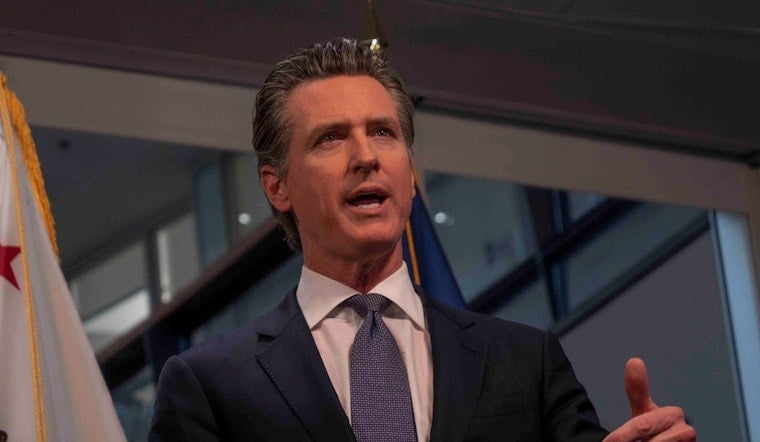
Governor Gavin Newsom stood at a San Francisco press conference and called Trump Accounts, the federal child savings program named for President Donald Trump, one of the best things the president has ever done. It was a striking moment of bipartisan praise from a governor known for sparring with the administration, and it came as California pushes its own residents to sign up for both the new federal accounts and the state's existing CalKIDS program.
Newsom said Trump Accounts are among the best things Senators Ted Cruz and Cory Booker have done, according to the New York Post, crediting both lawmakers for promoting the accounts. He was joined at the event by his wife, Jennifer Siebel Newsom, San Francisco Treasurer José Cisneros, and venture capitalist Brad Gerstner, who pushed for the tax-advantaged children's investment accounts through his nonprofit, Invest America. Newsom went further still, saying Trump Accounts were one of the outstanding things the Trump administration has done and adding that Trump became president for a reason and knows how to brand himself.
The governor also couldn't resist a bit of envy over the branding itself. Newsom joked that he wished California's own program had been called Newsom Accounts, and mused separately that calling the federal program Newsom Accounts would have generated controversy and attention. Still, he encouraged people to obtain a Trump Account regardless of their views of the president, saying he was enthusiastic about encouraging people to get one.
How the Federal Accounts Work
Trump Accounts were included in the One Big Beautiful Bill and formally established under Section 530A of the Internal Revenue Code, according to the U.S. Department of Labor. The accounts function as tax-deferred child IRAs that automatically convert to standard traditional IRAs on January 1 of the year the beneficiary turns 18. Any U.S. citizen with a child aged 18 or under can open one, and parents, guardians, family members, and employers can contribute up to $5,000 annually.
Children born between January 1, 2025 and December 31, 2028 are eligible for a free $1,000 government deposit, and starting in October, accounts will be created automatically for eligible children. Newsom's office says one million families have already claimed accounts, though many remain unclaimed, and the U.S. Treasury has launched a mobile app to let families make contributions directly. Gerstner has estimated that weekly family contributions of just $10 could grow to as much as $1 million by the time a child reaches 55, per the Post's report.
California's Own Head Start on Child Savings
Newsom's enthusiasm for a federally branded program is rooted in a much older California experiment. Newsom and Cisneros created the nation's first universal, automatic municipal child savings program, Kindergarten to College, in San Francisco back in 2011, giving every public school kindergartener a $50 seed deposit, according to SF.gov. The program has since grown to more than 57,000 student accounts and became a model studied nationally.
A September 2024 academic study found that the modest $50 deposit increased overall college enrollment by 6 percentage points and closed 30% of the college entry gap for underrepresented minority students, as reported by KQED. California built on that foundation with CalKIDS, launched statewide four years ago, which automatically awards up to $175 for newborns and up to $1,500 for eligible low-income students to support education or training programs.
A Tax Question California Hasn't Answered
Beneath the celebratory tone sits an unresolved conflict between state and federal tax law. The California Franchise Tax Board has ruled that California does not automatically conform to the new federal §530A statute, since state tax law is tied to the federal code as it existed on January 1, 2025. That means investment earnings inside Trump Accounts could remain subject to California's annual income tax unless state lawmakers pass explicit conformity legislation, a gap that has not yet been closed.
Newsom's office did not address that tax question at the event, instead urging families to visit the program website to determine eligibility for both CalKIDS and the federal accounts. CalKIDS itself has now established more than 6 million accounts holding over $2.3 billion in college and career funds since 2022, and reached a milestone of 1 million accounts formally claimed by families in August.
Corporate and Philanthropic Money Pours In
The event also highlighted a wave of private money flowing into both programs. Chipmaker Micron Technology pledged $250 million to support Trump Accounts and CalKIDS accounts for children in Sacramento and Santa Clara counties, according to Newsom's office. That commitment builds on an earlier gift Hoodline reported on in February, when an anonymous San Francisco donor contributed $3.5 million toward $500 deposits for children born in the city.
At the national level, Michael and Susan Dell have committed $6.25 billion to seed Trump Accounts for 25 million American children, targeting kids in zip codes with median incomes below $150,000. Invest America and its partners are working to secure further philanthropic donations to expand free seed money to more children, and Gerstner founded the nonprofit in 2021 after calculating that the bottom 50% of American households owned only 1% of stock market assets, according to Forbes.
Framing It as the American Dream
Newsom tied the initiative to a broader philosophical argument, describing the American dream as a universal American philosophy that includes a chance for economic mobility, and invoking Abraham Lincoln's description of that mobility as the right to rise. Newsom's framing echoes a nationwide trend: state lawmakers elsewhere have begun introducing their own matching legislation, such as Oklahoma's Senate Bill 2148, which Hoodline covered in April, allocating $12 million in state funds toward $250 deposits for eligible children there.
Federal regulators, meanwhile, have moved to lock in investor protections for the accounts. Proposed Treasury and IRS regulations issued in August specify that 530A assets during a minor's growth period must be invested exclusively in broad-based, unleveraged U.S. stock index funds with total annual management fees capped at 0.10%, per the Bipartisan Policy Center. BNY Mellon and Robinhood are serving as the initial financial institutions managing the accounts. Public support appears broad as well: an Urban Institute survey found 76% of American adults back the Trump Accounts concept, according to the same Post report.





