

























































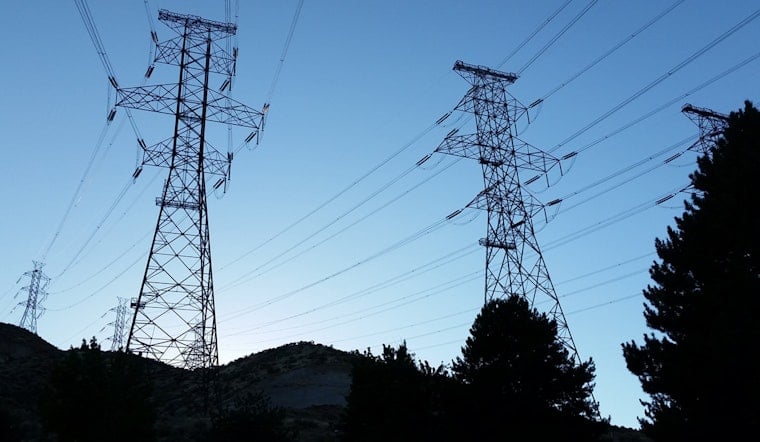
A dozen years after gunmen opened fire on a Pacific Gas and Electric substation just outside San Jose, the unsolved attack is once again fueling warnings that the nation's power grid remains dangerously exposed. A former federal energy regulator says the United States now faces heightened risk of a catastrophic blackout that could last up to 18 months, and the vulnerability traces back to a small number of substations that keep the entire system running.
The 2013 assault on PG&E's Metcalf substation involved gunmen firing roughly 120 shots and knocking out 17 transformers, according to the New York Post, citing reporting from The New York Times Magazine. PG&E restored the substation to service after 27 days, but no arrests have ever been made, and the attack remains a mystery years later. In the aftermath, the Federal Energy Regulatory Commission ran a power flow analysis that, according to former FERC chair Jon Wellinghoff, produced what he called astounding numbers.
Wellinghoff has said that nine substations could black out the entire United States if just one of them ranks among the ten most important substations in each of the nation's three power interconnections — the Western, Eastern, and Texas grids managed by 101 regional balancing authorities nationwide. He has said that a coordinated attack with enough guns could take out the entire U.S. power grid in roughly 20 minutes. Wellinghoff briefed the White House, Congress, and the Department of Energy on FERC's findings and wrote a memo urging immediate action following the Metcalf attack and the agency's analysis.
A Map Away From Disaster
Part of what alarms Wellinghoff is how little specialized knowledge an attacker would need. He has said that anyone with internet access could identify critical substations simply by examining a grid map. That concern sits alongside a broader pattern federal regulators have already documented: physical security incidents targeting the U.S. bulk power system reached nearly 1,700 reported events in 2022, a 10.5% jump from the year before, according to North American Electric Reliability Corporation testimony before the Federal Energy Regulatory Commission.
Those incidents have not stayed theoretical. A December 2022 gunfire attack on two Duke Energy substations in Moore County, North Carolina, damaged transformer cooling radiators and knocked out power for roughly 45,000 residents for up to five days, per the same federal presentation. That same month, a series of physical attacks hit at least six electrical substations across Oregon and Washington, involving firearms and hand tools that caused localized outages and drew in federal investigators, as reported by Oregon Public Broadcasting. Early the following year, federal officials say they thwarted a plot by domestic extremists planning simultaneous ballistic attacks on five substations serving the Baltimore metropolitan area.
Why High-Voltage Transformers Are the Weak Link
The physical targets in these incidents matter because of how concentrated the grid's critical infrastructure really is. High-voltage transformers make up less than 3% of all transformers in U.S. substations but carry between 60% and 70% of the nation's electricity across 200,000 miles of transmission lines, according to Congressional Research Service analysis cited by ASIS International. Knock out the right few, and the damage cascades far beyond a single substation.
Compounding the risk is the age and scarcity of replacement equipment. Large power transformers had an average age of 38 to 40 years back in 2014, and around 75% of distribution transformers nationwide are now older than their 50-year life expectancy, per the New York Post's report. Aging infrastructure across the grid is slow to update, leaving utilities dependent on machines built decades before today's threat landscape existed.
A Supply Chain Stretched to the Breaking Point
Even if a utility wanted to replace a destroyed transformer immediately, it likely couldn't. Wait times for large transformer replacements have grown from less than a year in 2021 to 128 weeks today, a delay that Ajey Pandey described as extremely serious in comments to ChinaTalk. In some cases, replacement lead times now exceed five years. A 2025 Wood Mackenzie industry survey found standard power transformer delivery times reaching a record 128 weeks by mid-2025, while generator step-up transformers stretched to 144 weeks, according to IndustrialSage.
Tim Holt has said the transformer shortage is expected to worsen, telling ChinaTalk that grid spending over the next 15 years will match total spending over the previous 150 years combined. Transformer demand is expected to more than double 2020 levels by 2027. The International Energy Agency has attributed part of that surge to AI data center construction, grid modernization, and renewable energy integration driving global procurement lead times to nearly double pre-2021 levels, per CWIEME Berlin.
A 2023 Government Accountability Office report found that large power transformers can cost up to $10 million each, plus hundreds of thousands more to transport, and noted that establishing a federally owned Strategic Transformer Reserve faces hurdles because equipment isn't standardized across the industry, according to the Government Accountability Office. Grid repair experts have said that fixing a damaged substation would take significantly longer during a nationwide blackout than during normal grid operations, since crews would be working without the power infrastructure they'd normally rely on.
States Move to Fill Regulatory Gaps
Federal rules do exist for the grid's most critical nodes. In the wake of the Metcalf attack, FERC approved Reliability Standard CIP-014 in 2014, legally requiring physical security risk assessments, protection plans, and third-party verification for the highest-priority transmission substations. But that standard covers only a fraction of the grid's infrastructure, leaving thousands of lower-voltage distribution substations protected by little more than chain-link fencing.
States have started stepping in where federal jurisdiction stops short. California enacted Senate Bill 699 in 2015 to mandate physical security standards for state electric distribution assets, while North Carolina, South Carolina, and Arizona introduced similar substation defense legislation following the 2022 attacks, according to the Climate Solutions Legal Digest. Whether that patchwork of state action can close the gap before another coordinated attack tests it remains an open question — one that Wellinghoff's warnings suggest the country may not have fully answered.





