

























































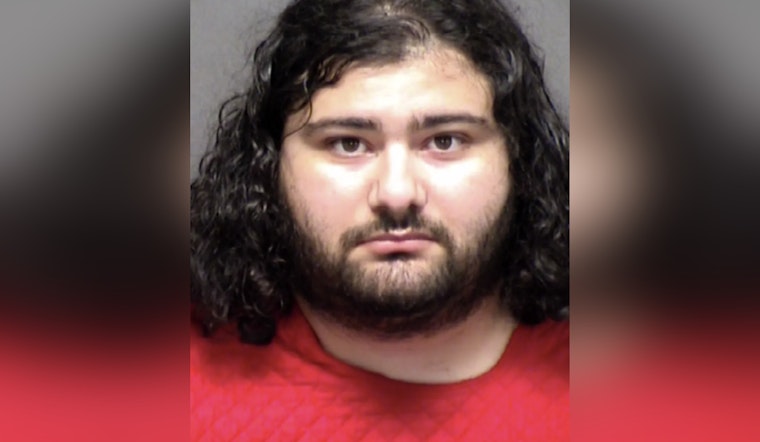
A Bexar County judge sentenced a North Bexar County man to 30 years in prison this week for stabbing his father 27 times inside their family home in 2020, rejecting a defense request that would have let him avoid prison altogether in favor of mental health treatment. Christian Rodriguez pleaded no contest to aggravated assault with a deadly weapon in June under a plea agreement, closing out a case that began nearly six years ago when deputies found his father, Jorge Rodriguez, dead in their Whistling Acres home while Christian barricaded himself inside with a knife.
State District Judge Joel Perez denied Rodriguez's application for deferred adjudication probation, according to the San Antonio Express-News, which first reported the sentencing. Perez instead handed down 30 years in prison, telling the court he found evidence of deliberate conduct in how Rodriguez had acted that day, including that Rodriguez had talked about picking the strongest knife before the attack. Prosecutors Ana Rocha and Zulema Patino had requested a maximum sentence of 40 years under the terms of the plea deal, while Rodriguez had originally faced a murder charge that could have carried a sentence of life in prison if he had been convicted at trial.
The stabbing happened on September 28, 2020, when Bexar County sheriff's deputies were called to the 25000 block of Whistling Acres in North Bexar County. Then-Sheriff Javier Salazar said at the time that Jorge Rodriguez, 45, had been dead for several hours by the time deputies arrived, having sustained multiple stab wounds. The Bexar County Medical Examiner's Office ruled his death a homicide caused by multiple sharp force trauma injuries, according to an earlier report from KSAT.
A Barricade, a Ballistic Shield and a Mental Health Unit
Deputies used a ballistic shield to enter the home, finding Jorge Rodriguez's body in a front bedroom before locating Christian Rodriguez barricaded in a back room with a knife, per MySA. A mental health unit helped deputies negotiate with him, and he eventually surrendered after those negotiations. He was arrested that day and indicted by a Bexar County grand jury on a charge of first-degree murder roughly three months later, in December 2020, the Express-News reported at the time.
Rodriguez told the court he did not believe he was a threat to others and said his father's return from Mexico, along with his father's desire to sell the family home, had been a triggering event for him that day. His attorney, M'Liss Christian, said Rodriguez had suffered for years with mental health issues and had stopped taking his medications for about two years before the killing. The defense had asked the judge for deferred adjudication probation so Rodriguez could continue mental health counseling and treatment rather than serve prison time.
Prosecutors Push Back on Rodriguez's Account
Prosecutor Ana Rocha told the court that Rodriguez minimized his guilt and blamed external factors for his actions, and she asked the court to protect the family and community by sending him to prison rather than granting probation. Judge Perez ultimately sided with that request, giving Rodriguez credit for time served since his 2020 arrest — time he spent housed at the Bexar County Adult Detention Center, where healthcare and psychiatric services for inmates are provided through University Health.
Texas law gave the judge wide discretion in that decision. Under Texas Code of Criminal Procedure Article 42A.103, trial judges can grant or deny deferred adjudication for felony offenses based on public safety risk and how deliberate the underlying conduct was found to be. Perez has presided over the 437th Criminal District Court in Bexar County and brings more than 30 years of legal experience in San Antonio as both a prosecutor and defense attorney, according to background compiled by the San Antonio Report.
Why the Charge Reduction Still Carries Decades Behind Bars
Aggravated assault with a deadly weapon is normally a second-degree felony under Texas Penal Code Section 22.02, punishable by two to 20 years in prison — but it escalates to a first-degree felony carrying five to 99 years or life when committed against a family member causing serious bodily injury, according to state law summarized by Varghese Summersett. That family-violence enhancement is part of why Rodriguez's plea to a reduced charge still resulted in a lengthy sentence rather than a lighter one.
Because the case included an affirmative deadly weapon finding, Rodriguez must serve at least half of his 30-year term — roughly 15 calendar years — before he becomes eligible for parole. Texas Government Code Section 508.145(d) requires offenders with such findings to serve at least 50 percent of their sentence day-for-day, without eligibility for good-conduct credit toward earlier release, per guidance from the Texas District and County Attorneys Association.
A County Still Building Its Crisis Response System
The 2020 standoff predated major changes to how Bexar County handles psychiatric emergencies. Following a string of high-profile mental health crisis calls that year, the county established its Specialized Multidisciplinary Alternate Response Team, known as S.M.A.R.T., which pairs deputies with paramedics and mental health clinicians. That program expanded into a full 24/7 operation in November 2024, according to KSAT.
The case is one of several recent Bexar County stabbing cases tied to family conflict and mental health. Hoodline previously reported that a Universal City mother was deemed fit for trial in the stabbing death of her 9-year-old son, and that a North Side San Antonio woman was left critical after a separate home stabbing tied to family violence charges. Regional reporting has also documented tens of thousands of family-violence reports handled by local law enforcement and social service agencies in recent years, underscoring the scale of the challenge facing Bexar County's crisis intervention resources.





