

























































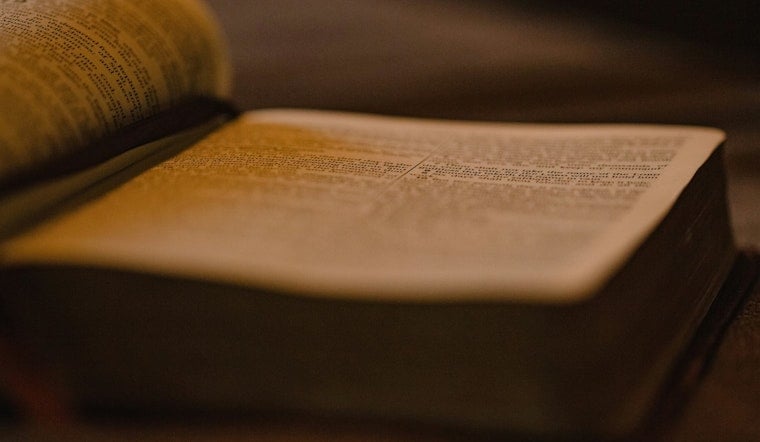
A 1708 King James Bible that once belonged to a Boston sea captain who fought off pirates in the Bay of Honduras has finally returned home, arriving at the New England Historic Genealogical Society nearly 318 years after it was printed. The 800-page volume, bound in calf leather and measuring 16 inches long, 10.5 inches wide, and 3.5 inches thick, was donated by 64-year-old Boston tour guide Benjamin Edwards, a sixth-great-grandson of the original owner, also named Benjamin Edwards.
A Sea Captain, a Pirate Battle, and a Family Legacy
According to The Boston Globe, the original Benjamin Edwards was a Boston merchant captain who traded cargoes of boards, staves, shingles, and fish between New England and the Caribbean. On January 10, 1722, Edwards commanded the 200-ton, six-gun ship Greyhound — described by the Globe as an outmanned six-gun vessel — carrying a load of logwood from the Bay of Honduras when pirate ships commanded by George Lowther and Edward Low attacked. Logwood was a prized blood-red dye wood harvested in Central America and exported to New England, according to the Online Review of Rhode Island History.
Edwards fought for an hour before surrendering the Greyhound, per the Globe's account. Afterward, the pirates whipped and beat the crew, looted and burned the ship, and forced five crewmen to join them, according to the History of Massachusetts Blog. One of those men, first mate Charles Harris, would go on to become a notorious pirate captain in his own right, and Edward Low himself was renowned as one of the most violent pirate captains of the Golden Age of Piracy, the same source notes.
A Life Marked by Loss and Civic Standing
Edwards married Hannah Harrod in 1706, and his first marriage was officiated by the Reverend Cotton Mather, the Globe reports. He would go on to marry three times total, and after his second wife died in 1738, he raised seven small children on his own. Beyond his maritime trade, Edwards served as a Boston tax collector and was one of the original founders of the New Brick Church, established in Boston's North End in 1718, according to a document held in the Internet Archive. That church was formed by seceding members of Boston's Second Church.
Edwards died in 1751 at age 66 and is buried in a family tomb at Copp's Hill Burying Ground in Boston's North End, per the Globe. Boston town officials had granted him permission to build that tomb on June 27, 1717, according to Boston Walking Tours with Ben Edwards, and he was later joined there by his son Alexander and a friend, Jedediah Lincoln.
Ties to the Sons of Liberty and the Revere Family
The family's story didn't end with the sea captain. His descendant Alexander Edwards, a North End cabinetmaker, was a member of the Sons of Liberty, the secret colonial organization that opposed British taxation ahead of the American Revolution. Another descendant, Benjamin 2d, served in the French and Indian War, the Globe reports.
The family's line also crossed with one of Boston's most famous Revolutionary names: Sally Edwards married silversmith Paul Revere Jr., son of Patriot Paul Revere, and the couple had 12 children, according to the Paul Revere House. Paul Revere Jr. managed his father's silver shop and was a partner in the Paul Revere & Sons bell foundry.
From Boston to Wyoming and Back Again
The Bible itself traveled far from its North End origins. It was taken to Wyoming more than a century ago and later traveled between Wyoming, Connecticut, and Boston, per the Globe's reporting. About 15 years ago, Jeannie Edwards Cook shipped the Bible to Benjamin Edwards's parents in Connecticut. Mary Edwards Parkhurst, another descendant, died in Sharon in 1870 at age 91 years, 10 months, and 19 days, according to the family record.
Benjamin Edwards retrieved the Bible himself during a family visit the previous Christmas. He first visited the family's Copp's Hill tomb at age 2, the Globe reports, a lifelong connection to his ancestors that eventually led him to become the Bible's steward and, ultimately, its donor.
Restoration and a New Home in the North End
Edwards gave American Ancestors, the nonprofit organization that operates the New England Historic Genealogical Society, $10,000 to fund the Bible's digitization and restoration. Founded in 1845, American Ancestors is the oldest genealogical society in the Western Hemisphere and holds more than two million items in its R. Stanton Avery Special Collections, according to the organization's own collections catalog.
Conservator Todd Pattison, who joined American Ancestors in June 2018 after more than 25 years at the Northeast Document Conservation Center and managing book conservation at the Harvard College Library, performed page-by-page conservation work on the Bible. That work included dust removal, paper mending, condition descriptions, and photography, per the Globe. Pattison, who has 48 years of bookbinding experience and specializes in paper and rare book conservation, said the Bible had remained in the same family throughout its journey. The conservation work aims to preserve the volume for several hundred more years.
The Bible's 800 pages include family records of marriages, births, and deaths, along with atlases of the Holy Land and the Atlantic Ocean. Handwritten flyleaf entries like these have long been critical evidence for genealogists, since colonial New England town vital registers were often incomplete, according to American Ancestors. American Ancestors says it now holds the oldest family Bible from Boston in its collections, alongside a Geneva Bible from 1560 and a 1599 Geneva Bible containing Richards family records from Hartford.
Why an Imported Bible Was So Rare
The Edwards family's 1708 volume was almost certainly printed in Britain, since Great Britain maintained a strict royal monopoly on printing the King James Bible throughout the 18th century, barring American colonists from printing English Bibles locally. Families were forced to import volumes from British presses; the first English-language Bible printed in America wasn't published until Robert Aitken's 1782 edition during the Revolutionary War, according to Britannica.
Edwards, reflecting on the Bible's long and winding path, said it's made this journey for 300 years, and now it's back where it started — in Boston. He has said he sees his family as temporary custodians of the object rather than its permanent owners. American Ancestors will allow the public to view the Bible by appointment under controlled, supervised conditions.





