

























































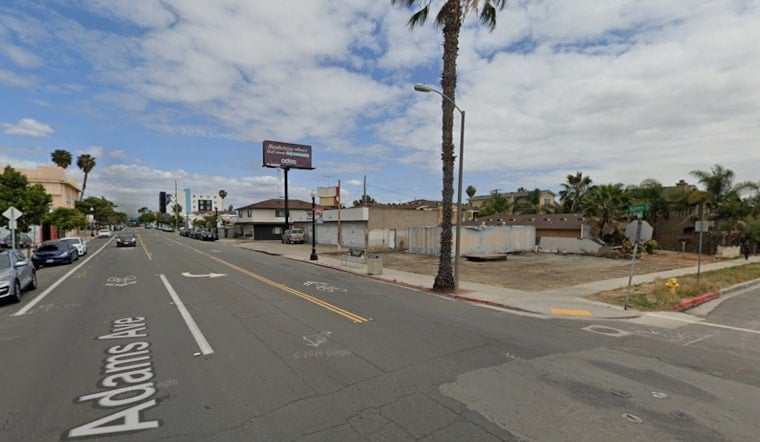
A Chicago developer with an increasingly crowded North Park footprint has locked down financing for its biggest San Diego bet yet. CEDARst Companies has closed on an $80 million construction loan for The Samuel, a 197-unit multifamily development planned for the corner of Adams Avenue and Idaho Street, with completion targeted for September 2028.
Financing Details and the Team Behind the Build
CrossHarbor Capital Partners provided the $80 million construction loan, according to Connect CRE, which first reported the closing. JLL Capital Markets arranged the financing, with the deal led by Zach Kersten, while KPRS Construction Services is serving as general contractor on the project. The site sits at 2821 Adams Avenue and 4677-4685 Idaho Street, a North Park parcel that, per CEDARst Companies, previously held small residential cottages and an auto repair shop.
Once built, The Samuel will include 189 parking spaces along with a pool, roof deck, lobby lounge, custom cabinetry and balconies. Will Murphy of CEDARst said the project reflects the company's commitment to thoughtfully designed, amenity-forward housing in infill locations, adding that the firm appreciates its partnership with CrossHarbor and KPRS. Murphy also said North Park remains one of San Diego's most in-demand submarkets.
A Rapidly Expanding North Park Portfolio
The Samuel is CEDARst's sixth multifamily project in San Diego and adds to four other CEDARst developments already under construction in the city, according to the Connect CRE report. The company currently has one stabilized asset in San Diego. That track record began with The Nash, a 190-unit building at the intersection of University Heights, Hillcrest and North Park that opened in May 2024 as a Qualified Opportunity Zone project featuring a rooftop skydeck and outdoor pool.
CEDARst broke ground in November 2025 on Bancroft Lofts, a $106 million, eight-story, 218-unit project at 3760 Bancroft Street in North Park, also built by KPRS and financed in part by Pacific Life, with delivery expected in December 2027, per REBusinessOnline. The company opened a West Coast office in Solana Beach to manage a local development pipeline that now totals roughly 1,250 units valued at approximately $585 million, according to CEDARst.
Legal Fight Slowed a Nearby Sister Project
Not every CEDARst project has moved forward without friction. In October 2025, the company broke ground on The Lawson, an $89 million, 180-unit mixed-income project in South Park developed with Bridge Investment Group near Balboa Park, where 51% of units are reserved for affordable housing, as reported by Multi-Housing News. But the eight-story project drew substantial neighborhood opposition over its height and scale, and a San Diego County Superior Court judge issued a temporary restraining order that same month to halt construction, according to a report cited by OB Rag. Community group Preserve Greater Golden Hill brought the suit challenging the project's transit-oriented density allowances.
CEDARst's pipeline extends beyond North Park and South Park. In February 2024, the company formed a joint venture with Quartz Lake Capital to acquire a one-acre assemblage in Hillcrest for a planned $145 million, 301-unit podium apartment development, according to a PR Newswire announcement — the first of three planned joint projects between the two firms.
Why San Diego Zoning Rules Are Fueling the Boom
The wave of CEDARst construction traces back to city policy. San Diego's Complete Communities Housing Solutions framework, adopted in 2020, grants developers floor-area-ratio and density incentives in exchange for deed-restricted affordable housing near transit, replacing traditional unit-per-acre caps with FAR-based zoning, according to research from Circulate San Diego. That shift has driven rapid infill apartment development across North Park and surrounding neighborhoods.
The trend is not unique to CEDARst's projects. Research published by Circulate San Diego in April 2026 found that California's density bonus laws enabled approval of more than 25,000 housing units between 2021 and 2023 that exceeded standard local zoning caps. For developers like CEDARst, those incentives have become central to keeping large infill projects financially viable — even as cases like The Lawson show that density bonuses alone don't guarantee a smooth path through neighborhood review.



