

























































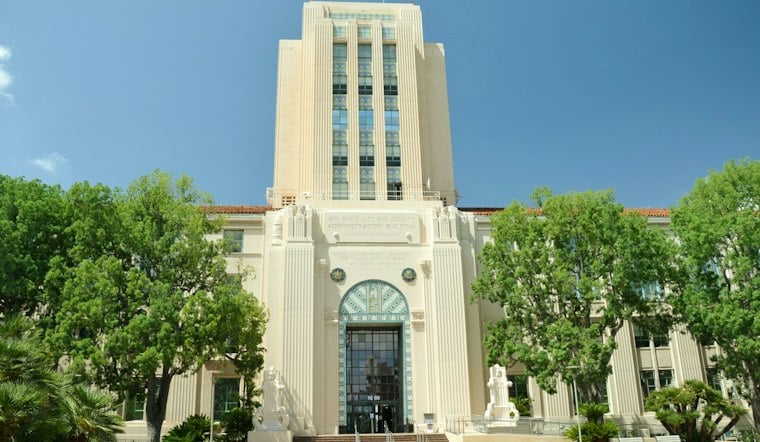
The San Diego County Board of Supervisors voted Tuesday to limit each person’s public comment to three agenda items per meeting. The new cap limits the number of subjects a speaker may address; it is separate from the county’s earlier reduction of speaking time, as reported by The San Diego Union-Tribune.
Supervisor Terra Lawson-Remer authored the measure, saying it addresses a disproportionate share of meeting time taken up by a small group of repeat speakers. Figures from her office, reported by the Union-Tribune, showed that five frequent speakers accounted for one-third of public testimony at county meetings in 2026, while ten accounted for 44%.
Supervisors disagreed over the cap. Jim Desmond opposed it, arguing that repeat appearances do not diminish the public’s right to be heard. Paloma Aguirre supported it, saying hostile comments had discouraged educators from bringing schoolchildren to meetings. Board Chair Joel Anderson backed the measure after the board added discretion to ease the limits in individual cases, according to the Union-Tribune.
The legal question is how far meeting rules can go
California’s Brown Act permits local legislative bodies to adopt reasonable rules for public comment. A California appellate decision discussed by law firm Dannis Woliver Kelley upheld a time limit for public speakers. That decision concerned speaking time, rather than San Diego County’s new cap on the number of agenda items a person may address.
Restrictions on speech content have faced separate scrutiny
The California Attorney General’s Brown Act guide cites Leventhal v. Vista Unified School Dist. (1997) and Baca v. Moreno Valley Unified School Dist. (1996), in which courts found school-district policies prohibiting criticism of employees unconstitutional. Those cases involved restrictions on what people could say, rather than San Diego County’s limit on how many agenda items a person may address, according to the California Attorney General’s Office.
First Amendment Coalition Legal Director David Loy said he knew of no other local government that had limited the number of agenda items a speaker could address and questioned whether the county’s approach went too far, the Union-Tribune reported. In earlier comments to San José Spotlight, Loy acknowledged agencies’ latitude under the Brown Act while warning that reducing opportunities to participate can harm civic engagement and transparency. County Counsel Damon Brown argued that the new county rules are legal, according to the Union-Tribune.
A separate state law, Senate Bill 1100, authorizes a presiding officer to remove a person who continues disrupting a public meeting after being warned. The law firm Lozano Smith describes that authority and its warning requirement; it concerns removal for disruptive conduct, not the county’s three-item comment limit.
Earlier efforts and other meeting changes
The county has previously shortened the public speaking period from three minutes to one and considered rules addressing threatening, profane, slanderous, or abusive language, the Union-Tribune reported. In November 2021, community organizations also sent supervisors a letter opposing racist and hateful remarks made during public comment and expressing concern that people felt unsafe participating. The letter was signed by representatives of local organizations.
The county’s earlier responses included a voluntary Code of Civil Discourse developed by the National Conflict Resolution Center. In August 2024, a local watchdog group sued the county, alleging that prior efforts to control public comments violated free-speech protections, according to KPBS.
The board’s action also changes when some county business is heard. Land-use discussion items are now scheduled for 1 p.m. Wednesdays instead of 9 a.m.; closed-session items are scheduled for 4:30 p.m. Tuesdays or 11 a.m. Wednesdays. Closed sessions can include discussion of lawsuits against the county and employee pay, according to the Union-Tribune.




