

























































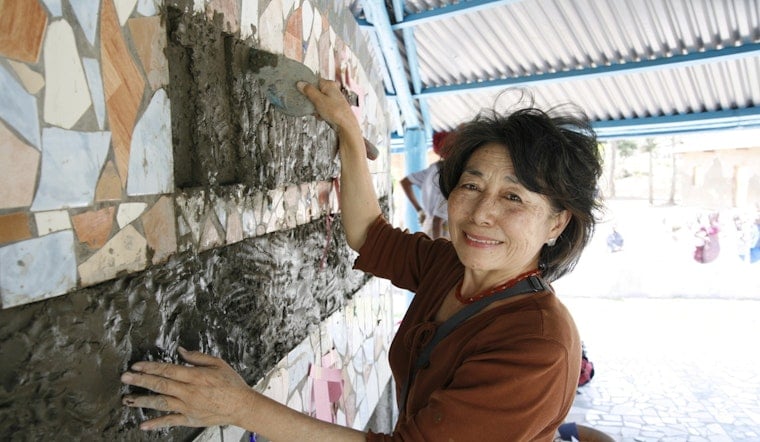
A former tenured professor who once turned a trash-filled vacant lot off Germantown Avenue into a mosaic-covered public art park is about to stand on a stage in Tokyo as the first artist ever honored with the Goi Peace Award. Lily Yeh, founder of North Philadelphia's Village of Arts and Humanities, will formally receive the prize on Saturday, November 28, 2026, during the Goi Peace Foundation Forum in Japan. She says she plans to give the accompanying cash award, worth 1 million yen, to young people in a youth peace ambassadors program rather than keep it for herself.
According to WHYY, the Goi Peace Foundation announced it is honoring Yeh for her contributions to a just and sustainable future through art, and the cash prize is worth just over $6,000. The Tokyo-based foundation, per its own criteria, selects laureates not just for past achievements but for ongoing contributions toward building a peaceful global society, as outlined in its “Declaration for All Life on Earth,” according to The Goi Peace Foundation. Yeh told WHYY she was stunned by the news: “I couldn't believe it. Did they make a mistake?”
From a Vacant Lot to a Village
Yeh's story in Philadelphia began in 1986, when she started what became the Village of Arts and Humanities in North Philadelphia, according to WHYY's report. The site traces back further, to 1969, when dancer and activist Arthur Hall opened the Ile Ife Black Humanitarian Center at 2544 Germantown Avenue as an Afrocentric creative hub meant to counter disinvestment in the neighborhood, per the University of Pennsylvania Stuart Weitzman School of Design. Hall invited Yeh, then a tenured professor at the University of the Arts, to transform the neighboring vacant lot into a public art park, and she created outdoor sculpture and mosaics there with help from nearby residents, including people living with addiction and without homes, WHYY reports.
The project did not stay small. Over three decades, the Village of Arts and Humanities expanded from that single trash-filled lot into a renewal effort spanning more than 120 formerly vacant lots, filled with murals, mosaic gardens, and performance spaces, according to Project for Public Spaces. Incorporated as a nonprofit in 1989, the organization grew to cover a 260-square-block area serving thousands of residents each year, the same account notes. One of those residents was James “Big Man” Maxton, who moved from a 22-year struggle with drug addiction to become a lead mosaic artist and teacher for the Village before his death in 2005, per the same report.
Stepping Back to Go Global
Yeh stepped down from leading the Village of Arts and Humanities in 2004, according to WHYY, shifting her focus to international projects through the nonprofit she founded, Barefoot Artists. She started the organization in 2002, naming it after Chinese “barefoot doctors” to reflect a nimble model of traveling directly to impoverished communities worldwide, according to CoGenerate. Her international work had actually begun a decade earlier, in 1994, when she organized residents of the Korogocho slum near Nairobi, Kenya, to paint murals inside St. John's Catholic Church near a major city landfill — a dedication that drew more than 1,000 attendees, per the same account.
Yeh has also worked in Rwanda since 2004, WHYY reports, where she leads projects at a mass grave site of Tutsis killed during the 1994 genocide. Through what became known as the Rwanda Healing Project, she collaborated with genocide survivors in the Rubavu District to transform a volcanic mass grave into the official Rugerero 1994 Genocide Memorial, complete with stone gardens and bone chamber mosaics, according to CoGenerate. The site was created to bring beauty and sacred honor to a location where mass killings occurred, the organization notes. Yeh also supports the Dandelion School of Migrant Children in Beijing, which serves impoverished families of migrant workers, per WHYY's reporting.
Following Notable Past Honorees
Yeh's selection makes her the first artist to receive the Goi Peace Award, a distinction that places her alongside a list of past honorees that includes Jane Goodall, Bill Gates, and Deepak Chopra, according to WHYY. The Goi Peace Foundation has presented the award annually since 2000 to individuals and organizations advancing global harmony; the 2025 award went to UK peace activist Jeremy Gilley, while Goodall received it in 2024, per the foundation's own records.
Yeh's life and international work, including her personal journey tracing her family's history in China, were previously the subject of the 2014 documentary “The Barefoot Artist,” co-directed by her son Daniel Traub and filmmaker Glenn Holsten, according to PBS. The film balanced her public art projects across Africa and Asia with that personal narrative, the outlet reported at the time.
Now leading community-based art projects in disadvantaged places around the world, Yeh described her approach to WHYY in simple terms: listening, finding hidden resources, and awakening creativity in others. “Art is not a noun. It's a verb. It's action,” she told the outlet, adding that art can help transform brokenness into hope.



.jpg)