

























































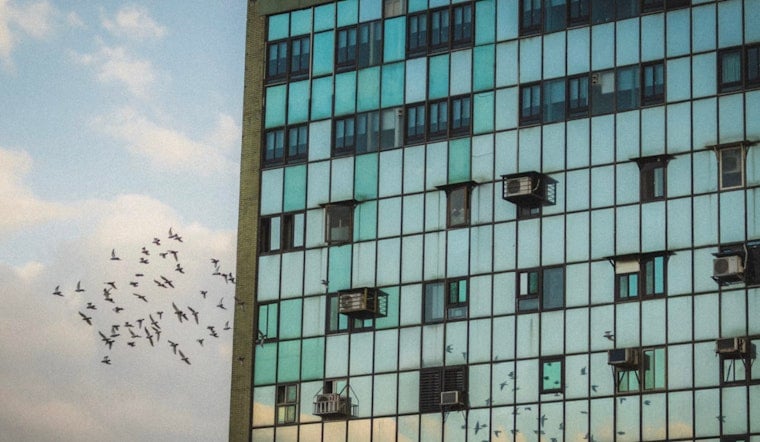
Lawmakers, avian scientists and animal welfare advocates gathered on the steps of City Hall in Lower Manhattan to demand passage of a bill that would force office towers and large retailers to dim their lights at night, arguing the measure could save hundreds of thousands of birds a year from fatal building collisions. The legislation, dubbed Flaco's Law 2 in honor of the Eurasian eagle-owl who died after flying into a Manhattan building in February 2024, would require non-essential indoor and outdoor lighting in commercial and mercantile buildings to be turned off or dimmed overnight.
As reported by amNewYork, Manhattan City Council Member Harvey Epstein was due to reintroduce the bill, which would apply to office buildings and large retailers, requiring them to turn off or dim both decorative and non-essential indoor and outdoor lighting at night. Epstein, who chairs the council's animal welfare caucus, said the legislation would protect wildlife while reducing energy use and costs, telling advocates the bill would cut energy usage and save money for New Yorkers. He said the measure could protect potentially 250,000 birds a year from preventable death.
That estimate lines up with figures from avian expert Andrew Farnsworth of Cornell Lab of Ornithology and the Lights Out Coalition, who said more than 250,000 birds die from building collisions in New York City every year. The rally drew a broad coalition of elected officials, including Julie Menin, Antonio Reynoso, Donovan Richards, Brad Hoylman-Sigal, Carl Wilson, and Republican Frank Morano, who said protecting wildlife is a nonpartisan issue.
How the Bill Would Work
Per the New York City Bar Association, the reintroduced measure — filed as Intro 896 and Intro 1039 — targets commercial building classifications defined as Group B business and Group M mercantile under the NYC Building Code. Small retailers under 4,000 square feet and landmarked buildings over 20 stories would be exempt, and the bill also includes additional public-safety provisions beyond the lighting mandate. The legislation is part of a broader package of animal-welfare measures inspired by Flaco, which the Columbia Spectator notes also includes a rat-contraceptive pilot enacted in September 2024 and a separate proposal introduced in October 2024 to mandate retrofitting existing buildings with bird-safe glass by 2030.
New York City has moved incrementally on the issue for years. The council pioneered mandatory bird-friendly glass for new construction through Local Law 15 in 2020, a mandate that took effect in January 2021 and required bird-safe materials on at least 90 percent of exterior facades up to 75 feet on all new construction and major window replacements, according to the NYC Bird Alliance. In December 2021, the council followed with Local Laws 30 and 31 of 2022, which required city-owned and city-leased properties to turn off non-essential outdoor lighting overnight during peak spring and fall migration windows and install occupancy sensors — but that mandate never extended to private commercial real estate, the group notes.
The Scale of the Problem
An estimated 15 million to 25 million migratory birds travel through New York City's airspace and urban green spaces each year during spring and fall migrations along the Atlantic Flyway, per the NYC Bird Alliance. Dustin Partridge, the organization's senior director of conservation and science, has reported that over 1 billion birds die annually in the United States from window collisions, while the New York City Bar Association points to a 2025 study estimating the national toll could run between 621 million and 2 billion birds a year. Light pollution contributes to those collisions by disorienting migrating birds and increasing the risk they strike buildings, and the Wild Bird Fund treated more than 13,000 birds injured in collisions last year, according to co-founder and director Rita McMahon.
Multi-year research at the annual 9/11 Tribute in Light, conducted jointly by the Cornell Lab of Ornithology and NYC Bird Alliance volunteers, found that the high-intensity beams can increase local nocturnal bird density up to 150 times above baseline levels — but shutting the lights off for just 15 to 20 minutes lets trapped birds disperse safely. That finding underpins advocates' argument that even brief, targeted lighting reductions at commercial buildings could meaningfully cut collision deaths during migration season.
Real Estate Pushback and a Broader Push
The Real Estate Board of New York has historically opposed expanding mandatory lights-out requirements to private commercial buildings, citing concerns over tenant safety, building security, operational disruption and economic viability, according to The Real Deal. Even so, the bill was gaining support from some New York businesses at the rally, including The Container Store, whose co-founder Garrett Boone said reducing building lighting could cut both bird collisions and energy costs.
The City Hall push is unfolding alongside state-level efforts. New York State lawmakers renamed the statewide Bird Safe Buildings Act the FLACO Act in February 2024 to require bird-friendly window designs on state-owned buildings, while advancing a companion Dark Skies Protection Act that would require outdoor fixtures statewide to be shielded or extinguished between 11 p.m. and 5 a.m., per the New York State Senate. That statewide dark-skies measure has faced its own opposition to light-related bills in Albany. Other cities have already adopted similar seasonal approaches — Raleigh, North Carolina, enforces an annual Lights Out policy from September 10 through November 30, turning off non-essential lighting at city facilities between 11 p.m. and 6 a.m., as Hoodline previously reported.
Whether New York's commercial towers will follow suit remains an open question, with REBNY's safety and security concerns still standing against the scientific case advocates made at City Hall. For now, the rally keeps Flaco's name attached to a legislative fight that has stretched across two City Council terms and now reaches into state government as well.





