

























































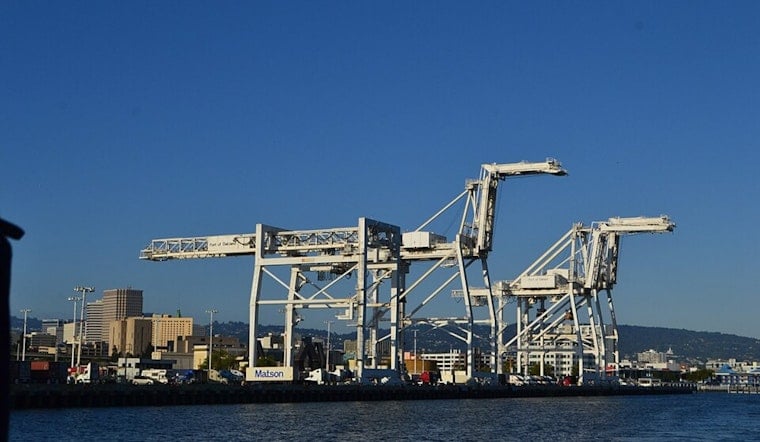
Modern container ships stretching as long as 1,200 feet are now routinely calling on Oakland, and the port's turning basins simply were not built for them. Wind and currents currently limit crews to as few as one opportunity per day to safely rotate these vessels, according to the Port of Oakland. Yesterday, port officials and the U.S. Army Corps of Engineers signed a $640 million design agreement aboard the historic USS Potomac in Oakland to fix the bottleneck.
The signing formally launches a project to modernize the port's turning basins, as reported by The Mercury News. The Army Corps project will widen the estuary between Oakland and Alameda and expand both the Inner and Outer Harbor turning basins. Justin Taschek, senior maritime project administrator at the Port of Oakland, has described the geometry problem bluntly: modern ships have less than 150 feet of clearance on each side of the estuary during rotation, in a waterway that reaches only about 1,500 feet at its widest point. For scale, the report notes that Los Angeles's Wilshire Grand Center stands 1,100 feet tall — shorter than the ships now trying to turn around in Oakland's harbor.
Under the design plan, the project will add 334 feet to the width of the Inner Harbor turning basin. The Outer Harbor Turning Basin diameter grows by 315 feet, from 1,650 feet to 1,965 feet, at a maintained depth of -50 feet Mean Lower Low Water, according to the U.S. Army Corps of Engineers. The wider estuary is also expected to reduce disruptions to ferry operations and give the port more flexibility to maneuver large ships into San Francisco Bay multiple times a day rather than waiting on a single tidal window.
Dredging, Wetlands, and a Reserved Slice of Howard Terminal
Getting there requires moving a lot of mud. The project will dredge just under 5 acres of the North Alameda shoreline, and executing that widening on the Alameda side requires building roughly 2,380 linear feet of stabilization bulkhead walls and acquiring 4.6 acres of fast lands, per the Army Corps' design documents. Overall, the turning basin expansion will require excavating approximately 2.7 million cubic yards of sediment, with about 454,000 cubic yards of that set aside during construction for beneficial reuse in tidal wetland restoration.
That dredged mud and soil will be relocated to the Montezuma Wetlands in Solano County, where it is expected to help restore more than 200 acres of habitat. On the Oakland side, the port has reserved roughly 10 acres at Howard Terminal for the turning basin expansion — a spatial commitment that once fueled debate during city reviews of the Oakland A's proposed waterfront ballpark district, as The Oaklandside reported in 2022. Maritime interests pushed to preserve that acreage even as the commercial stadium proposal advanced.
Racing the Clock on Federal Funding
Construction is slated to start in 2028, with completion targeted for 2030, according to the Mercury News report. Once underway, the project is set to be the largest Army Corps effort in the Bay Area while under construction. Virginia Brickner said she is looking forward to starting the actual work, per the same account.
Keeping that timeline on track depends on Congress. U.S. Representative Lateefah Simon, who represents District 12, requested federal Fiscal Year 2027 appropriations in March 2026 to launch the first Oakland-side construction contract and complete engineering work on the Alameda side, under the authority of the Water Resources Development Act of 2024, according to a document from her office. Simon said modernizing the estuary was essential, and her office notes that the Port of Oakland supports more than $90 billion annually in regional economic value, serving as a primary West Coast export hub for U.S. agricultural and manufactured goods.
Jason Kelly said the design agreement moves the project out of the study phase and into reality, according to the Mercury News. Barbara Lee said the project will sustain jobs, keep Oakland competitive, strengthen the city's position as a green innovation hub, provide community benefits, and help the port transition to zero-emissions operations. Shipping containers moving through the Port of Oakland create jobs for warehouse workers, mechanics, merchant mariners, truck drivers, and East Bay community members, and the turning basin expansion is described as protecting those jobs.
Why Oakland Can't Afford to Fall Behind
The current 50-foot channel and turning basin depths trace back to the -50-Foot Navigation Improvement Project, authorized by Congress under the Water Resources Development Act of 1999 and completed in 2009 at a cost of $252 million, according to research published by the American Society of Civil Engineers. Vessel sizes have grown well beyond what that footprint anticipated, and the new widening is framed as a long-term investment in the port's competitiveness against the ports of Los Angeles, Long Beach, and Seattle.
That competitive pressure comes as cargo volumes have swung sharply. Oakland processed 185,499 TEUs in April 2025, a 14.7% drop from the prior month, with China supplying roughly 45% of inbound cargo, Hoodline previously reported. Even amid that volatility, freight-adjacent real estate near the port has stayed in demand — investment firm WPT Capital Advisors paid $112.5 million in March 2026 for a 374,700-square-foot warehouse near I-880 and the port corridor.
The port has also been layering environmental commitments onto its infrastructure push. In July 2025, the Port of Oakland joined the Protecting Blue Whales and Blue Skies program as an ambassador, encouraging container ships to voluntarily slow to 10 knots in coastal waters between May and December to protect whales and cut emissions. Whether the turning basin project's federal funding arrives on the schedule Simon requested remains an open question for the port's timeline heading toward 2028.





