

























































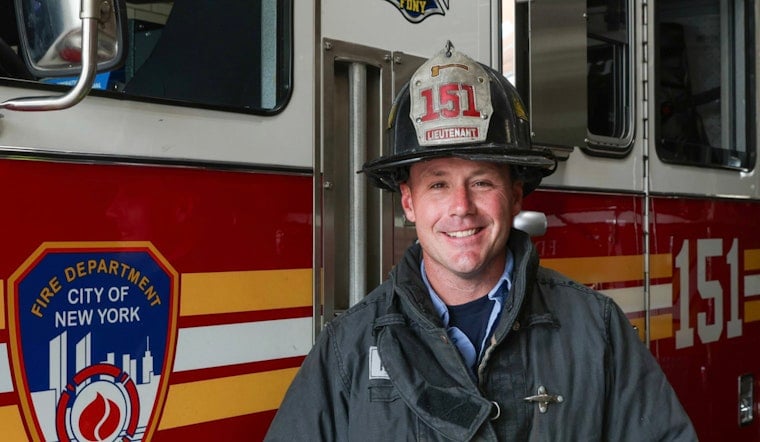
James McConville was still in his running clothes, a t-shirt and shorts, when he spotted thick black smoke pouring from a private home in Queens. The FDNY lieutenant, who leads Ladder 151 out of Forest Hills, had no gear, no truck, and no backup. He went in anyway.
According to a post from the FDNY, McConville was returning home from a morning run when he noticed the smoke and realized no fire units had yet reached the scene. Hearing signs that someone might still be trapped inside, he entered the smoke-filled house and, roughly 20 feet in, found a man semi-conscious on the floor. He pulled the man out of the home himself.
For FDNY members, the commitment to helping others extends beyond the firehouse.
— FDNY (@FDNY) August 30, 2026
While returning home from a morning run, FDNY Lieutenant James McConville of Ladder 151 in Queens noticed thick, black smoke coming from a private dwelling. With no FDNY units yet on scene,… pic.twitter.com/o7gG8BWiVK
Once outside, McConville discovered the man had no pulse. He immediately began CPR, alternating chest compressions with rescue breaths, according to the FDNY. The man began breathing on his own before additional help arrived, and McConville then went back inside to complete a primary search of the home before continuing to fight the fire until conditions turned too dangerous to stay.
A Split-Second Decision With Life-or-Death Stakes
The medical odds McConville was working against were steep. National data from the American Red Cross shows only about 10.5% of people who suffer non-traumatic cardiac arrest outside a hospital survive to discharge, though immediate bystander CPR can double or triple those chances. A historical study of cardiac arrests in New York City published on PubMed found an overall survival-to-discharge rate of just 2.1% when arrest occurs before EMS arrives without immediate intervention, with survival odds dropping roughly 10% for every minute resuscitation is delayed.
That is what makes the timing of McConville's actions so significant. The FDNY maintains a citywide target response time of 4 minutes and 38 seconds for fire companies responding to life-threatening medical emergencies, according to the city's FY2026 Preliminary Mayor's Management Report as reported by the Hunters Point Ledger. McConville did not wait for that window to close. He was already on scene, working, before any FDNY unit arrived.
Asked why he acted, McConville kept it simple: “I do this for people I don't know. Why wouldn't I do this for my neighbor?”
Training Built for Exactly This Moment
McConville's instincts trace back to standard FDNY preparation. All firefighters complete 18 weeks of training at the FDNY Fire Academy on Randalls Island, covering structural fire suppression, primary search techniques, and emergency medical response including CPR, per the department's own account on Facebook. That training is designed to hold up whether a firefighter is in full gear or, as McConville was, in running shorts with nothing but his hands and his knowledge.
This was not McConville's first brush with a high-stakes structure fire. In August 2019, he served on a forcible entry team with Ladder 39 during a three-alarm private dwelling fire in the Bronx, holding back flames at a doorway so fellow firefighters could search for and rescue a trapped woman. That rescue effort ultimately earned team leader Captain Theodore J. Conroy the department's Hugh Bonner Medal at the 2020 FDNY Medal Day.
A Century-Old Firehouse in Forest Hills
McConville's Ladder 151 has deep roots in the neighborhood it serves. The company was organized alongside Engine 305 on November 15, 1924, and the two units have operated out of the same Forest Hills firehouse for more than a century, covering a district that mixes high-rise residential towers with single-family homes. The firehouse at 111-02 Queens Boulevard, known locally as the home of the “Pride of the Hills,” was designated an official New York City Individual Landmark in June 2012, recognized for its neo-Medieval design by FDNY head inspector John R. Sliney, built between 1922 and 1924 with steep gabled copper roofs and twin square towers, according to a report at the time by DNAinfo.
Off-duty rescues like McConville's carry weight within the department beyond the moment itself. FDNY personnel who perform heroic acts while off duty are eligible for the department's top awards, evaluated alongside line-of-duty actions; Staten Island Captain William J. Grant, for instance, received the FDNY's highest honor, the James Gordon Bennett Medal, after rescuing neighbors while off duty when he smelled fire in their home, as detailed by Firefighter Nation. The FDNY has held its annual Medal Day Ceremony at City Hall Plaza continuously since 1869, marking its 157th ceremony this past June, the department's official pipeline for formally recognizing firefighters and EMS personnel for extraordinary lifesaving actions.
It remains unclear whether McConville will be nominated for departmental recognition for this rescue. What is documented, according to the FDNY's account, is that a man who might otherwise have become another grim statistic is alive today because an off-duty lieutenant in running shoes chose not to keep jogging.





