

























































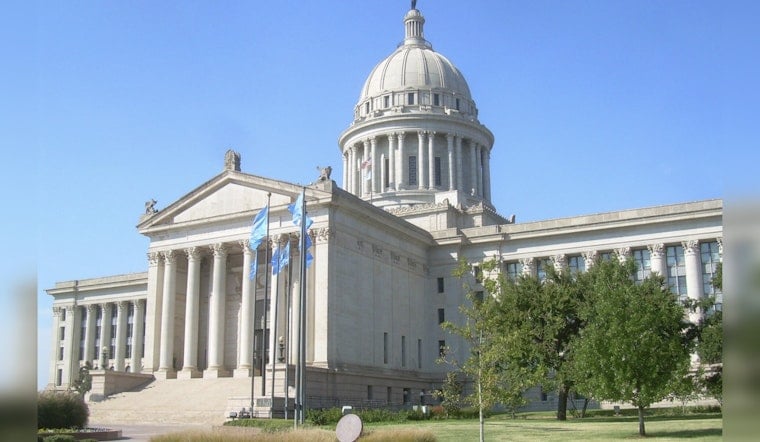
Oklahoma voters will decide Aug. 25 whether to hand state lawmakers new power over how much money flows back to schools and counties under a decades-old manufacturing tax break, a question that has already split the legislature from the school superintendents who depend on that money. State Question 844 would let lawmakers recalculate reimbursement payments owed to local governments for revenue lost to the state's manufacturing property tax exemption. Backers say the current formula lets a handful of wealthy industrial counties soak up an outsized share of the payout, while school leaders warn a change could gut budgets that cover teacher pay, bond debt and new buildings.
According to Oklahoma Voice, Pryor Public Schools received $24 million in manufacturing exemption reimbursements this year, revenue that Superintendent Lisa Muller said has revolutionized what the Mayes County district can do. Muller said the money covers operations, payroll, facilities and school bond debt, and that Pryor is among the districts that receive no state aid formula money at all. Losing that reimbursement revenue, she said, could push Pryor and similar districts to rely on the state's finite formula funding — a shift school superintendents argue would proportionally shrink the dollars available to every district statewide.
What State Question 844 Would Change
Lawmakers placed State Question 844 on the ballot by passing House Joint Resolution 1087, which cleared the House 76-16 on March 25 and the Senate 38-7 on April 9, according to Ballotpedia — comfortably clearing the two-thirds threshold Oklahoma law requires to refer a constitutional amendment to a non-November ballot. The measure would amend Article 10, Section 6B of the Oklahoma Constitution, letting lawmakers set reimbursement methodologies so that no single county receives an amount "detrimental to other Oklahoma counties," according to the ballot title published by the Oklahoma Secretary of State. It leaves the underlying five-year property tax exemption for manufacturers untouched — companies would still receive the same break — while making the state's reimbursement to schools and counties subject to legislative discretion, per an analysis published on William's Substack.
Legislators point to Mayes County, home to Oklahoma's largest industrial park and Google's data center complex, as the clearest example of the imbalance they want to fix. Oklahoma Voice reports that Mayes County entities took in about 40% of the state's manufacturing exemption reimbursements in 2025, and a separate breakdown of state tax records by BatesLine found Google's data center complex alone drew $34.2 million — nearly 39% of Oklahoma's $88.6 million total statewide reimbursement payout. Mayes County sits northeast of Tulsa.
School Leaders Say the Stakes Are High
That reporting also found manufacturing reimbursements tied to a nearby wind farm have let Minco Public Schools, located about 30 miles southwest of Oklahoma City, pay teachers $5,000 above the state minimum salary. The money also funded a new high school, middle school and auditorium, plus improvements to the football field, according to Superintendent Kevin Sims. A new solar farm is expected to generate even more reimbursement revenue for Minco in the coming year — a pipeline Sims said Question 844 puts at risk, calling the measure a costly situation for schools and counties.
House Speaker Kyle Hilbert dismissed the schools' warnings as a scare tactic, telling Oklahoma Voice that the legislature does not intend to change reimbursement rates already locked in and would only negotiate terms for future industrial deals. Hilbert said lawmakers could redistribute some reimbursement funds to schools statewide and argued that lawmakers should have input into the amounts owed. He noted that a county assessor sets the property assessment while the state — and, by extension, the other 76 counties — ends up covering the bill, even though the state has no ability to contest that assessed value. Even so, the legislature could still eliminate all current and future reimbursements by deeming every industry ineligible for the underlying tax break, a scenario Question 844 does not rule out, per the same Oklahoma Voice reporting, though Hilbert said that isn't the intent behind the measure.
A Program Rooted in the 1980s Oil Bust
Oklahoma's manufacturing tax exemption dates to April 1985, when voters approved State Question 588 by 69.7%, hoping to spur industrial development after the 1980s oil bust, according to Ballotpedia. That vote enshrined the reimbursement guarantee in the state constitution, requiring Oklahoma to make local taxing districts whole for the exemption's cost. Lawmakers tried to eliminate the program in 2020, but then-Gov. Kevin Stitt vetoed the effort.
The dedicated Ad Valorem Reimbursement Fund, financed by a 1% cut of state personal and corporate income tax revenue, has fallen short of covering the full reimbursement bill every year since 2002, according to the Oklahoma Policy Institute. Lawmakers have had to add tens of millions of dollars in supplemental appropriations to close the gap; public schools alone needed a $64.8 million supplement in 2025 to cover reimbursement obligations. Total reimbursements peaked at $161 million in 2020 before falling after lawmakers disqualified wind energy farms from the program in 2015 and closed it to new data center equipment in 2021, as reported by the Tulsa Flyer. Solar farms are set to be phased out of the program in 2028.
Zero Dollars for Most Counties, and a Vote Looms
The imbalance lawmakers cite doesn't touch most of the state: 35 of Oklahoma's 77 counties received zero manufacturing exemption reimbursement dollars in 2025 because they had no qualifying industrial projects, according to Oklahoma Watch. Legislative leaders argue that altering the formula could let surplus funds be redistributed to public schools statewide rather than concentrated in a handful of industrial-heavy districts.
State Question 844 will share the Aug. 25 runoff primary ballot with State Question 846, a legislative referendum that would enshrine voter ID requirements in the state constitution, according to Oklahoma.gov. Both measures were referred directly by the legislature and need only a simple majority to pass. Ahead of the vote, the Oklahoma State School Boards Association is holding a statewide virtual town hall on Wednesday to walk school board members and superintendents through the measure's potential budget impacts.





