

























































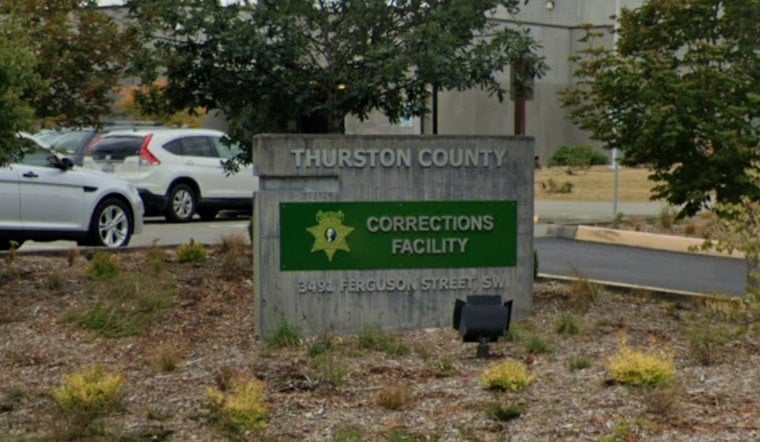
A 29-year-old Olympia woman remained in critical condition Wednesday, more than a week after a medical emergency inside the Thurston County Jail led the facility's contracted medical provider to fire the nurse involved in her care. The woman was booked into the jail on a warrant on Aug. 10, and medical staff initially attributed her symptoms to narcotics withdrawal before she was ultimately taken to a hospital on Aug. 13 and later transferred to another medical facility.
The case, first reported by The Seattle Times, has prompted the Thurston County Sheriff's Office to request an outside review. The sheriff's office asked the Mason County Sheriff's Office to conduct an independent investigation into the woman's medical care, according to regional reporting from Corrections1. Additional details about the nurse's termination were not immediately available.
Thurston County Sheriff Derek Sanders has spoken publicly about the pressure the jail is under, telling The Chronicle that the facility seemed one step away from being sued over the issue. Sanders has also pointed to a paramount duty that corrections staff carry to protect the health and well-being of people in their custody, a standard that echoes state law: Washington's RCW 70.48.130 requires local governments to provide necessary medical care to people in jail and bars delaying emergency treatment over reimbursement disputes, according to the Municipal Research and Services Center.
A Jail Already Strained by Overcrowding
The Thurston County Jail has been contending with a growing population for years, and money once set aside for expanding the facility instead went toward other capital projects in 2024, per the Seattle Times report. Just this month, the sheriff's office enacted booking restrictions for female detainees after female housing units hit maximum physical capacity, forcing the jail to convert transfer units and court spaces into temporary housing, according to The JOLT News Organization.
The jail had previously lifted booking restrictions in 2024, but capacity pressure has clearly returned. That strain sits alongside another operational headache: Sheriff Sanders has said a state Administrative Code update, WAC 246-230-040, cut jail body scanner radiation imaging power to one-eighth of its previous setting, making it harder for deputies to spot swallowed narcotics balloons during booking.
Legal Scrutiny Is Not New for the Facility
This is not the first time medical decisions at the Thurston County Jail have drawn legal fire. In February 2024, a woman filed a federal civil rights lawsuit against the county and the jail after she was left on a cell floor for more than 24 hours in March 2022 with a severe frontal-lobe brain bleed that jail staff allegedly mocked and mistook for intoxication, as reported by the Seattle Times and AP News.
The jail also saw two in-custody deaths within a single week last September — 65-year-old Earl Alexander II on Sept. 7 and 53-year-old Steven O. Ray on Sept. 14 — both of which prompted external death investigations by neighboring law enforcement agencies. Under Washington's RCW 70.48.510, local governing units operating jails must conduct an unexpected fatality review whenever someone dies in custody, with the goal of developing policy recommendations to prevent future health crises.
Systemic Risks in Jail Medical Screening
Research from Disability Rights Washington has found that people experiencing acute substance withdrawal or mental health crises in local Washington jails face heightened vulnerability to misdiagnosis, since correctional environments often lack immediate access to specialized clinical diagnostic equipment. That gap helps explain why intake screening remains a persistent vulnerability even as the county has invested elsewhere in monitoring technology.
Last year, the Thurston County Board of Commissioners authorized nearly $48,300 to install seven ceiling-mounted biomedical sensors in detox and suicide-watch holding cells, allowing continuous monitoring of vital signs like heart rate and respiration during medical or psychiatric crises. Those sensors, however, are aimed at inmates already flagged as high-risk — not at catching a misdiagnosis during initial booking, which is where the Olympia woman's case appears to have gone wrong.
Third-party medical providers that service jails nationwide, including Wellpath Inc., have faced extensive legal pressure of their own, including a 2024 Chapter 11 bankruptcy filing amid more than 1,500 wrongful death and malpractice suits, according to public court filings reviewed by Prison Legal News. It remains unclear whether the provider involved in the Olympia woman's care is tied to those broader industry pressures. The Mason County Sheriff's Office investigation is expected to examine whether systemic intake protocols or an individual misdiagnosis led to her critical condition.





