

























































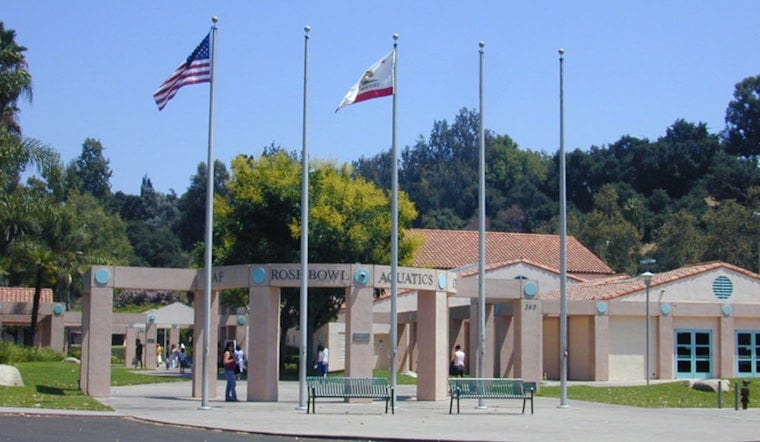
Pasadena’s Rose Bowl Aquatics Center is heading toward a shutdown that could stretch from spring 2027 through the end of the 2028 Olympics, putting a giant question mark over the routines of swimmers, divers, water-polo players and aqua-aerobics regulars.
The Los Angeles Times reports that the center could close as early as April 2027 and remain unavailable to regular users until after the Games conclude in summer 2028. Operators plan to announce shutdown details Monday, while negotiations over the construction scope and financing are still underway.
The Olympic Win Comes With A Local Cost
LA28 moved Olympic diving to Pasadena after determining that the LA84 Foundation/John C. Argue Swim Stadium near the Los Angeles Memorial Coliseum would require a more expensive retrofit. In LA28’s venue announcement, organizers said the Rose Bowl facility requires minimal work, offers additional athlete amenities and could produce up to $17.6 million in combined revenue increases and cost savings.
For the Pasadena facility, however, “minimal work” may still mean temporarily emptying nearly the entire complex. The RBAC FAQ says the center will operate fully in 2026 and for part of 2027, but that the construction schedule and specific effects on operations have not yet been finalized.
More Than 400,000 Annual Visits Could Be Rerouted
The center serves more than 400,000 people each year, according to the Times, across two 50-meter pools, an adjacent therapy pool and two large hot tubs. A closure would affect far more than lap swimmers, with youth teams, Masters swimming, diving, water polo, lessons, adaptive programs and water-fitness classes all looking for temporary homes.
Rose Bowl Aquatics Center leaders have begun contacting other pool operators and are developing an “RBAC on the Road” program for relocated teams and user groups. A Pasadena Now report said the center’s planning documents identify replacement pool space, staff retention, parking and funding as some of the central challenges of the move.
For Regulars, The Pool Is Part Gym, Part Community
Regular users describe the center as more than a place to exercise. The Times spoke with patrons who rely on the water to manage health conditions, stay mobile and maintain social connections, including one swimmer with a disability who described the pool as a place where she could do things that were otherwise difficult.
That community role is especially significant because the center supports Pasadena’s water-safety efforts and aquatic programs for children, families and athletes. The City of Pasadena says the nonprofit’s programming includes water-safety instruction for every third-grade student in Pasadena Unified School District, including students with special needs.
The Closure Could Ripple Beyond The Pool Deck
The financial disruption could be substantial for the nonprofit and the businesses operating around it. ProPublica’s tax data, drawn from the center’s 2024 IRS filing, lists roughly $8.6 million in program-service revenue and about $1.6 million in contributions, figures that show how much activity depends on keeping the pools busy.
The aquatics center also houses a cafe and the Swim Guy, a swim-equipment shop whose owners told the Times they are worried that customers and teams scattered among different pools may not return as a group. The center has said relocated programming could help preserve jobs and services, but the details remain unsettled.
Organizers Are Betting On A Long-Term Payoff
LA28 and Pasadena officials are framing the project as a legacy investment rather than a temporary Olympic makeover. The new plan is expected to address the diving tower, pools and mechanical systems, while Olympic spectators could watch competition from temporary bleachers built over the pool deck.
The Southern California Association of Governments has said the Games’ budget, visitor spending and related transportation investments are expected to create measurable economic benefits across the region. Pasadena stands to gain hotel, restaurant and retail activity from Olympic visitors, but those future benefits do not solve the immediate question facing local swimmers: where to go when the water disappears.
The diving competition is scheduled for July 16 through July 28, 2028, with 11 competition days, according to the center’s LA28 information page. LA28 will lead work tied directly to the Games, while the city owns the property and the nonprofit remains responsible for improvements beyond Olympic requirements—a division of responsibility that could shape what Pasadena gets after the crowds leave.





