

























































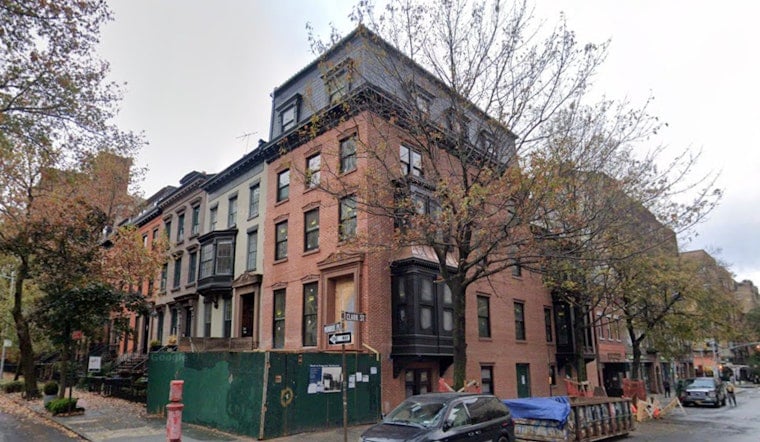
A Brooklyn Heights mansion that spent nearly two decades as a half-demolished eyesore is about to become the centerpiece of the neighborhood's most anticipated design event. The Brooklyn Heights Association will hold its 2026 Designer Showhouse at One Monroe Place, the restored 1852 landmark also known as 100 Clark Street, with 17 designers and architects transforming individual rooms inside the newly reborn mansion.
The showhouse, which serves as the Brooklyn Heights Association's primary fundraising event, opens with a party on September 30 and welcomes the public starting October 2, closing on November 1, according to the Brooklyn Eagle. Lara Birnback, the association's executive director, said the house was nearly destroyed and later resurrected, per the outlet's report. The nine-bedroom, seven-bath residence now includes a rooftop terrace and will consist of a single-family residence on the upper floors alongside two garden-level studio apartments, features corroborated by StreetEasy, which lists the fully restored home at 9,525 total square feet on a 25-foot-wide corner lot with a private elevator and triple-exposure windows.
A Mansion Nearly Lost to Demolition
The building's recent history reads like a cautionary tale for landmarked properties. In May 2008, the New York City Department of Buildings deemed One Monroe Place structurally unsound after being notified that a door at the property was bowing outward, and the top two and a half floors, including the mansard roof, were demolished that same month while the building was owned by Penson Cos., per the Brooklyn Eagle's account. Three rent-stabilized tenants were removed and relocated that month as well. A lawsuit halted the remaining demolition before the building could be torn down further, and a temporary roof was built in June 2008 just to keep the elements out.
The Historic Districts Council declared the property an at-risk structure during the standoff, and the Brooklyn Eagle reported separately that in June 2024, heavy winds blew down a long-standing wooden construction fence at the site, scattering building materials across the sidewalk and prompting an FDNY response. Inspectors had previously cited the site for cracked exterior walls, bent window lintels, and expired permits, underscoring how long the property lingered in limbo before its recent completion.
Newcastle Realty's Long Road to Restoration
Newcastle Realty Services bought One Monroe Place for $1.2 million in 2010, following the building's emergency partial demolition two years earlier, according to The Real Deal. Margaret Streicker Porres serves as president of the firm. The Landmarks Preservation Commission issued a reconstruction permit in 2011, though Newcastle and architect Tom van den Bout of nv/design.architecture did not announce a new restoration plan until 2016, and the commission formally approved that proposal that August. The approved design incorporated a modern steel frame, a restored mansard roof, a reconstructed Monroe Place stoop, and a new stair and elevator bulkhead, according to New York YIMBY.
Notably, The Real Deal's report also documented that Newcastle and Streicker Porres agreed in June 2015 to pay $1.2 million in restitution in a settlement with the New York State Attorney General over illegal tenant buyouts and improper deregulation of rent-stabilized apartments at a separate Upper West Side building, context that shadows the developer's broader regulatory history even as the Brooklyn Heights project reached completion. The full restoration ultimately took 10 years, and the finished mansard roof restored the distinctive feature first added to the house in the 1860s.
From Merchant's Rental to Florist's Home
The house's layered past predates its recent troubles by more than a century. One Monroe Place was built in 1852 for New York merchant Samuel Bell as a simple three-story Greek Revival rental property, lacking the mansard roof, bay windows, or stoop that would later define its appearance, according to Old Brooklyn Heights. In the 1890s, the house served as home to the Weir family, owners of the James Weir Floral Company, which has operated continuously since 1853 as one of Brooklyn's longest-running neighborhood florists. A city certificate shows the building was subdivided into three apartments per floor in 1950, converting the single-family home into multi-unit housing decades before its 21st-century reconstruction.
The mansion sits within the Brooklyn Heights Historic District, designated on November 23, 1965, as New York City's first historic district under the Landmarks Law, per the Historic Districts Council. The district contains more than 600 pre-Civil War and 19th-century structures spanning Federal to Italianate styles. In 2017, the Brooklyn Historical Society hosted a discussion focused specifically on the mansion's restoration, reflecting sustained local interest in the property's fate well before its transformation was complete.
Designers Take Over the Restored Rooms
This year's roster of 17 designers and architects will present their creativity throughout the restored mansion, joining participants such as SRF Interiors, known for pattern-driven, functional, lived-in classic designs; Studio Olivine, founded by Hannah Blumenthal; and Llewellyn Chupin, a firm based in both New York and Paris. Event co-chairs emeritus Erika Belsey Worth and Ellen Hamilton help lead the showhouse, though the Brooklyn Heights Association has not yet announced an honorary design chair for this year's event.
The showhouse continues a tradition the Brooklyn Heights Association has run every two years since 2017, when the inaugural event took place at a Livingston Street townhouse. Subsequent showhouses moved through 13 Pineapple Street in 2019, 145 Columbia Heights in 2022, and 182 Clinton Street in 2024, each featuring 15 to 17 designers transforming individual rooms, according to the association. Founded in 1910, the Brooklyn Heights Association is New York City's oldest continuous neighborhood advocacy organization and played a leading role in creating the city's landmarks legislation that now protects buildings like One Monroe Place.
With its restoration finally complete, the mansion has also re-entered the real estate market. StreetEasy shows the property listed for $14,995,000 as of June, down from a $20,990,000 asking price earlier this year, offering a striking coda to a building that spent most of two decades as a construction hazard rather than a showpiece.





