

























































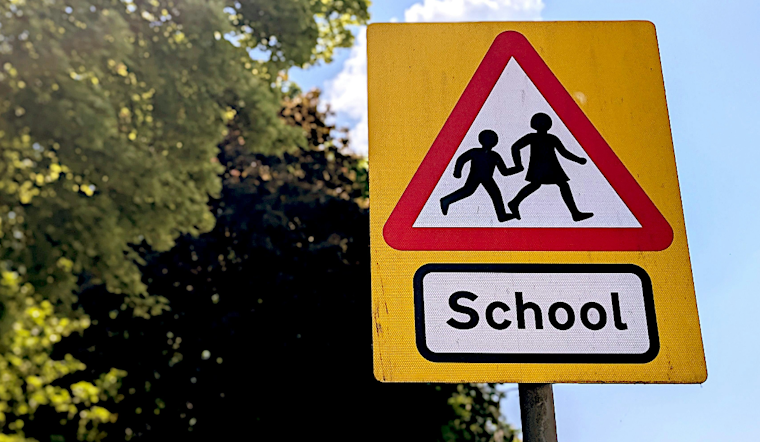
Orange County has poured more than $40 million into new sidewalks, lighting, and slower streets around schools since 2023, and the county says it is only about halfway done. Along South Rio Grande Avenue near Jones High School, crews have lowered the speed limit, cut the number of travel lanes, and added pedestrian islands and buffered bike lanes, reshaping a corridor that students cross every day on their way to class.
The changes are part of the county's Accelerated Transportation Safety Program, a five-year, $100 million effort launched in 2023 to reduce crashes and make walking, biking, and driving safer across Orange County, according to WFTV. Orange County officials say more than 115 safety improvements have been completed so far, with projects prioritized partly based on proximity to schools and hazardous walking conditions. On August 4, county Public Works and LYNX officials gave the Board of County Commissioners a midpoint update, reporting $40.6 million spent across 117 completed safety and transit projects, according to Citizen Portal.
When commissioners approved the program in 2023, they split the money: $55 million for county infrastructure — including $25 million for 26 miles of new sidewalks and $15 million for 131 miles of roadway lighting — and $45 million for transit operational upgrades, per the county's own program breakdown. So far, the county has delivered 26.5 miles of roadway lighting, 15 miles of new sidewalks, and 24 miles of safer road corridors overall, per WFTV's reporting. New sidewalks have also gone in along Oleander Drive near Colonial High School and Good Shepherd Catholic School, and the county installed a new traffic signal at the intersection of Clarcona Ocoee Road and Fountains West Boulevard near Ocoee High School.
A Retired Teacher Sees the Difference Underfoot
Louis Abramsky, a retired schoolteacher, told WFTV that the sidewalk improvements reduced tripping risks and cut down on water pooling that used to gather along the walkways. Kelly Nowell said roadway lighting and community connectivity work together to help prevent accidents, according to the same report. Their accounts echo the county's broader push, which has combined new sidewalks, roadway lighting, speed tables, and traffic signals across multiple commission districts.
The transit side of the program has moved in tandem with the street work. The $45 million transit portion allowed LYNX to cut bus wait times from 60 minutes to 30 minutes on major corridors and generated roughly 735,000 additional passenger trips annually by mid-2026, Citizen Portal reports, with 44 new sheltered bus stops also planned in each commission district.
From No. 1 Deadliest to No. 25
The stakes behind the spending are rooted in Orange County's traffic safety record. In 2022, the county recorded 209 traffic fatalities and 1,208 severe injuries, prompting the Board of County Commissioners to pass a resolution embracing Vision Zero strategies aimed at eliminating traffic deaths by 2040, according to Orange County government records. WFTV reports the county has reduced traffic fatalities by up to 28 percent from 2022 to 2024, per county figures, though officials say the work is far from finished and will continue through the remaining years of the $100 million program.
Those local gains line up with a broader regional shift. Smart Growth America's July 2026 “Dangerous by Design” report ranked the Orlando metro area as the 25th-deadliest metro in the nation for pedestrians, a sharp drop from its number-one ranking in 2019, according to reporting from WKMG. Pedestrian deaths in the metro area fell from 433 between 2015 and 2019 to 419 between 2020 and 2024, even as neighboring Central Florida counties saw their own risk levels climb — Tampa ranked eighth nationally in 2026, Brevard County eleventh, and Volusia County fourteenth, per the same WKMG report.
What's Left to Untangle
Not every dangerous road in the region belongs to Orange County. Regional planning organization MetroPlan Orlando secured a $3.79 million federal Safe Streets and Roads for All grant in 2023 to coordinate Vision Zero safety planning across Orange, Osceola, and Seminole counties, noting that state-maintained roads make up 60 percent of the region's High Injury Network — meaning much of the most dangerous mileage sits outside county control entirely.
Other Central Florida cities are leaning on technology rather than concrete. Lakeland launched school zone speed cameras this week that issue $100 civil citations to drivers going more than 10 mph over posted limits during active school hours, transitioning from warning notices to paid tickets under its own Vision Zero plan, WKMG reported. Orange County's approach so far has centered on physical redesigns like the Rio Grande Avenue changes rather than automated enforcement.
Orange County's program has ramped up steadily since its 2023 launch. At the one-year mark in July 2025, the county had completed 76 safety projects, including 44 sidewalk installations and 25 roadway lighting enhancements across all six commission districts, according to county figures. That pace has since pushed the completed-project count past 115, with two and a half years still remaining before the five-year, $100M pedestrian safety push is scheduled to wrap.





