

























































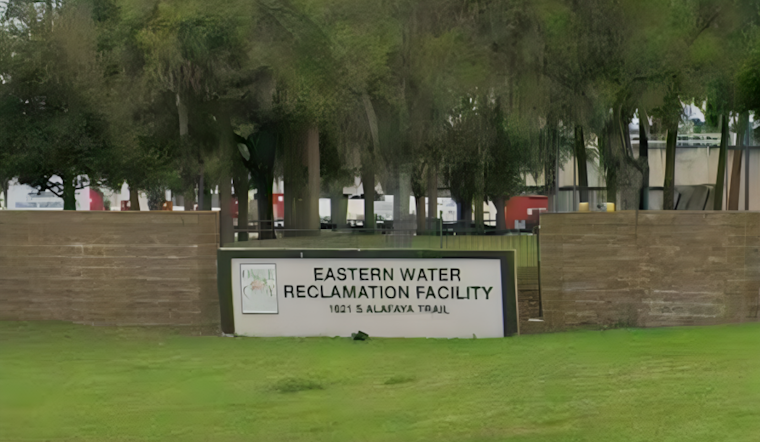
Three of Orange County's four water reclamation facilities are registering high concentrations of SARS-CoV-2 in their sewage samples, even as a local physician says he's not particularly worried. The Hamlin, Northwest, and Eastern facilities all reported high readings, while the South facility came in at a medium level, according to county monitoring data.
The finding might sound alarming on its face, but as reported by Spectrum News 13, the measured concentration is actually much lower than it was in previous years, even though it currently registers as high on the county's scale. Dr. Aftab Khan, an internal and primary care physician, told the outlet that Orange County's unique demographics help explain the readings. He pointed to the area's high population density and its status as a tourism hotspot that draws visitors from around the world.
Wastewater technicians sample sewage to detect viruses and bacteria present in fecal matter, giving public health officials a window into community spread that doesn't depend on people actually going to get tested. That distinction matters to Khan, who said wastewater data gives the real picture of viral circulation, since many people with symptoms don't test themselves or seek medical treatment.
A Milder Virus, According to a Local Doctor
Despite the elevated wastewater signal, Khan said a high concentration in the sewage isn't necessarily cause for concern. He said he's actually seeing fewer COVID-19 cases at his Davenport clinic, and he attributed the virus's apparent mildness to a combination of immunity built up from vaccination, past infection, and viral mutation over time. The current variant, in his assessment, is less strong than the strains that circulated in the pandemic's earlier years.
Symptoms people should watch for still include the familiar list: flu-like symptoms, sore throat, fatigue, fever, shortness of breath, and asthma-like symptoms. Khan advised that anyone experiencing those symptoms should take a COVID-19 test. Orange County's own case counts back up his read on severity — the county has recorded a little more than 3,000 COVID-19 cases so far this year, and the trend in reported cases is heading downward.
Why Sewage Data Still Matters in Florida
Orange County is one of only a handful of places left in Florida that still tracks COVID-19 through wastewater, a distinction that carries more weight given how much less clinical data the state now makes public. The Florida Department of Health shifted from daily to biweekly COVID-19 reporting back in 2022 and stopped sending aggregate case data to the CDC entirely in early 2023, according to Johns Hopkins CSSE. That reduction leaves municipal wastewater surveillance as one of the few continuous, unfiltered indicators of how the virus is actually moving through communities statewide.
State guidance has also diverged from federal recommendations. Florida State Surgeon General Dr. Joseph Ladapo has discouraged mRNA COVID-19 boosters for younger residents and pushed for a broader halt to mRNA vaccine use, putting the state's public health messaging at odds with the CDC and FDA, per FactCheck.org. That friction shapes how differently vaccination rates — and community immunity — can look from one Florida county to the next.
Orange County's Sewer System Behind the Numbers
The four plants generating this data — Eastern, South, Northwest, and Hamlin — together process more than 62 million gallons of wastewater daily for more than 870,000 residents across unincorporated Orange County, according to Orange County Government. The Eastern facility, which reported high concentrations, is permitted to treat 19 million gallons per day and recently underwent an $81 million expansion to add 12 million gallons of reclaimed water storage capacity, per the Florida Water Resources Journal. The Hamlin facility, also flagged as high, opened in 2022 in Horizon West with an initial capacity of 5 million gallons per day — the county's first new water reclamation plant built in more than three decades, built specifically to keep pace with rapid growth in southwest Orange County, according to Horizon West News & Info.
The South facility, which registered a medium reading, recently upgraded its Influent Pump Station with six pumps rated at 31 million gallons per day each, giving it the ability to handle peak flows up to 200 million gallons per day. That upgrade helped the plant avoid sewage overflows during Hurricanes Ian, Nicole, Helene, and Milton, according to CHA Consulting. For scale, none of this year's readings come close to the historic peak recorded during the Omicron surge in December 2021, when Eastern hit more than 8.2 million gene copies per liter, South reached 7.6 million, and Northwest measured 4.2 million — more than double any level recorded before that point, per Orange County Government.
A National Uptick, and a Funding Question Looming
Orange County's numbers aren't happening in isolation. National test positivity for COVID-19 rose above 3% for the first time since March, driven by an expanding late-summer surge across the Southern and Western United States, even though the CDC's respiratory surveillance still classified national wastewater activity as very low for the week ending August 8, according to KVIA. That puts Orange County's readings in line with a broader regional pattern rather than something unique to Central Florida.
The infrastructure that makes this kind of local tracking possible, however, is facing its own uncertainty. The CDC's National Wastewater Surveillance System, which pulls data from roughly 1,200 to 1,300 monitoring sites covering 142 million Americans, could see its budget cut from $125 million to $25 million in fiscal year 2026, according to The Sick Times. Such a reduction would threaten the federal grants that support wastewater testing programs like the one currently keeping tabs on Orange County's sewage — one of the last continuous health metrics available in a state that has otherwise scaled back its public COVID-19 reporting.





