

























































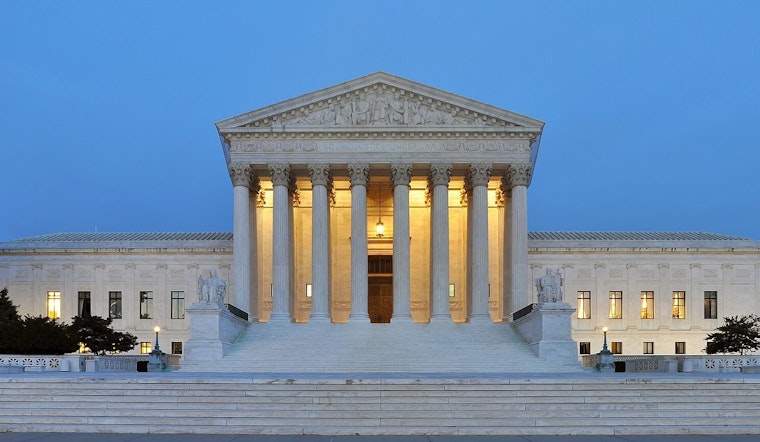
Oregon could become the next battleground in a fast-spreading legal strategy aimed at getting around Citizens United, with advocacy group Honest Elections Oregon preparing a state constitutional amendment that would bar corporations, nonprofits and other business entities from spending money to influence political races. The group plans to file its first ballot petitions by the end of August 2026, according to the proposal's backers.
The effort, first detailed by Oregon Public Broadcasting, would prohibit independent-expenditure spending by corporations and business entities, effectively cutting off the unlimited political spending that the U.S. Supreme Court's 2010 ruling in Citizens United v. Federal Election Commission allowed by declaring corporations have First Amendment rights, including unlimited spending on political messaging. Attorneys Dan Meek and Jason Kafoury, who are driving Honest Elections Oregon, expect to file the initiative and believe Citizens United itself is vulnerable to this kind of state-level challenge, per the outlet's reporting. Kafoury said the push has national momentum right now, the station reports.
A Workaround Built on State Corporate Charters
The legal theory behind the initiative did not originate in Oregon. It traces to Tom Moore, a senior fellow at the Center for American Progress and a former counsel to Federal Election Commission Chair Ellen L. Weintraub, who argued that because states charter corporations, they hold sovereign authority to withhold political spending powers from those entities without violating First Amendment speech rights. Moore has said states have reserve powers to change or eliminate corporate powers altogether, and has argued that states can simply deny corporations the ability to spend on politics in the first place, according to the same reporting relayed by the station. The underlying claim, echoed in OPB's coverage, is that corporations and business entities exist only because states grant them legal rights and privileges — meaning those privileges can theoretically be narrowed.
Hawaii became the first state to test that theory in practice. Governor Josh Green signed Senate Bill 2471 into law as Act 11 on May 14, 2026, stripping political spending authority from incorporated entities starting July 1, 2027, under threat of corporate dissolution, according to Aloha State Daily. Owen Yeates has said the Hawaii law affects any corporation, the station's report notes, and the Hawaii Legislature's passage of the concept has already drawn a legal challenge. The Grassroot Institute of Hawaii, represented by the Institute for Free Speech, filed a federal lawsuit on June 5, 2026, on behalf of a Hawaii advocacy nonprofit, seeking to strike down Act 11 as an unconstitutional infringement on First Amendment speech and association rights, per Aloha State Daily's account of the case.
Oregon's Long Road Without Contribution Limits
Oregon has operated without campaign contribution caps for nearly three decades because of a 1997 Oregon Supreme Court ruling, since overturned in practice, that found political contribution limits unconstitutional under the state constitution. Oregon voters moved to change that by approving Ballot Measure 107 in November 2020 by a 78% margin, amending the state constitution to grant the legislature and local governments explicit authority to limit campaign contributions and require finance disclosures, according to reporting cited by the station.
That authority led to House Bill 4024, which Governor Tina Kotek signed in 2024 after Oregon unions, labor groups and top lawmakers negotiated the bill together, establishing the state's first political contribution limits since 1997, including a $3,300 per-election individual cap to candidate committees that takes full effect in 2027. Hoodline previously reported on the bipartisan push behind those caps and the bill's eventual passage. But Honest Elections Oregon views that legislative deal as riddled with loopholes. Kafoury has said the legislature created large loopholes in the contribution-limit system, and the group plans to seek tighter limits on candidate fundraising along with transparency requirements about where campaign funds originate, in addition to its corporate spending ban. The group may also file additional ballot petitions beyond the initial measure, according to the reporting.
A Familiar Playbook, With Statewide Ambitions
Honest Elections Oregon and its allies have a history of placing similar measures before voters, having developed and passed local campaign finance reform ballot measures in Multnomah County and the City of Portland in 2016 and 2018, according to background reported by Sludge, before turning to statewide restrictions. Oregon House Speaker Julie Fahey has said meaningful campaign finance reform is not possible while Citizens United remains in effect, and she has called the Hawaii and Montana concepts intriguing; her office says it will follow legal developments in the Hawaii case, per the station's reporting.
Montana offers a parallel test case. The Montana Supreme Court ruled in April 2026 in favor of former Political Practices Commissioner Jeff Mangan and the Transparent Election Initiative, overturning the attorney general's rejection and clearing a 2026 ballot initiative to restrict corporate election spending, according to Courthouse News Service. Montana voters will decide this November whether to adopt the corporate power reset approach, per the article's attribution. As of July 2026, versions of the strategy have been introduced or proposed across at least 20 states through legislative bills, constitutional amendments or ballot measures, according to People United For Privacy.
Business Groups and Some Unions Push Back
Opposition to the strategy cuts across ideological lines. Oregon Business & Industry has suggested it would oppose the initiative and said any campaign finance regulations must be constitutional and nondiscriminatory, though the group is reserving further comment until an Oregon initiative petition is actually filed. Critics of the corporate power reset theory contend it is unconstitutional, and some warn that additional proposals expected around 2028 could create chaos.
Felisa Hagins, director of the Service Employees International Union's Oregon State Council, has criticized the initiative effort. That mirrors opposition seen in Hawaii, where several labor unions formally opposed Act 11, warning that stripping entity spending powers could restrict non-corporate associations, advocacy groups and unions from participating in policy debates, according to People United For Privacy. Bradley Smith has written that organizations allow individuals to pool resources and express political views, a concern opponents say applies just as much to nonprofits and unions as to corporations — and one now playing out directly in the federal lawsuit challenging Hawaii's Act 11.





