

























































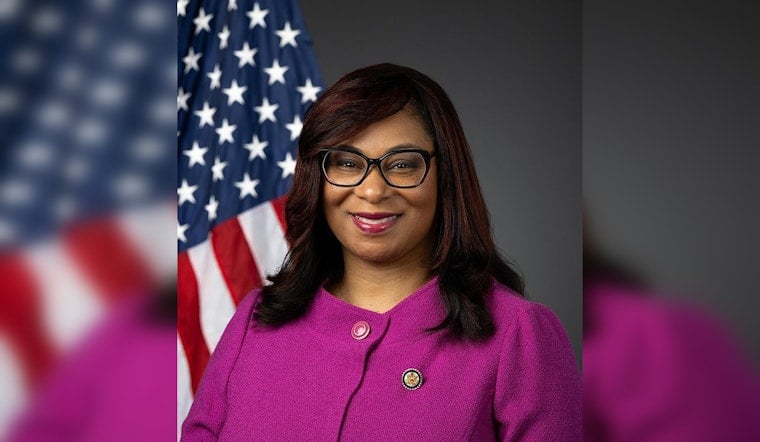
An AI-generated campaign ad that depicted U.S. Rep. Janelle Bynum and Gov. Tina Kotek with glowing red eyes chasing frightened children has landed former congressional candidate Jonathan Lockwood under state investigation, in what may become the first real courtroom test of Oregon's landmark law requiring disclosure of artificial intelligence in political ads.
The Oregon Secretary of State's office opened its inquiry into Lockwood's ads in July, according to Axios, after Lockwood sought to unseat Bynum in the 5th Congressional District primary this May but came up short. One of the ads at the center of the probe reportedly showed Bynum in a McDonald's uniform handing a drag queen the keys to a girls' locker room, closing with the phrase “don't let me down.” Another depicted Bynum and Kotek, rendered with glowing red eyes, chasing scared children.
Lockwood has not denied using AI to make the videos. Instead, per a letter cited by Axios, he wrote that the ads were so outlandish that no one could mistake them for the real thing — arguing they were obvious satire rather than deceptive synthetic media requiring a disclosure label. The Secretary of State's office told Axios the investigation remains ongoing, with no timeline yet for a resolution.
What Oregon's 2024 Law Actually Requires
Oregon lawmakers passed Senate Bill 1571 in 2024, after the state Senate voted 23-7 to approve it on February 26 of that year and Gov. Kotek signed it into law the following month, according to The Bulletin. The statute defines synthetic media as any image, audio, or video manipulated with artificial intelligence to depict a realistic but false appearance, speech, or conduct that leaves a fundamentally different impression than the original, per the Oregon Legislative Information System. Ads that meet that threshold must be labeled, and the law requires candidates to disclose when AI was used to create a campaign ad.
Violators can face civil penalties of up to $10,000, and the law also lets the Secretary of State and Attorney General ask courts to immediately block noncompliant ads before voters even see them, according to the same legislative record. If investigators determine Lockwood broke the law, Axios reports he could face that $10,000 fine as well as possible prosecution.
Lockwood Calls the Probe Unconstitutional
Lockwood has pushed back hard on the investigation itself. In a statement reported by Arizona Capitol Times from Oregon Public Broadcasting, he dismissed the inquiry as a “frivolous censorship complaint” intended to weaponize what he called an unconstitutional law, framing his ads as protected political speech. The complaint that triggered the state's investigation was filed by a rival congressional candidate, according to the same report.
Lockwood's First Amendment argument isn't coming out of nowhere. Similar state deepfake laws in California and Hawaii have already been struck down in court on those exact grounds, per the National Conference of State Legislatures. A federal judge blocked California's AB 2839 in October 2024 in *Kohls v. Bonta*, ruling that pre-election bans on political deepfakes violate the First Amendment because counter-speech remains a less restrictive alternative, according to TechPolicy.Press. That case began after a political commentator posted a synthetic parody video of then-Vice President Kamala Harris.
Hawaii's law fared even worse. After a federal court struck down the state's Act 191 in January 2026 for lacking constitutional narrow tailoring, officials abandoned their defense entirely, agreeing in May to pay more than $118,000 in legal fees to satire outlet The Babylon Bee, which had challenged the statute, according to Alliance Defending Freedom.
A Patchwork of State Rules, No Federal Standard
Oregon is far from alone in trying to police AI in elections, but the approaches vary widely. As of June 23, 2026, 29 states had election-related AI deepfake laws in effect, per Axios. Some states, like Texas and Minnesota, prohibit political deepfakes only within a set window before an election, while Maryland bans them year-round. Nationally, the National Conference of State Legislatures counts 31 states regulating political deepfakes as of June 2026, with 28 of those favoring mandatory disclosure labels over outright bans — the same disclosure-based model Oregon adopted.
A few states have gone further on the technical side. Colorado and Utah now require political AI creators to embed digital content provenance and metadata inside campaign files to track authorship and edit history, according to NCSL. Separately, prosecutors in some states are turning to older criminal impersonation statutes to target deceptive AI content in elections even where no deepfake-specific law exists, the organization notes.
At the federal level, there's still no baseline standard. Congress has considered proposals to regulate AI in elections for years without passing comprehensive legislation, according to Axios, though lawmakers did attempt to address nonconsensual intimate deepfakes specifically. House Democrats plan to push new legislation targeting election deepfakes next year if they regain power, Axios reports, but for now Oregon remains ahead of the federal government on AI election regulation.
Advocates tracking enforcement of these state laws say the process has been uneven. Per Axios, advocates cited inconsistent processes for removing flagged posts and said implementing protections against nonconsensual intimate deepfakes has proven difficult in practice. Some predict that litigation, not statutes alone, will ultimately determine how much teeth these disclosure laws really have — a dynamic Oregon's investigation into Lockwood's ads may soon test directly.





.jpg)