

























































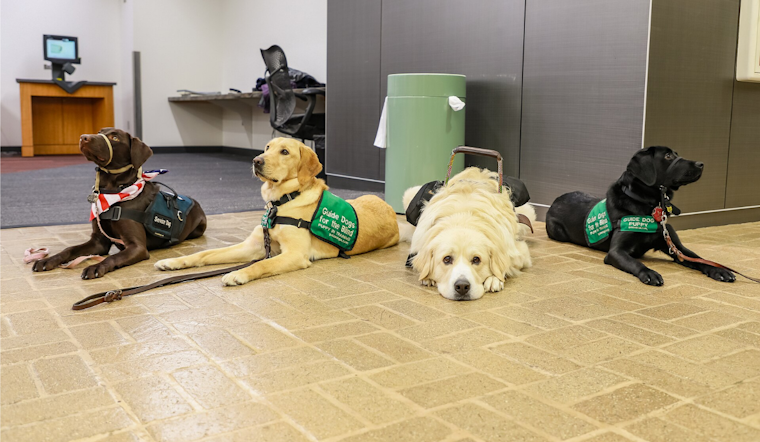
Thirteen service dogs officially became working partners for adults, children and veterans with disabilities at a graduation ceremony this week at Canine Companions' Southeast Regional Training Center in Orlando. Among the new teams was national disability advocate Mia Ives-Rublee, who was paired with a dog named Timber, trained to retrieve dropped objects, pull her wheelchair and push crosswalk buttons for her.
The Orlando ceremony was covered by FOX 35 Orlando, whose reporter Amanda McKenzie attended graduation day. Ives-Rublee told the station that Canine Companions and its donors and puppy raisers gave her “such a joyful gift.” Before the ceremony, she and Timber spent two weeks together in a training dorm, a mandatory stretch known as Team Training that pairs recipients with their dogs and teaches them to manage commands, public outings and long-term care, according to Shepherd Center.
Ives-Rublee is not just any recipient. She serves as Senior Director of the Disability Justice Initiative at the Center for American Progress, and in December 2021 President Joe Biden appointed her to the President's Advisory Commission on Asian Americans, Native Hawaiians, and Pacific Islanders. She also founded the Women's March Disability Caucus and organized accessibility operations for the 2017 Women's March on Washington.
From Puppy Raiser to Graduation Day, With Heartbreak in Between
Canine Companions began training 33 dogs for this cohort, but the organization reports that roughly half of dogs ultimately make it all the way to graduation, per the station's report. One of the dogs that did, a service dog named Julian, was delivered to begin his training by longtime volunteer and puppy raiser Bill Gordon, who has helped raise 14 puppies over the years.
Gordon described a familiar mix of emotions that comes with the job: happiness for the recipients paired with sadness at losing the dog he had raised, the same account notes. Cathy Rodgers, executive director of Canine Companions, said the organization selects only dogs that meet its safety, task-performance and reliability standards, requiring every service dog to be safe in public, perform needed tasks and remain reliable before it can graduate.
The $50,000 Price Tag Recipients Never Pay
Canine Companions provides its highly trained service dogs free of charge to adults, children and veterans with disabilities, and this Orlando class alone paired all 13 graduates with human companions at no cost. Raising, training and placing a single service dog — plus providing lifelong follow-up support — costs the nonprofit approximately $50,000, according to US Service Animal Registrar. Nonprofit service dog organizations like this one lean on corporate donations and volunteer networks to absorb costs that would otherwise be out of reach for the people who need the dogs most.
The pipeline behind each graduate spans roughly two years: 18 months of basic socialization and obedience work with volunteer puppy raisers, followed by six months of intensive professional training in which dogs learn up to 45 specialized tasks, per Covetrus. Founded in Santa Rosa, California, in 1975, Canine Companions now operates six regional training centers nationwide, including the Orlando campus, and has paired more than 8,500 dogs with human companions since it began, according to the station's report.
Legal Ground Rules Every Business Owner Should Know
Federal law draws a hard line around what businesses can and cannot ask a service dog handler. Under Title II and Title III of the Americans with Disabilities Act, public entities and businesses may only ask two specific questions when a disability is not obvious: whether the dog is required because of a disability, and what work or task it has been trained to perform, according to the U.S. Department of Justice. Staff cannot demand medical documentation, a demonstration of the task or details about a handler's diagnosis.
Federal regulations also do not require service animals to wear vests, harnesses or identification tags, and the federal government does not recognize or mandate any official service dog registry or certification, per Northeast ADA. Commercial websites sell service animal tags and certificates online, but the Department of Justice has made clear those carry no legal weight. Emotional support animals, meanwhile, are legally distinct from service dogs because they are not individually trained to perform specific tasks tied to a disability, meaning they do not share the same public access rights, though they may qualify for housing accommodations under the Fair Housing Act.
Beyond Individual Placements
Canine Companions' work in Orlando extends past pairing dogs with individual recipients. The center also trains facility dogs placed with professional handlers in courtrooms, child advocacy centers and hospitals, where the dogs use up to 40 commands to comfort trauma victims and pediatric patients, according to Child Advocacy Center program records shared on Facebook. The organization also accepts applications for service dogs, facility dogs and medical alert dogs, and offers volunteering, puppy-raiser and breeder-caretaker opportunities for community members who want to get involved.
The demand for these placements reflects a broader national need. More than 1 in 4 U.S. adults — roughly 61 million people — live with a disability, and mobility disabilities affect an estimated 12.2% to 13.7% of the adult population, according to the Centers for Disease Control and Prevention. With demand routinely outpacing supply, nonprofit training programs like Canine Companions remain a lifeline for applicants who often face long waitlists, and local fundraising efforts like a recent Columbus charity concert have aimed to help close the gap.





.jpg)