

























































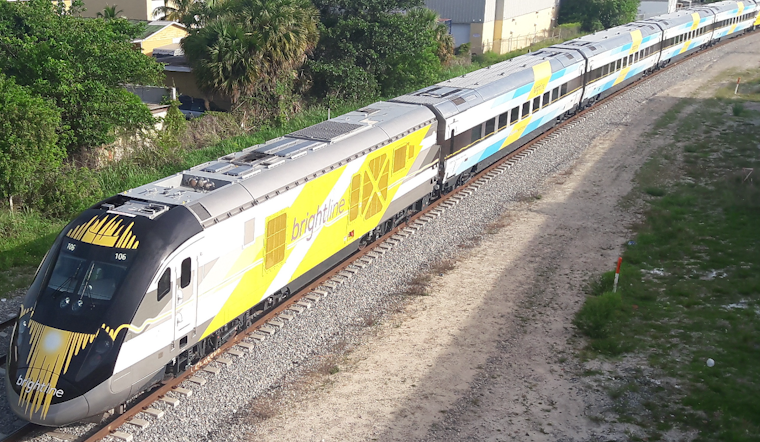
A 46-year-old Orlando man died after being struck by a Brightline train traveling roughly 90 miles an hour near State Road 528 last month, marking the first fatality ever recorded on the fenced, high-speed rail segment connecting Cocoa to Orlando International Airport. Francisco Valenzuela Fernandez lived about seven miles from the site where he was killed on July 28, and the train itself sat stopped for more than two hours after the collision.
According to the Miami Herald, the train had departed Orlando International Airport and was roughly 15 minutes into its trip toward West Palm Beach when the conductor and engineer spotted an object on the tracks near the Central Florida Greeneway. The crew identified the object as a skinny-built man curled in a fetal position, and Fernandez reportedly looked at the train crew just before impact. Emergency responders who arrived at the scene found his body dismembered, the Herald reported. The Orange County Sheriff's Office released an incident report on the fatality the following day.
Florida state law exempts the autopsy report from public record, per the Herald's reporting, but the medical examiner's office ruled Fernandez's death a suicide. Ashley Blasewitz, reached for comment, told the paper she had “nothing to add.” Brightline has broadly attributed its fatalities to people walking or driving onto the tracks and disregarding gates and warning signs, though the company has not been found liable for any of the deaths on its line.
A Segment Once Considered the Safest on the Line
The 35-mile stretch between Cocoa and the Orlando airport was built with complete fencing and zero street-level grade crossings, allowing trains to hit speeds up to 125 miles an hour, according to Brightline's own account of the milestone. That full physical isolation from pedestrians and traffic is why the corridor had gone roughly three years without a fatal strike, a design contrast Metro Magazine has noted sets the Orlando extension apart from Brightline's street-level South Florida corridor, where trains max out around 79 miles an hour between West Palm Beach and Miami. Brightline extended service to Orlando in September 2023, four years after first launching passenger service in South Florida in 2018.
Fernandez was the first person fatally struck by a Brightline train in Orange County. Brightline is now adding fencing, safety striping, better signage and other upgrades, largely grant-funded, across South Florida, though the Herald's reporting focused specifically on the Orlando fencing gap this death exposed.
A Death Toll That Keeps Climbing
Fernandez's death pushed Brightline's overall toll to at least 220 people killed, according to a Herald/WLRN investigation, cementing the railroad's status as the nation's most dangerous major passenger train by that same analysis. A separate review by Meldon Law found that between July 2025 and March 2026 alone, at least 12 additional fatalities occurred along the corridor, pushing the total past 200 by May 2026 — a pace of roughly one death every two weeks. Federal Railroad Administration data analyzed by the same firm puts Brightline's fatality rate at 24.55 deaths per million train-miles, about three times higher than Tri-Rail or SunRail and nearly six times higher than Amtrak.
An investigation by the Thoreau Institute examining 182 Brightline deaths through mid-2025 found that 158 of the victims were pedestrians or cyclists, with only 24 involving vehicle occupants. Separate law enforcement and medical examiner records reviewed by InsuranceNewsNet found more than half of all track deaths in Brightline's early operations were classified as suicides or suspected suicides. Brightline's very first fatality, in fact, came during pre-service test runs in Boca Raton in July 2017, when 18-year-old Madison “Maddie” Brunelle stepped in front of a test train in a death also ruled a suicide.
Federal Money and Legislation Haven't Closed the Gap
The U.S. Department of Transportation awarded Brightline a $25 million federal grant in 2022 to fund 33 miles of pedestrian fencing, crossing improvements, and 170 suicide crisis hotline signs along its corridor. Federal Railroad Administration data cited by Transit Talent shows nearly 30 percent of Brightline fatalities — 51 deaths — occurred within local quiet zones, where municipalities had train horns silenced at their own request to reduce noise near residential neighborhoods.
U.S. Representatives Maxwell Frost and Brian Mast introduced the Safer Rail Crossing Act earlier this year, aiming to help local governments more easily secure federal grants for fencing and crossing safety, as Hoodline reported on the bill's introduction. That legislative push followed a string of fatal strikes across the system this year, including deaths in Fort Lauderdale, Deerfield Beach, Hallandale Beach, Biscayne Park and Martin County, each previously reported by Hoodline. Whether that funding and fencing push will ever reach segments like the one where Fernandez died remains an open question, since the Orlando-to-Cocoa stretch was already considered fully isolated before last month's strike.
Herald investigative journalist Brittany Wallman, who joined the paper in 2023, has continued reporting on the human toll behind Brightline's safety statistics. Her account of Fernandez's death underscores a tension that has defined coverage of the railroad for years: safety advocates and lawmakers point to unfenced tracks and quiet zones as contributing factors, while railroad officials and law enforcement note that no death has been legally attributed to company negligence, since so many incidents involve deliberate trespassing or suicide.




