

























































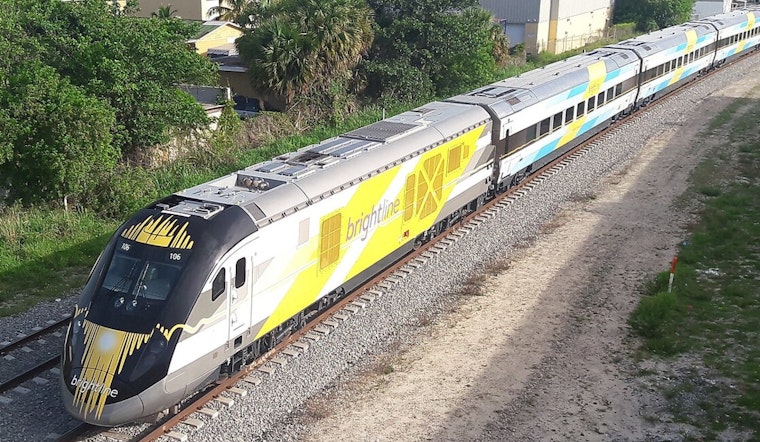
Two Florida members of Congress are trying to shake loose more federal money to keep people alive at railroad crossings, as Brightline’s death toll keeps climbing along the state’s passenger-rail corridors.
Reps. Maxwell Frost and Brian Mast this week rolled out a federal proposal aimed at steering transportation cash toward projects that keep pedestrians and cyclists off the tracks. Their timing is no accident, coming after years of fatal collisions tied to Florida’s fast-growing, privately run Brightline service.
What the Safer Rail Crossing Act would do
Their bill, the Safer Rail Crossing Act (H.R. 7358), would order the Federal Highway Administration to issue clear written guidance within one year on which pedestrian-focused projects qualify for money under the Railway‑Highway Crossing Program. In practical terms, backers say, that means cities, counties and rail operators could more easily tap federal funds for fixes like fencing, upgraded crossing gates, improved lighting and detection systems.
Supporters argue that getting those rules in black and white would cut red tape and remove guesswork for local agencies trying to prioritize safety work, according to materials from Congressman Maxwell Frost and Rep. Brian Mast.
Florida's rail safety record
Florida’s recent history with passenger rail has been grim. Investigative reporting has chronicled a long series of deadly incidents since Brightline started test runs in 2017, with trains moving at high speeds along tracks that often run at street level. Reporters have highlighted local “quiet zones” that limit train horn noise and long stretches with little or no fencing as factors that leave people on foot particularly vulnerable, as detailed by WLRN.
The Herald/WLRN tally of Brightline-related deaths rose to roughly 198 after a Feb. 2, 2026 fatal collision in Deerfield Beach. The majority of those killed were walking or biking, not riding in cars. That pattern, with more deaths occurring away from formal crossings than at them, underpins advocates’ calls for more fencing and grade separations to physically block access to the tracks, according to reporting by the Miami Herald.
Funding and fixes
Federal money is already trickling into the corridor. The U.S. Department of Transportation has committed about $42 million to safety projects along the Brightline route, including new fencing, crossing upgrades and a trespass-detection pilot. Those grants fall under the broader National Railroad Partnership Program, which is aimed at speeding up grade‑crossing safety work around the country, as reported by Railway Age.
“Florida’s 21st District is all too familiar with the tragic consequences of railroad crossing malfunctions and unsafe pedestrian crossings,” Mast wrote in explaining his support for the bill. He and Frost argue that a short, standardized federal playbook would let local governments move faster and more confidently on costly capital projects such as fencing and grade separations.
Not everyone is impressed with the optics. Critics point out that Florida has one of the country’s worst records for train-related pedestrian deaths, yet its own delegation is now front and center on a safety push. At the same time, the fenced, grade-separated segment of Brightline’s route between Cocoa and Orlando has logged far fewer, or no, Brightline fatalities, a real-world example advocates cite when they push for barrier-heavy designs, according to the Miami Herald.
H.R. 7358 is listed on Congress.gov and has been sent to the House Committee on Transportation and Infrastructure. If it advances, the one-year clock on federal guidance could eventually be written into law. For now, supporters and skeptics alike say the real test will come later, in whether state agencies and private rail operators actually follow that guidance and build the kinds of physical protections that reporting suggests can bring the death toll down.




