

























































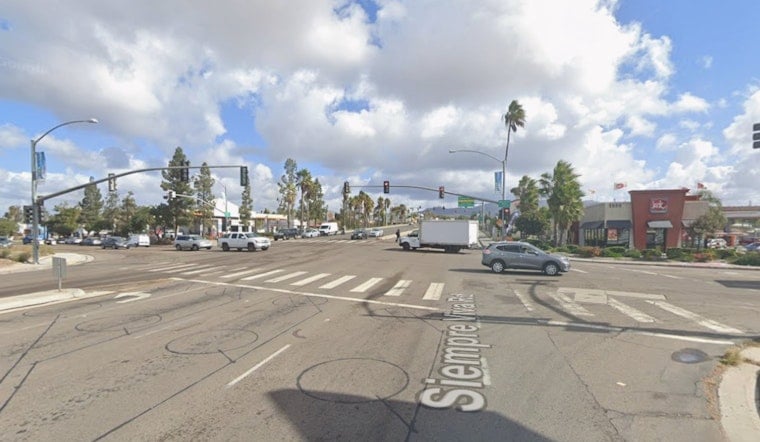
A 59-year-old bicyclist was killed Tuesday afternoon when a big rig driver turned right into his path at the intersection of Siempre Viva Road and Otay Center Drive in Otay Mesa, an industrial corridor near the U.S.-Mexico border that has no bike lane or other protective infrastructure at that crossing. The cyclist was declared dead at the scene.
According to the San Diego Police Department, the collision happened at approximately 2:17 p.m. on Tuesday when a 38-year-old truck driver made a right turn on a green light and struck the bicyclist, who was traveling along the right side of the tractor-trailer, as reported by Pacific Attorney Group. Police determined that alcohol was not a contributing factor in the crash. But accounts of exactly what happened just before impact differ depending on the source.
BikinginLA reports that the bicyclist was riding south on Otay Center Drive next to a semi-truck that was stopped at a red light at Siempre Viva Road. When the light turned green, the big rig driver turned right onto Siempre Viva Road, and the crash involved the truck and the bicyclist's right front wheel as the rider attempted to continue straight on Otay Center Drive. Per Fox 5, cited in the same BikinginLA report, the victim was traveling behind the truck. The San Diego City News Service offered a different characterization, reporting that the victim rode his bicycle into the big rig after being right-hooked by the driver.
A Contested Description of the Crash
That gap in framing has drawn scrutiny from bicycle advocates, who argue that describing the cyclist as riding into the truck shifts blame onto the victim in a maneuver — the right hook — where the law places responsibility on the turning driver. Under California Vehicle Code Section 21717, drivers preparing to turn right across an adjacent bicycle lane must merge into that lane before turning and yield to any bicyclist already riding there, according to Justia's compilation of the vehicle code. Even without a marked bike lane, Vehicle Code Section 22100(a) requires that right turns be made as close as practicable to the curb, and Section 22107 bars drivers from turning until it can be done safely.
The intersection where the crash happened sits deep in an industrial corridor built to move freight, not bikes. The Otay Mesa Port of Entry is California's busiest commercial land border crossing, processing nearly 990,000 inbound freight trucks in 2025 and accounting for 13% of all U.S.-Mexico border truck traffic, according to the Bureau of Transportation Statistics. San Diego broke ground in July 2023 on the $42.7 million La Media Road Improvements Project to widen freight corridors connecting Siempre Viva Road to the port of entry, an effort aimed at easing truck congestion, as reported by Inside San Diego at the time — but that project targeted commercial traffic flow rather than bicycle safety on adjacent streets.
How Right-Hook Crashes Fit Into California's Bigger Picture
Statewide research offers some grim context for how this kind of crash tends to unfold. UC Berkeley's SafeTREC program identifies improper turning as the single leading primary crash factor in fatal and serious injury bicycle collisions in California, responsible for 17.9% of all severe bike crashes. Broadside collisions, meanwhile, are the most common crash type involved in California's fatal and serious bicycle injuries, accounting for 34.9% of all such crashes statewide, per the same research body's 2026 data.
The California Office of Traffic Safety recorded 145 bicyclist fatalities statewide in 2023, a 20.8% drop from 183 the year before, though California still ranks second nationally behind Florida in annual bicycle deaths. Those statewide totals sit alongside a grim regional tally cited by BikinginLA: Southern California has seen at least 40 bicycling deaths so far this year, and San Diego County has recorded seven known bicycling fatalities in 2026. The outlet also noted that this crash marked the third Southern California bicycling death in a single week.
A Second Fatal Crash in the Same Neighborhood
The Otay Mesa crash comes just three days after another fatal collision in the same general area. On August 8, a 43-year-old motorcyclist was killed in nearby Otay Mesa West at Palm and Norstad avenues when a pickup truck broadsided his motorcycle at a signalized intersection, as Hoodline previously reported. The back-to-back fatalities underscore ongoing safety concerns for road users who share Otay Mesa's arterials with heavy commercial and cross-border traffic.
Those concerns also echo a broader struggle across San Diego. The city set a Vision Zero goal in 2015 to eliminate traffic fatalities by 2025, but annual pedestrian and bicyclist deaths in San Diego County have instead hovered near 35 per year in recent years, up from roughly 25 a decade earlier, according to reporting from EIN Presswire. That deadline has now passed, with fatalities among the county's most vulnerable road users still far from zero.




