

























































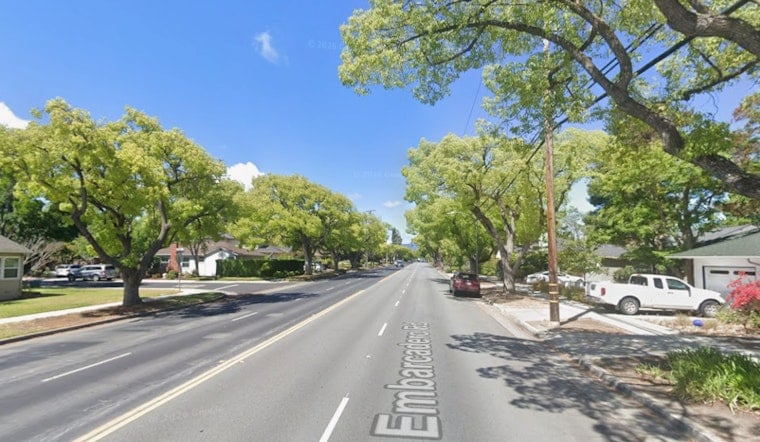
Palo Alto has won a $500,000 grant to overhaul aging traffic signals and pedestrian crossings along Embarcadero Road between U.S. Highway 101 and El Camino Real, a stretch that passes directly by Palo Alto High School and Town & Country Village. The money arrives just as city crews are racing to finish a separate, nearly complete phase of safety upgrades to the same corridor before Paly students head back to class next Thursday.
The grant, reported by Palo Alto Online, will fund eight new traffic signals to replace infrastructure that was installed and intermittently updated between 2004 and 2018, with the most recent update coming in 2017. The project also includes accessible pedestrian signal buttons at six locations along the corridor and improved vehicle and bicycle detection technology at four intersections. The Embarcadero and El Camino Real intersection, which frequently sees traffic backups, sits near both Paly and Town & Country Village.
The signal upgrades carry an estimated cost of $697,000, and the city is exploring ways to limit how much of that remaining balance comes from city funds, according to the same report. The money comes through the Vehicle Registration Fee-Intelligent Transportation Systems program, which funds traffic improvement projects across Santa Clara County. That program traces back to a $10 annual motor vehicle fee that voters approved in November 2010 under California Senate Bill 83, which reserves 15% of revenues specifically for countywide signal and intelligent transportation technology, according to the Santa Clara Valley Transportation Authority.
Palo Alto Beat Out Dozens of Applicants
Palo Alto applied for the grant alongside 16 other cities and transportation agencies in what officials describe as the fifth funding cycle of the program, which had $2.5 million available for traffic projects this round. A volunteer panel of Santa Clara County local agency staff evaluated and scored the applications, ultimately recommending seven projects for funding, per the article. The Embarcadero Road project made the final selection, while six other grants — ranging between $100,000 and $500,000 — went to San Jose, Campbell, Sunnyvale, Cupertino, Mountain View and Gilroy.
A VTA memo cited in the report notes that funded projects must show a relationship or benefit to the motor-vehicle owners who pay the underlying registration fee. The countywide Vehicle Registration Fee itself was established in 2010, and the remaining 80% of its revenue goes directly toward local road repair formulas rather than signal projects, per the Santa Clara Valley Transportation Authority.
Phase 1 Nearly Done Ahead of the First Bell
The grant-funded signal work is separate from — but closely tied to — the Embarcadero Road Corridor Improvements Project's first phase, which is nearly complete as of this week. City staff began that work in summer 2026 and are aiming to finish before Paly's first day of classes. That phase eliminates the slip lane at Kingsley Avenue, which previously let cars turn right onto Embarcadero without a stop light or stop sign, and widens the sidewalk between Emerson and High streets to accommodate more pedestrians and cyclists. Those improvements will also benefit families near Castilleja School and Walter Hayes Elementary School, and are expected to improve safety for students, parents and teachers traveling to Paly.
City officials directed staff in April to expedite Phase 1, according to the City of Palo Alto, with construction beginning June 8 on a segment between Alma Street and Emerson Street carrying an overall estimated budget of $2.3 million to $3.2 million. That stretch had sat paused for years amid utility work and debates over rail grade separation. Design details for the section between Emerson and High streets include squaring up side-street approaches and installing a raised crosswalk at Emerson Street, both intended to slow turning vehicles and improve visibility for people on foot or on bikes.
A Debate Over a Nearby Rail Crossing Sped Things Up
The push to speed up Embarcadero's safety fixes traces back to an early-2026 fight over whether to close the Churchill Avenue Caltrain crossing, which carries roughly 10,000 vehicles a day and hundreds of student cyclists, according to San José Spotlight. Closing that crossing would have pushed thousands of those daily vehicles and cyclists onto Embarcadero Road instead. The City Council voted unanimously in May to keep Churchill open, but the episode exposed how vulnerable Embarcadero already was — a corridor a 2022 city crash analysis flagged, alongside El Camino Real and Middlefield Road, as one of Palo Alto's primary high-crash arterials due to high vehicle speeds cutting through residential neighborhoods.
Student journalists at Verde Magazine reported in May that Embarcadero lacks the dedicated bike lanes and wide sidewalks found on other major student routes like Bryant Street or Park Boulevard, making it a clear target for upgrades given that Paly borders the corridor's western end near El Camino Real. The broader corridor project draws $2.8 million from Santa Clara County's 2016 Measure B sales tax on top of the VTA signal grant, and city staff plan to seek an additional $266,000 in the next fiscal year, per the same San José Spotlight report.
Construction Traffic Piles On
The roadwork lands amid a run of disruption along the same corridor. Palo Alto broke ground in May on a $16.12 million replacement of the 1911 Newell Road Bridge over San Francisquito Creek, a key north-south link between Embarcadero Road and East Palo Alto, as Hoodline previously reported. That follows a six-week gas main pipeline upgrade Palo Alto Utilities ran along the exact Alma-to-Emerson stretch in April 2025, which caused significant commuter delays at the time. In January, a fatal hit-and-run pedestrian collision occurred on the Embarcadero Road on-ramp to southbound Highway 101, underscoring the pedestrian risks at the corridor's eastern access point near where the new signal grant's boundary ends.





