

























































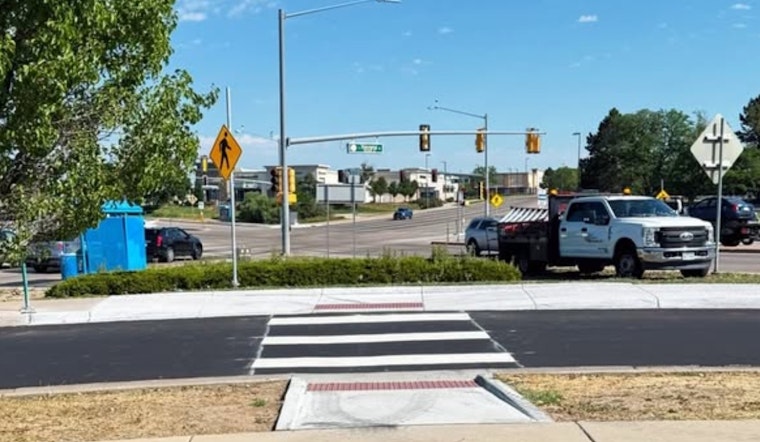
Five months of orange cones, single-lane squeezes and torn-up sidewalks along Parker Road have come to an end. The Colorado Department of Transportation says it has finished a $1.6 million ADA curb ramp overhaul stretching through Denver and Arapahoe counties, revitalizing nearly 100 ramps to meet federal accessibility standards along one of the region's busiest commuter corridors.
The project covered a 5.2-mile segment of Colorado Highway 83, better known as Parker Road, running between Mile Point 68.8 near East Quincy Avenue and Mile Point 74.0 near East Florida Avenue, according to the Colorado Department of Transportation. That stretch crosses the county line between Denver and Arapahoe County, and CDOT hired Denver-based Chatos Concrete LLC to handle the construction. Work touched more than 25 intersections between East Florida Avenue and East Quincy Avenue, according to a Colorado Department of Transportation Facebook post detailing the finished project.
Crews removed and replaced concrete sidewalks and curb ramps throughout the corridor, added push-button enhancements at crossings, refreshed striping, and swapped out aging signage. One of the more visible fixes came at the intersection of Parker Road and Havana Street, a heavily used arterial link between Denver and Aurora, where crews fully replaced curb ramps and repainted crosswalk striping, per the agency's project update.
A Corridor Built for More Than Cars
CDOT Region 1 Transportation Director Jessica Myklebust framed the project as more than a sidewalk fix. She said the upgrades are designed to provide safer multimodal travel paths, increase foot traffic for local businesses, and reduce vehicle miles traveled to help ease congestion along the corridor. Construction ran from April 6 through this month, with standard work hours set from 7 a.m. to 7 p.m. Monday through Friday, plus Saturday shifts and occasional night operations, according to CDOT's project archive.
CDOT says the project now has no further impacts on the traveling public, and it's encouraging motorists to check cotrip.org for current road and travel conditions statewide.
Part of a Much Bigger Statewide Push
The Parker Road work is one piece of a much larger effort. CDOT launched its statewide Curb Ramp Accessibility Initiative in 2017 with an initial $85 million allocation from the Colorado State Transportation Commission, aiming to bring state highway curb ramps up to federal standards. A statewide inventory found that of 23,430 curb ramps across Colorado's state highway system, only about 54 percent — roughly 10,825 ramps — were functionally accessible, which pushed CDOT toward a “worst first” retrofit strategy developed in consultation with the Colorado Advisory Council for Persons with Disabilities.
Every ramp retrofit and push-button installation under the agency's ADA Transition Plan has to comply with Public Right-of-Way Accessibility Guidelines and Americans with Disabilities Act standards, which set strict rules for ramp slopes, crosswalk alignment and tactile warning surfaces. Chatos Concrete LLC, the contractor on the Parker Road job, was founded in Denver in 2003 by Eleazar Villalobos and Marlene Andrade and has built a track record on public infrastructure and roadway concrete work across the metro area, according to the American Concrete Pavement Association's Colorado/Wyoming Chapter.
Parker Road already had a public-safety spotlight on it this year. An Aurora Police traffic enforcement operation near I-225 earlier in 2026 drove an 86 percent reduction in vehicle crashes along that stretch, as previously reported by Hoodline. With the sidewalks and ramps now rebuilt, the corridor's next test may be whether easier, safer pedestrian access actually changes how people get around a highway long dominated by cars.





