

























































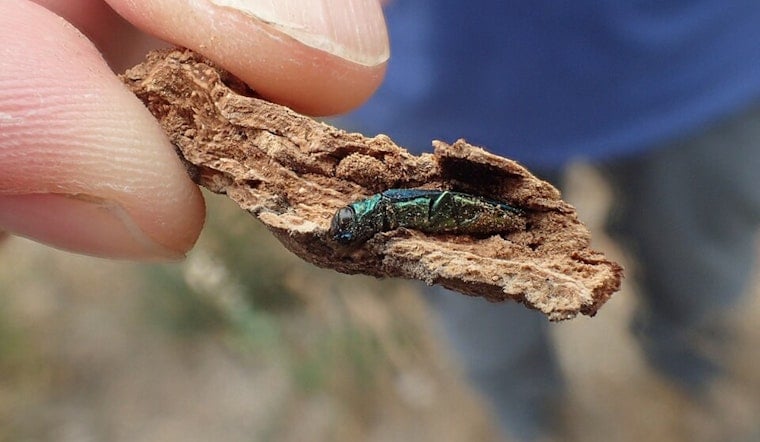
A tiny metallic-green beetle has officially crossed into Douglas County, and the first confirmed Parker tree is already marked for removal. The discovery gives local homeowners a short list of things to do: identify ash trees, inspect them for warning signs, and decide whether a healthy specimen is worth protecting before the insect gets established. This is not a one-tree problem so much as a warning shot for the southern Denver metro canopy.
The case began when certified arborist Jacob Griffiths found an adult emerald ash borer in a declining ash tree in Parker and submitted it to Colorado State University, whose entomologists confirmed the species. The finding is the first confirmed in Douglas County, according to CBS Colorado. The beetle was first found in Colorado in 2013 and has since spread to at least 29 Front Range communities, with Parker among four cities where Colorado State University confirmed new detections this year.
Why Parker’s Detection Matters For The Front Range
The Colorado State Forest Service describes emerald ash borer as an invasive pest whose larvae tunnel beneath the bark and disrupt the tissues that carry water and nutrients. It was first detected in Boulder in 2013, and the insect has continued expanding through communities where ash trees were widely planted as dependable shade trees.
Parker Town Forester Erik Stadsvold had already placed detection traps in the area before the specimen was found, and the town is now mapping the beetle’s movement through nearby neighborhoods, CBS Colorado reported. Warning signs include thinning branches near the top of the tree, dead limbs, green sprouts lower on the trunk, D-shaped exit holes and winding galleries beneath the bark. The confirmed Parker tree is scheduled to be cut down next Tuesday, while town crews are treating some ash trees in Parker parks. The station reported that trunk injections cost around $200, depending on tree size, and generally need to be repeated every two years.
Treatment Can Help Healthy Ash Trees But Not Every Tree
Homeowners are not entirely out of options, but timing matters. Colorado State University Extension says professional trunk injections using emamectin benzoate can protect ash trees for at least two years and may serve as a rescue treatment when canopy thinning is still limited. Trees with roughly 30% or less visible canopy loss may remain candidates for treatment, while heavily declining trees can be beyond recovery.
The Parker discovery arrives as Denver and surrounding suburbs are already trying to keep heat, drought and tree loss from turning shaded neighborhoods into much hotter ones. A recent Hoodline report described Denver’s push to test replacement species and accelerate planting as the region’s aging canopy faces pressure from both climate conditions and emerald ash borer.
What Parker-Area Homeowners Should Do Now
Residents should first confirm whether trees in their yards are ash, then have declining or valuable trees evaluated by a certified arborist rather than trying to diagnose the pest from a single hole in the bark. Preventive treatment may make sense for a healthy tree worth saving, while an ash tree in serious decline may need prompt removal to reduce the chance it becomes a breeding source. The Colorado State Forest Service and Colorado State University Extension both emphasize early identification and professional evaluation as the beetle continues moving south.




.jpg)