

























































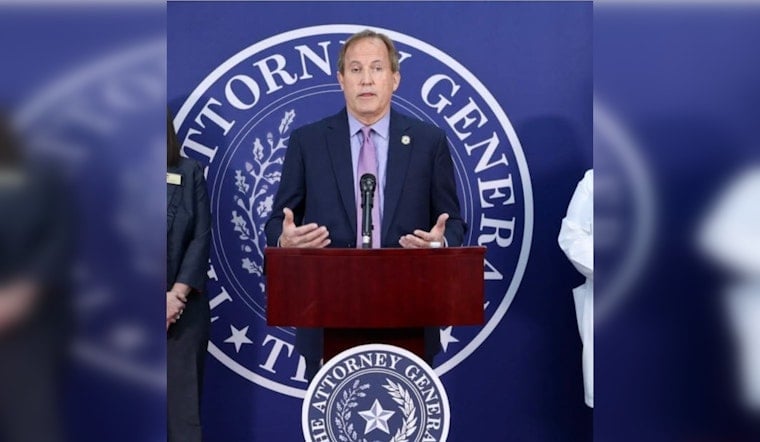
Texas Attorney General Ken Paxton's U.S. Senate campaign has collected at least $448,000 from data center executives and political committees, even as his office has sat for six months on a Hood County request asking whether counties have any power to slow the industry's rapid expansion. The donations, identified through Federal Election Commission reports, arrive as Paxton runs a tight race against Democratic nominee James Talarico and as the data center boom becomes an increasingly volatile issue for Texas voters.
The figure was first reported by news outlet NOTUS and detailed in an August 11 report from KERA News, which found the money flowed through Paxton's campaign, his leadership PAC, joint fundraising committees, and the Lone Star Liberty PAC. As the San Antonio Current reported, Paxton has otherwise stayed relatively quiet on data center development even as the issue has grown more contentious across the state. Campaign spokesperson Madison Cercy told the outlet that Paxton will soon release a policy plan on data centers and remains focused on protecting Texas families, water resources, and the electrical grid.
Hood County Still Waiting On An Answer
The unresolved request driving much of the frustration comes from Hood County, which asked Paxton's office in February whether counties have statutory authority to temporarily block large industrial developments under watershed protection rules. Paxton has not weighed in on that request. The question grew more urgent after county commissioners voted 3-1 in June to approve the 2,600-acre Comanche Circle data center complex near Tolar, a project slated for nine campuses drawing up to five gigawatts near the Comanche Peak nuclear plant, despite heavy resident opposition over water supply and noise, according to the same KERA News reporting.
Hood County's predicament isn't isolated. Neighboring Hill County imposed its own yearlong freeze on new data center land deals earlier this year, and San Antonio's city council has more recently pushed for a construction moratorium of its own. In May, Paxton himself called the data center issue complicated, framing the artificial intelligence boom as a balance between competing with China and protecting Texas residents' quality of life, per the same account from KERA News.
Talarico's Super PAC Ties To Tech Money
Talarico has built much of his campaign around opposition to data center expansion, calling for tighter regulation of the industry and supporting a repeal of the state's data center sales-tax exemption. But the reporting also revealed a complication for his side: the pro-Talarico super PAC Lone Star Rising received a $10 million donation from LinkedIn co-founder Reid Hoffman, an outspoken advocate for data center development. Federal law bars candidate campaigns from coordinating directly with independent super PACs, though the donation underscores that tech industry money is flowing into the Senate race on both sides of the aisle.
Texas has attracted data centers through tax incentives, a reliable grid, wide open spaces, and comparatively lax regulations, factors that have fueled the industry's rapid growth statewide. Those same incentives are now facing government scrutiny. A July audit update from the Texas Comptroller's office found that of 138 data centers benefiting from state sales tax exemptions, 20 were selected for compliance checks, and several failed to meet basic requirements such as creating 20 qualifying jobs or maintaining 100,000 square feet of operational space, according to Texas Scorecard.
Billions In Tax Breaks, Growing Voter Backlash
Those exemptions, created under a 2013 law known as House Bill 1223 and codified in Texas Tax Code Section 151.359, waive state sales and use taxes on equipment, software, and electricity for qualified data centers. The Texas Comptroller projects the exemption will cost the state approximately $3.2 billion in foregone tax revenue over two years, according to Server Country, with the tax break lasting 10 to 20 years depending on whether a project's capital investment reaches $200 million or $500 million.
Public opinion has moved sharply against the industry. A June University of Texas/Texas Politics Project poll found that 56% of registered Texas voters oppose data center construction in their communities, with opposition peaking at 62% among rural residents and 71% among Democrats, compared to 44% among Republicans, as reported by The Texas Tribune. That bipartisan discontent has been amplified by consumer advocate Erin Brockovich, whose national watchdog map tracking complaints recorded more than 3,000 submissions by late May, with Texas generating the most of any state at 652 reports.
The grid itself has also become a flashpoint. Governor Greg Abbott directed the Public Utility Commission of Texas and ERCOT in June to require all new large-load data centers to pay 100% of their own transmission infrastructure, grid connection, and power generation costs. That order followed a February proposal from ERCOT to subject roughly 8.2 gigawatts of prospective data center power requests to fresh batch-study re-evaluations aimed at weeding out speculative projects and easing grid congestion.
A Razor-Thin Race Heading Into November
The financial disclosures land in a Senate race that polling shows is essentially a toss-up. A June University of Texas poll had Paxton leading Talarico 43% to 42%, while a July Fox News survey showed Talarico ahead 51% to 48%, according to Texas Scorecard. The RealClearPolling average currently puts Talarico slightly ahead of Paxton, who secured the Republican nomination after defeating incumbent Sen. John Cornyn in a May runoff.
Money has flowed unevenly between the two camps. Talarico's campaign raised more than $31.6 million as of June 30 and had $21.5 million in cash on hand, compared to Paxton's roughly half as much in fundraising, nearly $1.8 million in cash on hand, and $9.3 million total in his campaign war chest. As Hood County and other rural communities continue waiting for clarity from the attorney general's office, both candidates now face pressure to explain where their industry ties end and their policy positions begin before voters weigh in this November.





