

























































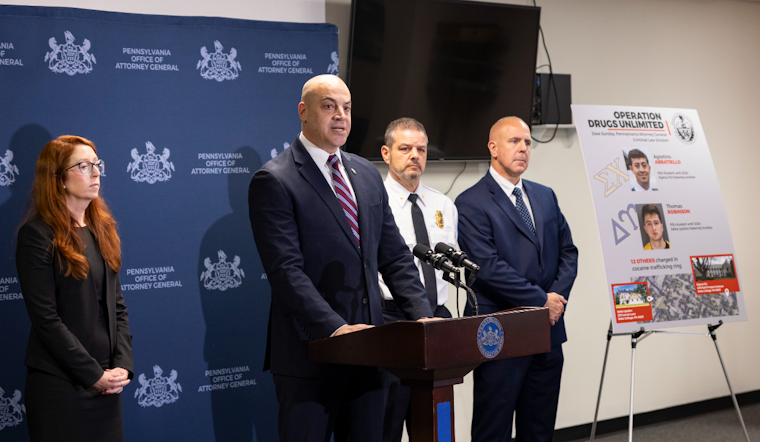
Pennsylvania investigators have charged 14 people, including a Pittsburgh father accused of hiding a safe full of drugs and cash, in a cocaine trafficking operation that prosecutors say ran through two Penn State fraternity houses and used drug packaging as a pledge initiation ritual. The charges cap a two-year investigation into cocaine supplied from Philadelphia and New York into State College.
Pennsylvania Attorney General Dave Sunday announced the charges against the 14 defendants, according to WPXI. The case grew out of Operation Drugs Unlimited, a probe launched in September 2024 that relied on confidential informants making controlled drug purchases, according to the StateCollege.com report on the case. Investigators say the operation moved kilos of cocaine from Philadelphia and New York into State College throughout 2023 and 2024, and it involved the Attorney General's Bureau of Narcotics Investigation, the State College Police Department, and two statewide investigating grand juries, per the same account.
Two Alleged Ringleaders Named
Grand jury witnesses identified 24-year-old Agostino S. Abbatiello as the largest cocaine dealer serving Penn State students, alleging he ran the trafficking operation alongside 23-year-old Thomas Michael Robinson, according to Daily Voice. Both men attended Penn State until 2024 and made regular supply runs to New York and Philadelphia, the outlet reports. Abbatiello, identified per investigators as an alleged leader of the operation from Westbury, New York, was a member of Sigma Chi fraternity, while Robinson, identified per investigators as an alleged leader based in Pittsburgh, belonged to Delta Upsilon.
Abbatiello and Robinson face felony counts including corrupt organizations, conspiracy, and dealing in proceeds of unlawful activity, alongside co-defendants Mohammed Hurabi and Lars Zeepvat, according to the Pennsylvania Office of Attorney General. A fifth defendant, Robert Zanolla, faces felony conspiracy and criminal use of a communication facility charges. Eight additional student-aged defendants — Liam Smith, Michael Brogno, Kaden Howe, Connor Hurleigh, Seth Beardsley, Kyle Ridpath, Daniel Price, and Charles Wiseman — were charged with misdemeanor counts of drug possession and drug paraphernalia, per the attorney general's office. In total, 13 of the 14 defendants were Penn State students at or around the time of the alleged offenses.
A Father Accused of Hiding the Evidence
Paul R. Robinson, 59, of Pittsburgh, is the only non-student charged in the case. He is Thomas Michael Robinson's father and faces felony charges of tampering with evidence and hindering apprehension for allegedly concealing a safe filled with drugs and cash to obstruct law enforcement, according to the attorney general's office. Under Pennsylvania's Controlled Substance, Drug, Device, and Cosmetic Act, possession with intent to deliver a Schedule II narcotic like cocaine is a felony punishable by up to 10 years in prison and fines reaching $100,000, per FindLaw.
Packaging Cocaine as a Pledge Ritual
Sunday said that cutting and packaging cocaine inside off-campus fraternity houses was used as an indoctrination hazing ritual for pledges joining Delta Upsilon and Sigma Chi, according to CBS News. Abbatiello and Robinson are accused of forcing other fraternity members and pledges to package cocaine, per attribution in reporting from WJAC dated to 2023. The packaging took place inside off-campus fraternity houses at 229 Locust Lane for Delta Upsilon and 400 East Prospect Avenue for Sigma Chi, with none of it occurring on Penn State University property, Daily Voice reports. Sigma Chi is not a recognized organization and operates without university oversight at its Prospect Avenue house.
This is not Thomas Robinson's first brush with drug charges tied to the Delta Upsilon house. He was previously arrested there in December 2024 after allegedly selling cocaine five times to police informants, an arrest during which officers tased him after he resisted, apparently believing his fraternity brothers were pulling a prank, according to CBS News. During that earlier search warrant execution, police seized cocaine, amphetamines, cash, and a loaded .45-caliber handgun.
Penn State's Response
Penn State has placed Delta Upsilon on interim suspension, per a university statement cited by WPXI. Andrea Dowhower said the university is horrified by the allegations against current and former students, adding that criminal activity, including hazing, has no place at Penn State. The university's Office of Student Accountability and Conflict Response is investigating the allegations involving Delta Upsilon, and Penn State says it will cooperate with law enforcement. Student Affairs is also establishing additional educational and hazing-prevention efforts for the first weeks of the fall semester.
The alleged use of hazing to coerce students into criminal activity carries particular weight in State College, where Pennsylvania's Timothy J. Piazza Antihazing Law took effect in October 2018 following a fatal hazing incident at Penn State's Beta Theta Pi fraternity, according to information provided by Penn State. That law created felony charges for aggravated hazing resulting in serious bodily injury and established organizational forfeiture penalties for fraternities found responsible.
Charged individuals in the case include three alleged drug dealers and eight current or former students facing lesser counts, while questions remain about whether additional organizational hazing or forfeiture charges could still be filed against the fraternities themselves. It's also unclear how Penn State intends to address unrecognized, off-campus Greek organizations like Sigma Chi that operate entirely outside university oversight, or how Thomas Robinson's original December 2024 case will ultimately be resolved.



