

























































Mike Bowers was shelling along the sand at Sea Isle City when he spotted something unusual poking up from the beach and called his son Bo over to take a look. What the pair pulled from the ground was a fossilized tooth belonging to a Megalodon, the long-extinct predatory shark that once ruled the ancient seas.
Mike Bowers, who is from Monongahela in Washington County, was vacationing in New Jersey with his family when he discovered the tooth, according to WTAE. Bo Bowers said he felt really excited after pulling the tooth free, and the station reports he intends to hold on to it. His father described the discovery as a bucket list find for both him and his son.
The family says the find was later confirmed as a genuine Megalodon tooth by the Cape May Whale Watch & Research Center, an organization that runs research cruises and tracks local marine life, including dolphins and great white sharks, off the southern New Jersey coast.
A Vanishingly Rare Beach Discovery
True Megalodon teeth are exceptionally rare finds along New Jersey's shoreline. Dr. Dana Ehret, curator of natural history at the New Jersey State Museum and a fossil shark specialist, notes that fewer than 10 confirmed beach-found specimens exist in state museum collections, according to the NJ Conservation Foundation. Smaller fossilized shark teeth, often from ancient sand tigers or makos, turn up far more commonly in New Jersey's streams and beaches, but a complete Megalodon specimen surfacing on the shore is a genuine rarity.
Marine paleontologists point to a specific mechanism behind these unlikely discoveries: fossilized Megalodon teeth found on New Jersey beaches often originate from deep underwater sediment deposits that get pumped onto land during municipal beach replenishment and dredging projects. Coastal engineering crews routinely haul offshore sand containing prehistoric marine layers onto public beaches, per the same conservation group, meaning a tooth like the one the Bowers family found may have ridden ashore inside sand dredged from the ocean floor rather than washing up naturally.
The Predator Behind the Tooth
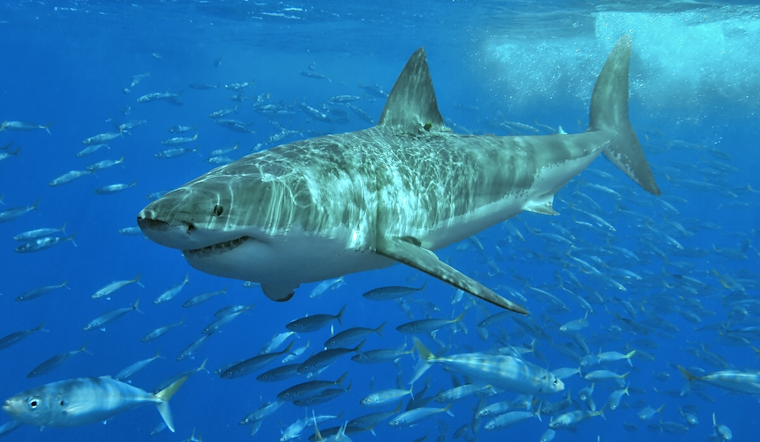
Megalodon, formally known as Otodus megalodon, grew up to 50 to 60 feet long and carried massive serrated teeth that routinely measured between 3 and 7 inches, built for feeding on ancient whales and other large marine mammals, according to the Natural History Society of Maryland. The organization notes the shark's bite force was up to ten times stronger than that of a modern great white. It was an apex predator during the Miocene and Pliocene epochs before going extinct roughly 3.6 million years ago as ocean temperatures shifted and prey grew scarce, as reported by Smithsonian Magazine.
Shark teeth take at least 10,000 years to fully fossilize, as surrounding minerals gradually replace the organic calcium, and their resulting dark gray, black, or tan coloration is determined entirely by the chemical makeup of the sediment where they were buried, per Forbes. Modern, non-fossilized shark teeth, by contrast, stay bright white.
Why Southern New Jersey Keeps Yielding Ancient Fossils
Southern New Jersey's coastal geology is uniquely suited to producing finds like this one. Millions of years ago, during the Cretaceous and Tertiary periods, much of the region sat beneath warm, shallow seas, leaving behind thick marine sediment formations that preserved abundant prehistoric ocean life, according to the New Jersey Department of State. Monmouth and Cape May counties are now considered two of the East Coast's premier fossil-bearing zones.
Sea Isle City, a barrier island community in Cape May County, sees strong tidal currents and shifting sandbars that make its shoreline a popular spot for casual beachcombers, and the city hosts guided beachcombing walks at 29th Street Beach during the summer, per Sea Isle City Tourism. Bo Bowers plans to keep the tooth, a decision that aligns with standard practice in the region: casual beachcombers are generally permitted to keep fossilized shark teeth found on public New Jersey beaches, though large, well-preserved Megalodon specimens can carry real value among private collectors and fossil markets, according to Buried Treasure Fossils.
For the Bowers family, who traveled from Monongahela, a Washington County municipality of roughly 4,100 residents situated along the Monongahela River about 17 miles south of downtown Pittsburgh, the trip to the Jersey Shore turned into an unexpected brush with deep time. A tooth shed by an animal that vanished from the world's oceans millions of years before humans existed ended up in a father and son's hands during an ordinary beach vacation.





