

























































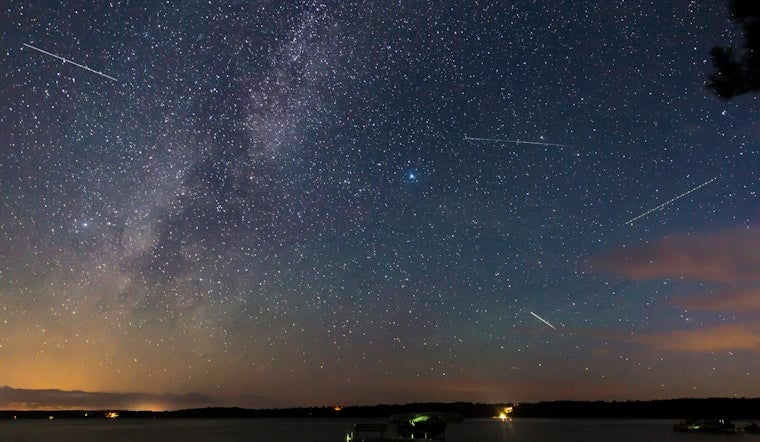
The Perseid meteor shower peaks over Richmond Wednesday into Thursday this week, arriving under a dark new moon that strips away the lunar glow normally washing out fainter shooting stars. At its best, the shower can produce 30 to 50 meteors an hour, and this year's moonless timing gives Central Virginia stargazers one of their clearest shots at the show in recent memory.
The best viewing window falls between midnight and dawn Thursday, according to Axios, though skywatchers willing to drive can find prime conditions even earlier. James River State Park, about a two-hour trip from Richmond, offers strong Perseid viewing between 9 and 10 p.m., per the same report. Closer to home, rural stretches of Hanover and Goochland counties carry noticeably less light pollution than the city core, making them a practical fallback for anyone who can't make the longer drive.
Why This Year's Sky Is Unusually Dark
The shower's source is Comet 109P/Swift-Tuttle, a 16-mile-wide body on a 133-year orbit that last swept through the inner solar system in 1992 and won't return until 2126, according to NASA. Earth passes through the trail of dust and debris the comet left behind, and those particles slam into the upper atmosphere at roughly 37 miles per second, or about 133,000 mph. That friction is intense enough to spark bright fireballs with visual magnitudes greater than -3, as the San Antonio Express-News explains, which is part of why the Perseids are considered the marquee meteor event of summer.
Weather remains the wild card. National Weather Service forecasts for central and northern Virginia on peak night called for mostly cloudy skies and a 30 percent chance of rain or thunderstorms, according to Patch. Humid summer air routinely brings overnight cloud cover to the region, so even a moonless sky is no guarantee of a clear one.
Free Telescopes at Local Libraries
Richmond-area residents don't need to own equipment to join in. Henrico libraries lend free stargazing kits that include a telescope, a program the county library system launched across five branches using a Meta Community Action Grant; the kits also come with a finder wheel, lens accessories, and observational guidebooks, per Henrico County Public Library. Chesterfield libraries offer a similar deal, lending kits built around Celestron FirstScope telescopes and specialized lenses through the county's check-out STEM kit program. Both programs simply require a library card to check out.
For those who'd rather look through someone else's telescope, the Richmond Astronomical Society is holding a free 9 p.m. viewing event Saturday on the ACAC rooftop in Short Pump. The club also partners with the Science Museum of Virginia on West Broad Street for public telescope skywatches on the museum's front lawn, according to the Richmond Astronomical Society.
Virginia's Dark-Sky Parks and What Comes Next
James River State Park's appeal for stargazers isn't accidental. The park earned its International Dark Sky Park certification in March 2019 after a two-year lighting retrofit championed by Lynchburg student Lora Callahan as her Girl Scout Gold Award project, an effort that brought exterior fixtures into 99 percent dark-sky compliance for roughly $3,000, according to the Virginia Department of Conservation and Recreation. It's one of four state parks in Virginia with the designation, alongside Staunton River, Natural Bridge, and Sky Meadows state parks, placing Virginia among the leaders in protected dark-sky locations along the East Coast.
The same morning as the Perseid peak, early risers could catch a predawn planetary parade featuring six aligned planets — Jupiter, Mercury, Mars, Uranus, Saturn, and Neptune — with Mars and Saturn easily visible to the naked eye high in the southern sky, per Patch. Later in the week, Venus becomes the brightest star-like object in the evening sky, visible low in the western sky 30 to 60 minutes after sunset from Friday through Sunday, according to Axios.
The celestial calendar doesn't stop there. A partial lunar eclipse arrives overnight on August 27 into 28, with Earth's shadow expected to obscure between 93% and 96% of the full Sturgeon Moon, according to EarthSky. That deep partial coverage is expected to give the moon a reddish, blood-moon appearance visible across North America, giving Richmond skywatchers a second reason to keep looking up before summer ends.





.jpg)