

























































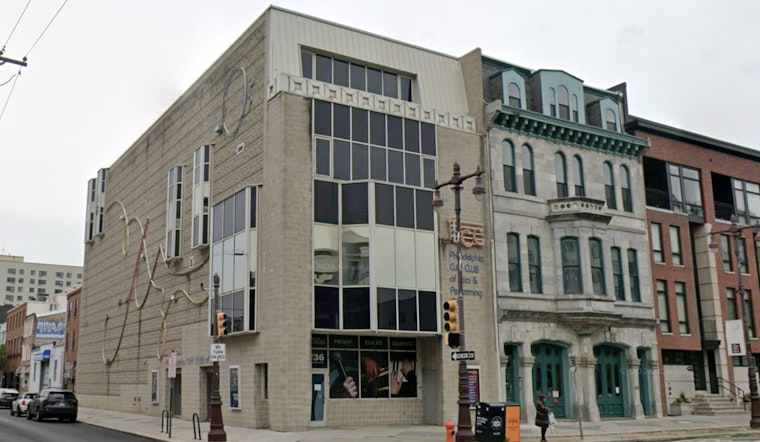
The Philadelphia Clef Club of Jazz & Performing Arts is preparing to launch a $2 million renovation of its South Broad Street home, a project organizers say will modernize the nation's first purpose-built jazz facility while honoring the institution's roots. Managing director Oscar Payne discussed what visitors can expect from the upcoming work in a conversation with reporter Judayah Murray.
According to FOX 29 Philadelphia, the renovation carries a $2 million price tag and will touch the Clef Club's 19,000-square-foot building at Broad and Fitzwater Streets. That figure is actually the lead piece of a much larger $4.5 million capital campaign, anchored by a $2 million grant from the William Penn Foundation awarded in August 2024 as part of a broader $24 million regional arts investment, according to PA Times Media. The Commonwealth of Pennsylvania has also kicked in a $600,000 Redevelopment Assistance Capital Program grant, with additional support from the Presser Foundation, McLean Contributionship, and William B. Dietrich Foundation.
What the New Building Will Look Like
Architectural plans from Kelly Maiello Architects call for new classroom spaces, reworked interior layouts, a state-of-the-art recording studio, and updated exterior signage and finishes. Per the firm's project description, full construction is targeted for completion in 2027. The current building, which opened in 1995, was the nation's first facility built specifically as a dedicated jazz institution, funded in part by an earlier William Penn Foundation grant more than 30 years ago.
That history matters to an organization whose identity is inseparable from Philadelphia's civil rights past. The Clef Club was incorporated in 1966 as the social and cultural arm of Musicians' Protective Union Local 274, an independent Black musicians' union chartered in 1935 after Black artists were barred from joining the city's segregated Local 77, according to Wikipedia's account of the organization's history. Local 274 operated for 36 years as the longest-surviving independent Black musicians' union in the country before the American Federation of Musicians revoked its charter in 1971, after the local refused to merge into Local 77 without guarantees of Black leadership and representation.
A Home Base for Jazz Legends
During its union hall era, Local 274 and the Clef Club served as a gathering place for some of the biggest names in jazz, including John Coltrane, Dizzy Gillespie, Nina Simone, Count Basie, Duke Ellington, Grover Washington Jr., Sarah Vaughan, Max Roach, and Art Blakey, per the same account from PA Times Media. The club's education program, established in 1985, has since trained generations of young musicians, with alumni including Christian McBride, Ahmir “Questlove” Thompson, Joey DeFrancesco, Immanuel Wilkins, Bilal, and Jaleel Shaw, according to WHYY.
The renovation arrives amid organizational change at the Clef Club. Longtime artistic director Lovett Hines, who founded the education program in 1985, departed the organization in September 2024, according to reporting from The Philadelphia Inquirer. That departure prompted Payne, the club's managing director, to introduce an updated curriculum and formal partnerships with local schools, including the Philadelphia High School for Creative and Performing Arts.
National Recognition Fuels the Campaign
The Clef Club's rebuilding effort has drawn attention beyond Philadelphia. In 2025, the Andrew W. Mellon Foundation named the club among eight national institutions receiving support through its new $35 million Jazz Initiative to preserve and advance jazz culture, according to an announcement the club posted on Facebook. The recognition lands as the Clef Club marks its 60th anniversary in 2026 with “Soundscapes for Tomorrow,” an artist residency project supported by The Pew Center for Arts & Heritage that features master classes and performances building toward a September anniversary gala, according to BroadwayWorld. Participating resident artists include Afro-Caribbean trombonist Papo Vázquez and saxophonist Tia Fuller.
Together, the renovation, leadership changes, and national grants point to an institution trying to secure its future while staying anchored to its founding mission on the Avenue of the Arts. For a club born out of segregation-era resistance and sustained for six decades by some of jazz's biggest names, the $2 million project is as much about preservation as it is about new recording booths and classrooms.



